

 6 days ago
6
6 days ago
6
ARTICLE AD BOX
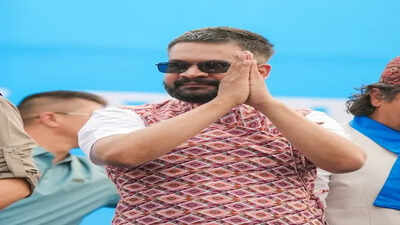
In today's landscape, celebrities are transforming their stardom into political capital, a phenomenon heightened by the rise of the 'attention economy' and social media platforms. Figures like Nepal’s Prime Minister Balen Shah and Ukraine’s President Zelensky exemplify this trend, showcasing how public affection can be a powerful tool for political ascendance.
In a world of endless scrolling, politics has a new currency: attention. Former rapper Balendra Shah (fondly called Balen), 35, took oath as PM in Nepal last Friday. In an era where attention is the ultimate currency, celebrities are increasingly leveraging their fanbases not just for financial gain but for political power.
This phenomenon is deeply rooted in the ‘attention economy’, a concept first articulated by American psychologist Herbert A. Simon in the 1970s, which identifies human attention as a scarce resource in an environment saturated with information.Simply put in our times, ‘attention economy’ is a social media currency that sees entertainers converting public adoration into electoral success. As Insta reels, tweets, aura farming and rage baits amplify their reach, stars from music, film, and sports, are entering politics with unprecedented visibility. Shah becoming the prime minister of Nepal isn’t the first instance where a celebrity has used his aura and fan following to enter politics and sit on a high or the highest political throne. Zohran Mamdani, now the Mayor of New York City, defeated his rival Andrew Cumo, riding his popularity wave on social media, on the promise of affordable housing. His online avatar was a carefully curated one appealing to the youth grappling with the cost of living in New York; and he succeeded brilliantly as he was sworn to office this January.
In the US, actors like George Murphy, a song-and-dance man, won a Senate seat from Califor nia in 1964, serving one term amid anti-communist fervour. Ronald Reagan, a former Screen Actors Guild president and B-movie actor, governed California from 1967 to 1975 before becoming US president in 1981, implementing conservative policies that defined the “Reagan Revolution.” Arnold Schwarzenegger transitioned from bodybuilding and action films like ‘The Terminator’ to California governor (2003–2011), where he advanced environmental reforms and raised the minimum wage despite initial skepticism over his lack of experience.South Indian legends like N.T. Rama Rao (NTR) in Andhra Pradesh, and M.G. Ramachandran (MGR) and Jayalalithaa in Tamil Nadu are known for reshaping regional politics. Yet, the resurgence of “celeb politicians” in the 21st century reflects a global comeback, fuelled by populism, digital media, and disillusionment with traditional elites. This article explores the dynamics of this shift, highlighting successes, spectacular failures, and the broader implications for democracy—drawing on examples from across the world.We live in an era of shrinking focus spans, an ambient, collective form of attention deficit. In the age of social media, the average voter consumes politics the same way they consume reels – quickly, emotionally, and often without depth. In this landscape, celebrities hold a decisive advantage. They don’t need to introduce themselves. They arrive pre-loaded with recognition, recall, and, most importantly, devotion.That is the power of celebrity capital – accumulated value of fame, familiarity, and fan loyalty. Increasingly, this capital is being repurposed—not for endorsements or brand deals—but for political power. Take Ukraine President Volodymyr Zelensky as an example. Before leading a nation at war, he played a fictional president on television. When he actually won the race for the presidency in 2019, his transition felt less like a leap and more like a continuation of a narrative audiences had already bought into.
In fact, Zelensky serves as the definitive case study for the transition from visibility to credibility. Zelensky’s fame long predated his political career, rooted in his status as a comedian and media producer in the post-Soviet environment.
His role in the sitcom ‘Servant of the People’, where he played a history teacher elected president after an anti-corruption rant went viral, and created a “fictional frame” that voters later used to interpret his real-world political potential.
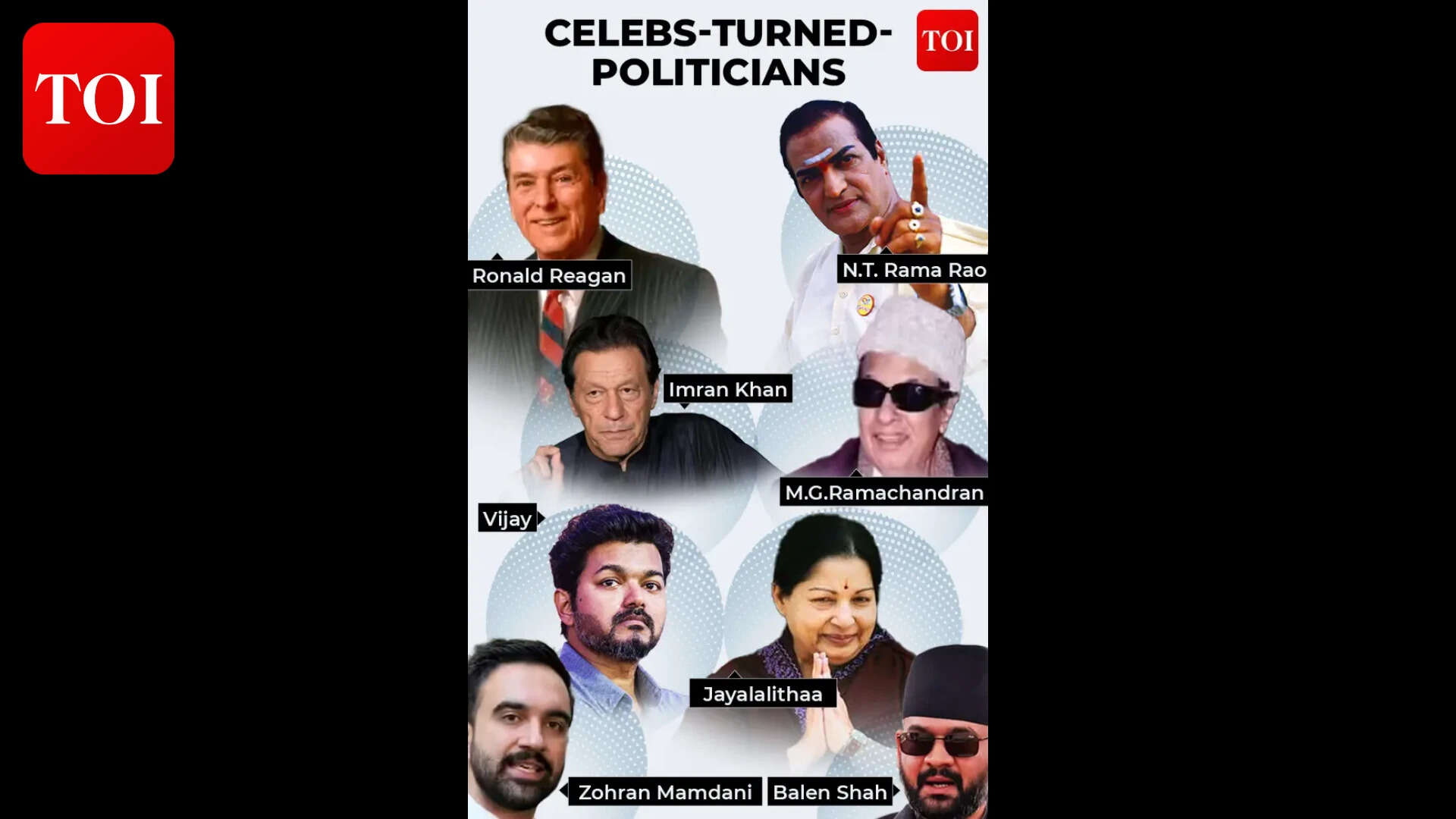
We live in an era of shrinking focus spans, an ambient, collective form of attention deficit. In the age of social media, the average voter consumes politics the same way they consume reels – quickly, emotionally, and often without depth. In this landscape, celebrities hold a decisive advantage. They don’t need to introduce themselves. They arrive pre-loaded with recognition, recall, and, most importantly, devotion.
From charisma to aura farming
If traditional politics was about credibility, modern politics is increasingly about aura. “Aura farming”—a term born on the internet in 2025—refers to the deliberate cultivation of mystique, relatability, and symbolic power. Celebrities are naturals at this. They have spent years, sometimes decades, building personas that audiences emotionally invest in. Reagan understood this before social media existed.
His affable, reassuring screen presence translated seamlessly into political trust. In India, M.G.Ramachandran and Jayalalithaa didn’t just win elections—they built near-mythical public identities that blurred the line between actor and leader. Today, that aura is no longer built slowly. It is engineered in real time. A viral clip, a perfectly timed tweet, a moment of defiance; these become political assets.
Instagram and X function as constant aura-generating machines, where visibility itself becomes legitimacy.
The attention economy advantage
In the past, politicians needed media coverage. Now, they need engagement. Celebrities begin with a built-in audience. They don’t chase attention, they command it. This flips the traditional political model on its head. Instead of earning visibility through policy or party work, they convert visibility into political credibility.
His current situation notwithstanding, Imran Khan is a classic example in Pakistan.
His cricketing legacy gave him a moral authority that conventional politicians struggled to match. Similarly, figures like Jesse Ventura, governor of Minnesota, US, was a Vietnam veteran, actor, and retired professional wrestler, who rode anti-establishment sentiment, using his outsider status as a strength rather than a liability.
In low-information environments—where voters may not track policy details—familiarity often substitutes for trust. A known face feels like a known quantity.Then there is the president of Argentina, Javier Milei – a former controversial television pundit in his country, whose wild hair, fiery appearances, and anti-establishment theatrics turned him into a viral figure long before he became president in 2023.
Milei’s rise in Argentina illustrates the power of the celebrity who uses the attention economy to bypass established party structures. A former television pundit, he leveraged ‘rage bait’ and ‘aura farming’ to position himself as a radical alternative to the political ‘caste’ (political elites).
His strategy was built on theatrics that are essential to celebrity branding; his rallies were not just political events but spectacles of showmanship designed for viral transmission.
A short dive into historical precedents
The rise of the celebrity politician is also an elaboration on historical processes rather than a radical break from them. Historical research indicates that even around 1900, “natural celebrities” like monarchs flourished in the international media coverage, monopolizing the “lighthouse” of public discourse to the detriment of their peers. Today, this process has been industrialized through algorithmic systems that prioritize engagement metrics over journalistic significance, effectively turning political leadership into a performance of “celebrification” where every aspect of the politician’s life becomes a marketable commodity.
In India, actor Vijay’s political entry follows a familiar script—one perfected by southern cinema for decades. But what’s new is the ecosystem he enters: one driven not by posters and rallies alone, but by memes, fan edits, and algorithmic amplification. To examine the celebrity-to-politician pipeline, we can utilize the lens of social theorists who predicted the current “politics as entertainment” paradigm.
French philosopher and filmmaker, Guy Debord’s critique ‘Society of the Spectacle’ says that modern life has moved from “having” to “appearing”. In this framework, the celebrity politician is not a representative of the people but a representative of the image of the people.
American author and educator Neil Postman argued in ‘Amusing Ourselves to Death’ that the medium of television—and by extension, the social media environment—has made “entertainment itself the natural format for the representation of all experience”.
Postman’s warning that a population can “amuse itself to death” is particularly relevant in the 2025 landscape, where political communication often takes the form of a “jest”, rendering people, with attention deficit, unable to distinguish between real policy needs and any manufactured crisis.Jean Baudrillard’s concept of “hyperreality” completes this philosophical trifecta by suggesting that the simulation of politics is now more real to the voter than politics itself.
Because, in a hyperreal world, the celebrity politician lives in a “mediated simulation”, where fictional portrayals—such as an actor playing a president in a sitcom—become the cognitive basis for their actual election. This blurring of boundaries between the screen and the palace ensures that the electorate treats “unreal things as real”, a phenomenon that has facilitated the rise of figures whose primary qualification is their familiarity on screen.
When stardom isn’t enough
But attention is volatile. What it gives, it can quickly take away. Some celebrity politicians successfully convert aura into governance. while others struggle when the performance ends and policy begins. In the US, actor Fred Thompson’s 2008 presidential run fizzled despite his ‘Law & Order’ fame. Caitlyn Jenner, a reality TV star, garnered just 1% in California's 2021 gubernatorial recall. Rapper Kanye West’s 2020 US presidential campaign was a chaotic flop, securing minimal votes.
TV doctor Mehmet Oz lost Pennsylvania's 2022 Senate race despite Trump’s endorsement. Globally, Haitian rapper Wyclef Jean's 2010 presidential bid was disqualified for residency issues. Child star Shirley Temple failed in her 1967 US congressional run. In India, Amitabh Bachchan won a parliamentary seat in 1984 but resigned amid scandals, calling politics a “cesspool.” Ugandan pop singer Bobi Wine, elected to parliament in 2017, faced arrests during his 2021 presidential challenge. Failures often arise from inexperience, scandals, or mismatched personas. In the long run, voters may admire stars but demand substance, leading to backlash against perceived superficiality. Attention may win the moment—but governance is a much longer test.



 English (US) ·