

 1 hour ago
2
1 hour ago
2
ARTICLE AD BOX
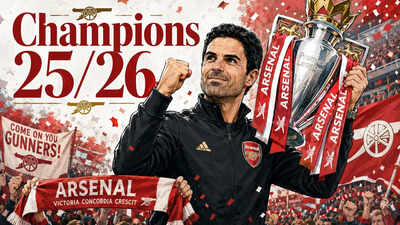
For a very long time, Arsenal was what you call a “banter club”. Now, what exactly is a banter club? Let me use the words of the poet known as Ian Holloway, who once famously described Arsenal as a team that “played some of the best football… and yet couldn’t have scored in a brothel with two grand in their pockets”. Politically incorrect commentary aside, this was how Football Twitter would often describe Arsenal since 2004, which makes it rather hard to say it out loud: Arsenal have won the Premier League.But why do we care, so much?
To fully explain that would require a small detour down memory lane. For millennials (and later Gen Z and whatever cumbersome Latin alphabets come after that) growing up in India, supporting European football clubs became a sort of rite of passage of becoming part of the global economy and appearing hip. That meant that we had to cast our lot with teams in the Premier League, La Liga or Serie A.Among them, the Premier League, thanks to favourable TV timings, growing audiences, the boom of satellite television and the aspirational middle-class propensity to fit in, found a global footprint. Earlier, NRI relatives who were required to come back with a bottle of Scotch from duty-free were also asked to pick up a Premier League jersey. They became more popular in Indian metros with those who weren’t born with silver suppositories wearing faux ones.
For many folks of my generation, our coming-of-age coincided with the rise of the Premier League. Mine coincided with Manchester United’s coming-of-age, thanks to a group of lads known as the Class of ’92 that included the likes of David Beckham, Ryan Giggs, Paul Scholes et al. They were all youth team members called up to join the first team of Manchester United, whose main rival at that time was Arsenal, led by Arsene Wenger, whose propensity for signing young talented players was often met with a chant that would have been more appropriate for Jeffrey Epstein.Most of us who started watching football in that era picked either of the two clubs and would form instant bonds based on their rivalries. Remember Ryan Giggs’ slaloming run in the 1999 semi-final? Remember 8-2? What about when Robin van Persie signed for Utd because he thought Arsenal could never win the league? For us, a pizza party meant the time someone threw a slice at Sir Alex Ferguson in the Old Trafford tunnel, and “see you out there” was a call to action to take up arms before a fight in the grand tradition of Messrs Vieira and Keane.Football, to borrow a line from Dani Rojas, was life, and the Arsenal-United rivalry was what kept the flame burning. That soon changed as the success of the Premier League started attracting Russian oligarchs and petrodollar dictators who needed football to sportswash their image.The Gunners’ last title came in 2004, when they went the entire season unbeaten. In the meantime, Arsenal became something of a banter club whose jollies we took for schadenfreude’s sake, a fate that would also befall Manchester United after Sir Alex Ferguson, who, with the benefit of hindsight, feels like he made a deal with the devil at the crossroads, retired. How else do you explain winning the league with a midfield that consisted of Anderson, Darron Gibson, the Da Silva twins, John O’Shea and Ji-Sung Park?While Manchester United’s decline was immediate, Arsenal’s was slower and more artistic, which made it more enjoyable for the rest of the world.
United collapsed like an empire after the emperor left no succession plan. Arsenal specialised in something more refined: looking beautiful while losing. Post-Fergie United were awful to watch. Arsenal still looked beautiful, with passing triangles, technically gifted midfielders and the faint smell of moral superiority.Arsenal could produce Cesc Fabregas, Tomas Rosicky, Alexander Hleb, Robin van Persie and Jack Wilshere, players who treated the football like a Fabergé egg, and still somehow concede from a long throw against a team whose centre-back looked like he had been assembled in a Midlands quarry.
They were often accused of trying to walk the ball into the net. The ultimate banter club whose streams rival fans watched after every stumble.Not that the banter has been missing this season, where Arsenal, who finished second in the last three seasons, have been accused of playing haramball, a term common on Football Twitter for uninspiring gameplay.For the last three seasons, Arsenal have been knocking at the door only to find Pep Guardiola already standing there with a clipboard and a wry smile to mock his former apprentice: Mikel Arteta.
In 2022-23, they finished five points behind City after spending 248 days on top, the longest any English side has been on top without winning the title. The year later, they fell two points short, and the year after that, seven points short of Liverpool.The cruelty had acquired its own banner. At Anfield, Liverpool fans had mocked Arteta with the line: “Always the bridesmaid, never the bride.” Fans joked that the real quadruple was Arsenal coming second thrice in a row.Arsenal had built a serious team, but seriousness was not enough in an era where Manchester City had a nation-state’s unlimited resources, and Liverpool kept finding ways to turn exhaustion into mythology.In a way, Arteta changed the moral terms of the club, stopped trying to win a beauty contest and created a throwback team that was reminiscent of the late nineties and early noughties, where defending was more important than fancy stepovers and one-twos.Arteta might have learned at Guardiola’s knees, but his football resembled his great rival Jose Mourinho’s instead: a man who famously called Arsene Wenger a “specialist in failure”.
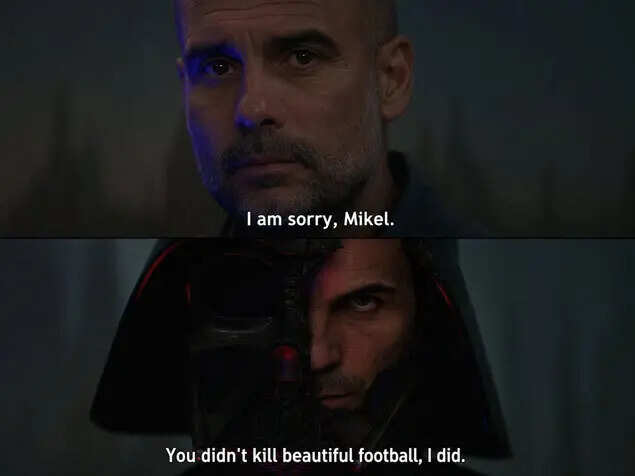
Arteta’s Arsenal didn’t become harder by some industrial accident, but by design, creating a siege mentality that saw him ban football channels and instead fill the training ground screens with just music, and an us-vs-them mentality reminiscent of the Fergie teams of yore.
Gabriel Heinze was brought in because Arsenal needed edge, and David Raya summed up the new mood neatly: “He wants us to fight — a lot of intensity.
” Ferguson had once famously written that Heinze was so ruthless he would “kick his granny to win”.And this season, Arsenal totally embraced their dark side, creating a set-piece mechanism that delivered like a perpetual motion machine, scoring 24 goals from set pieces, including 18 corners, and eking out 1-0 wins.
Still, there were times when it looked like they would fall short, like when they lost to Man City. Their chase for the quadruple was ridiculed as they fell short in the FA Cup and Carabao Cup, eventually managing to cross the line with Artetaball that might be blasphemous to those who worship at the altar of Wengerball.
And they could do one better and register their first triumph in Europe if they win against PSG.
Even Gabriel Jesus, a Brazilian and therefore constitutionally obliged to be suspicious of ugly football, admitted the internal contradiction.
As he put it, “beautiful football” can be annoying when the goals are coming from set pieces, before making the more important point: titles and World Cups have often been decided that way. That was Arsenal’s season in miniature: aesthetics complained, silverware answered.At London Colney, the new theology was apparently written in plain English on a banner: “Set pieces win games.”And that is where Nicolas Jover deserves his own shrine next to Thierry Henry, as the set-piece coach, who reportedly has a clause about the number of goals scored from set pieces in his contract, became the anti-Wenger figure: less interested in the perfect through ball than ensuring every corner was a hostage crisis.Jover, reports The Times UK, worked with players on grappling, blocking and even running behind the goal line to create anxiety for opposing goalkeepers.And yet, the most irritating thing for rivals who used to watch Arsenal TV for the jollies is that it worked.After one nerve-shredding West Ham win, Heinze was reportedly heard saying: “Mamma Mia, football.” That might be the most accurate description of Arsenal’s season: not beautiful, not always convincing, often ridiculous, but somehow dragging itself over the line while everyone else waited for the familiar collapse.
And it never came, and as one social media handle pointed out, given that Arsenal’s last Premier League triumph came before the advent of social media, this was the first time Arsenal fans could post about winning the Premier League.
In the old days, whenever Kolkata club Mohun Bagan lost the match, a popular headline in Bengali newspapers would read: “Bhalo kheliya parajito (Defeated after playing well).” It has been the curse of Arsenal fans for years, but now their football might not be beautiful, but life certainly is after winning the league.






 English (US) ·