

 7 hours ago
7
7 hours ago
7
ARTICLE AD BOX
The WHO's International Agency for Research on Cancer (IARC) declared glyphosate a 'probable carcinogen' in 2015. Despite this, Indian regulators are labelling it 'safe' based on data provided by companies.
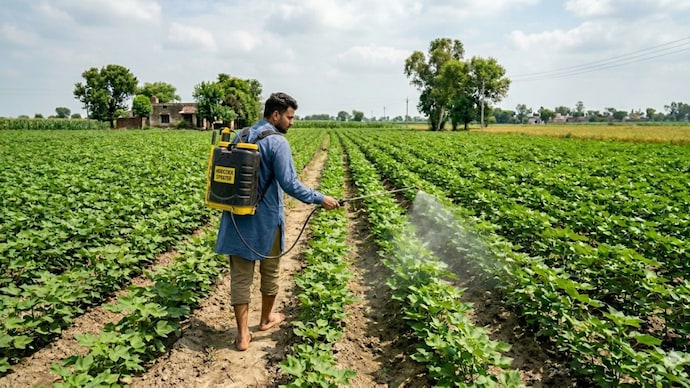
Indian farmers spend thousands of rupees each year buying and spraying glyphosate, but the weed returns even more aggressively. (AI-generated representative image)
A chemical that has been sprayed on farms across the world for half a century with claims that it is essential for modern agriculture, is actually proving to be a silent killer, slowly eroding the soil, human health, and farmers' economies. Multinational and domestic companies in India producing glyphosate are reaping billions of dollars in profits year after year, but instead of raising awareness among farmers, they are pushing them to their deaths.
The biggest paradox is that the very weeds farmers spend their hard-earned money trying to eliminate with this chemical continue to stand tall. Despite repeated applications, many weeds persist and return year after year. This raises some important questions: what kind of herbicide is this that fails to eradicate weeds completely, and instead endangers the health of farmers? Is this simply an endless vicious cycle of collusion between regulators and the greed of the companies that manufacture it?
Glyphosate is one of the most controversial weedicides in the history of modern agriculture; a journey that began in a simple laboratory and escalated into trillion-dollar lawsuits and a global environmental debate. Glyphosate kills friendly insects and causes cancer in human veins.
The World Health Organization's (WHO) International Agency for Research on Cancer (IARC) declared it a "probable carcinogen" in 2015. Despite this, Indian regulators are labelling it "safe" based on data provided by companies. This collusion between regulators and agrochemical companies is putting the health of millions of citizens at risk.
HOW DANGEROUS IS GLYPHOSATE?
Glyphosate manufacturers and some lax government regulators continually claim that the chemical is safe. However, if it is so safe, why has a large part of the world discontinued its usage? More than 30 countries, including Vietnam, Austria, Germany, France, Italy, the Netherlands, and Gulf countries, have either completely banned glyphosate or imposed strict legal restrictions on its use.
CASE AND BILLIONS IN DAMAGES
The claims of "safety" put forward by glyphosate manufacturers are being shattered before courts around the world. Patients suffering from non-Hodgkin lymphoma (a type of blood cancer) caused by this chemical have brought its manufacturers to their knees. More than 1 lakh lawsuits have been filed against the herbicide in US courts and globally.
Bayer, the company that acquired Monsanto, has already paid USD 11 billion (approximately Rs 91,000 crore) in compensation settlements to victims. Recently, the company outlined another massive USD 7.25 billion settlement to address future claims. If this chemical is harmless, why is a company pouring money on settlement costs?
DECEIVING FARMERS
Farmers in India spend thousands of rupees each year buying and spraying glyphosate, but the weed returns even more aggressively, suggesting that nature has adapted to the herbicide. Continued use of glyphosate has now led to the emergence of "superweeds" (grasses that are immune to the chemical). The companies' business model is akin to selling drugs.
First, they sell a chemical, the grass becomes addicted to that chemical, and then the companies present even stronger and more expensive products. The result: the grass never dies, but the farmer's health is certainly harmed. This chemical, carried by rainwater, flows into rivers and groundwater, poisoning aquatic life and human drinking water.
GOLD MINE OF PROFITS
The biggest culprits in this entire devastation are multinational agrochemical companies and government regulatory bodies. The manufacturers print flashy advertisements on the bottles, but never educate farmers about the importance of wearing protective equipment (PPE) while spraying the chemical. They expand their dealer network in villages solely to increase sales.
The budget earmarked by the companies for training farmers on the proper use of the pesticide is reduced to zero. When the government demands the introduction of trained sprayers, they hire a battery of lawyers to defend them in courts. However, until this pesticide is completely banned, farmers will have to understand the trap these companies have created for themselves. Because farmers are the primary victims, with consumers being affected next.
DISCOVERY OF GLYPHOSATE
Glyphosate was first discovered in 1950 by Henri Martin, a chemist at Cilag, a Swiss pharmaceutical company, while searching for a new drug. Because it showed no medicinal benefits, the formula was set aside and forgotten. However, in 1970, John E Franz, a scientist at the American agricultural chemical company Monsanto, independently re-examined the compound.
He found it to be highly effective at drying out plants and killing weeds. Monsanto patented it and launched it in 1974 under the brand name "Roundup," which quickly swept the agricultural market.
'ROUNDUP READY' CROPS
In the 1990s, Monsanto completely transformed the agricultural world. It created genetically modified crops that were resistant to glyphosate, and named them "Roundup Ready" seeds. Farmers would grow soybeans, corn, or cotton in their fields and spray Roundup over the entire field. This would eliminate all unwanted weeds in one go, without harming the main crop.
BEGINNING OF CONTROVERSIES
Mosanto's technology significantly reduced farmers' labour and costs, leading to skyrocketing demand. Glyphosate eventually became the most widely used agricultural chemical in the world's history. However, in 2015, the chemical's story took a major turn. In a report, the IARC declared glyphosate "Probably Carcinogenic to Humans." Following this, thousands of lawsuits were filed against Monsanto worldwide, including in the United States.
BAYER'S ENTRY AND CURRENT SITUATION
In 2018, German pharmaceutical giant Bayer acquired Monsanto. The acquisition coincided with a slew of lawsuits, which have cost the company billions of dollars. However, scientific and regulatory authorities remain divided over glyphosate.
Several major organisations, such as the US Environmental Protection Agency (EPA) and the European Food Safety Authority (EFSA), state that glyphosate poses no cancer risk when used correctly and according to label instructions. However, concerns about environmental damage, including its long-term persistence in soil and water, and health risks have led many countries and cities around the world to impose strict restrictions or ban its use altogether.
STATUS OF GLYPHOSATE IN INDIA
In India, glyphosate is legally approved only for weed control in tea plantations and non-crop areas. However, as illegal HT-Bt (herbicide-tolerant) cotton cultivation gradually increased, coupled with labour shortages, ordinary farmers began spraying it indiscriminately on food crops as well. Farmers are using it extensively to eliminate weeds in their fields before rice planting. It is also being used as an alternative to eliminate weeds in vegetable cultivation.
Since most Indian farmers spray the chemical by carrying tanks on their backs without any protective gear (masks, goggles, gloves, or special suits), the chemical comes into direct contact with their skin and respiratory tract. States like Kerala, Punjab, Maharashtra, and Andhra Pradesh have expressed concern. Globally, it has also been linked to cancer and neurological diseases. In response, the Union Ministry of Agriculture and Farmers Welfare prepared a draft in July 2020.
After two years of deliberation, the government issued a final gazette notification on October 21, 2022, titled "The Restriction on Use of Glyphosate Order, 2022." The Centre did not impose a blanket ban on the chemical, as it was in dire need in tea plantations. To ensure safety, the government found a middle ground and stipulated that no ordinary farmer would be able to directly purchase and spray the chemical.
The government stated that spraying should only be done by pest control operators (PCOs) who are licenced and trained to handle hazardous chemicals safely. Companies were instructed to return their old registration certificates so they could be amended accordingly.
The order sent a wave of panic among agrochemical companies, as the implementation of the PCO rule would directly reduce their sales and cost them their profits. Consequently, major organisations in the industry immediately approached the Delhi High Court. The companies argued against the central government's order with the aim of protecting their profits.
The first argument was that rural India lacks the adequate number of pest control operators. The second argument was that if farmers don't spray themselves and have to wait for PCOs, weeds will multiply, thereby destroying crops and increasing costs.
Hearing these arguments, in November 2022, the Delhi High Court granted a three-month interim pause on the government order and directed the Centre to review the decision in consultation with companies and other stakeholders. Amid this legal dispute, the Agriculture Ministry's stance softened.
When the matter returned to court in July 2023, government lawyers gave the court a written assurance that the Centre would not forcibly implement the PCO order until the matter was finally settled. This assurance was upheld during subsequent hearings in February 2024. As a result, the Agriculture Ministry's PCO notification was shelved.
COMPANIES SHRUGGING OFF RESPONSIBILITY?
Though the companies managed to obtain a pause on the order by arguing that PCOs were not adequately available in the country, they never bothered to train rural young people to build a PCO network or provide free PPE (safety) kits to farmers in order to ensure their safety.
As a result, even today, millions of small and marginal farmers in India, without any awareness or safety equipment, continue to spray glyphosate on their fields, slowly poisoning their bodies. A good government policy was thwarted before it could be implemented due to lobbying by chemical companies and legal manoeuvring.
WHY GOVT DIDN'T CHALLENGE THE DECISION?
When it comes to tax collection or defending political decisions, the central government is quick to approach the Supreme Court to challenge High Court rulings. However, when it comes to a deadly chemical that threatens the health of millions of farmers and the public, the Centre has chosen the slow path of "administrative laxity" and "review."
While WHO has declared glyphosate a carcinogen, India's Agriculture Ministry is hiding behind a pause ordered by the Delhi High Court. The stance is giving free rein to the pesticide lobby. This insensitivity to the lives of ordinary people makes it clear that for the Ministry of Agriculture, its policies and the interests of chemical companies are more valuable than the lives of the country's farmers and citizens.
- Ends
Published On:
Jun 11, 2026 16:52 IST




 English (US) ·