

 1 hour ago
4
1 hour ago
4
ARTICLE AD BOX
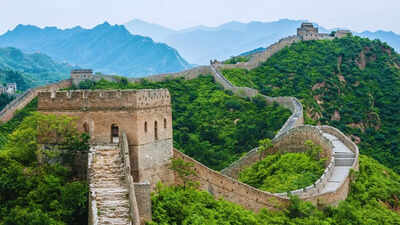
If there were an Olympic event for persistent global myths, the claim that the Great Wall of China is visible from space would win gold every single time. True. It has appeared in textbooks, trivia quizzes, travel brochures and dinner-table debates.
For decades, many of us grew up confidently declaring: “Of course you can see it from space!”Except, you probably can’t. At least not the way the legend suggests.Here’s the twist: the claim that the Great Wall is visible from space predates actual space travel. Long before rockets, satellites, and orbital selfies, writers speculated that the Wall was so massive it must be visible from the Moon.One of the earliest known mentions comes from English antiquarian William Stukeley in the 18th century.
Later, in 1938, author Richard Halliburton wrote in Second Book of Marvels that the Wall was “the only human work visible from the Moon.” It sounded impressive. It was also completely untested.You see, the first human space travel happened on April 12, 1961. Soviet cosmonaut Yuri Gagarin completed one orbit of Earth aboard Vostok 1 on the historic 108-minute mission, marking the beginning of the human space era. This was followed by the first U.S.
suborbital flight in May 1961.
Enter the Space Age
When humans finally began orbiting Earth, we had the opportunity to test the claim scientifically. Astronauts aboard the International Space Station orbit at about 400 kilometers above Earth’s surface. That’s much closer than the Moon, which sits roughly 384,400 kilometers away. If the Wall were clearly visible from the Moon, spotting it from low Earth orbit should be easy.Multiple astronauts have stated that the Great Wall is extremely difficult, nearly impossible, to see with the naked eye from space.
Chinese astronaut Yang Liwei, the country’s first person in space, publicly stated in 2003 that he could not see the Wall from orbit. NASA astronauts have echoed similar observations. According to NASA, while certain human-made structures can be seen from low Earth orbit under ideal conditions, the Great Wall is not easily distinguishable without visual aid.
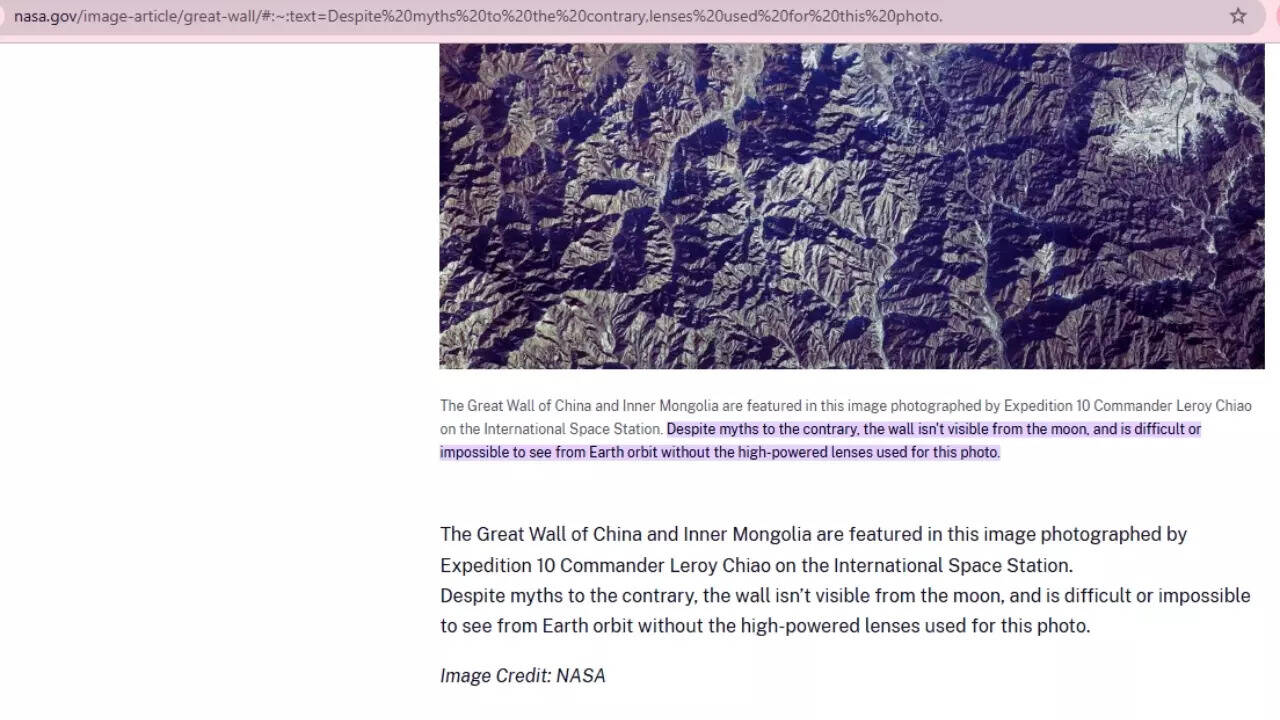
NASA's comment on Great Wall of China being seen from space
Why it’s so hard to see
At first glance, this seems surprising. The Great Wall stretches more than 21,000 kilometers in total length (including natural barriers and trenches).
But here’s the catch: length isn’t the issue, the width is.The Wall is typically about 6–7 meters wide. From hundreds of kilometers above Earth, that’s incredibly narrow. To put it in perspective, many highways, airport runways, and even large bridges are wider and therefore easier to detect. Another issue is colour. The Wall is made largely from stone, brick, and tamped earth. Its colour closely matches the surrounding terrain.
From space, it doesn’t contrast sharply with the landscape.
What can be seen from space?
Ironically, many modern human-made features are easier to spot. What can be seen from low Earth orbit by the human eye is:
- Large cities (particularly at night, when they are illuminated)
- Large airports
- Long bridges
- Large dams
- Agricultural land use
- Major highways
Cities shine brightly at night, and cities are much easier to spot than ancient stone walls. The reality is less romantic but more interesting: the human impact on the planet today is much easier to spot than most ancient ruins.
Why does the legend die hard?
The notion that an ancient civilization wove such a magnificent structure that it could be spotted from space is obviously symbolic.
It speaks of endurance, greatness, and human ambition. The trouble is, it’s simply not true. And science often substitutes poetry with perspective. The Great Wall is an impressive structure, not because it can be spotted from space, but because it represents centuries of engineering prowess across several dynasties, particularly the Ming dynasty.So next time someone confidently declares, “The Great Wall is the only man-made structure visible from space,” you can coolly reply: “Actually, no.”And perhaps that makes the Wall even more impressive. It doesn’t need to be visible from space to be extraordinary. Some wonders are best appreciated from the ground, where history, scale, and human perseverance are far clearer than any orbital view.









 English (US) ·