

 59 minutes ago
7
59 minutes ago
7
ARTICLE AD BOX
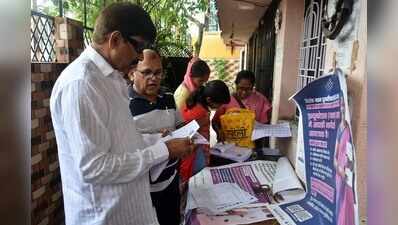
According to the official data, 97.64% of the 4.16 crore electors in the state have received their enumeration forms. Nearly 47000 booth level officers (BLOs) have disbursed 4,06,44,483 forms of the 4,16,27,694 registered electors in the state.
Vijayawada: Nearly 15 days after launching the special intensive revision (SIR) of electoral rolls, the Election Commission (EC) claims it has almost completed the distribution of enumeration forms (EFs) to voters across Andhra Pradesh.
However, the exercise has exposed a major bottleneck, with digitisation of the forms progressing at a slower pace in most districts even as only two weeks remain for completion of the enumeration phase.According to the official data, 97.64% of the 4.16 crore electors in the state have received their enumeration forms. Nearly 47000 booth level officers (BLOs) have disbursed 4,06,44,483 forms of the 4,16,27,694 registered electors in the state.
However, only 1,16,24,604 forms have been digitised, accounting for just 27.93% of the total electorate.The slow pace of digitisation has become a cause of concern for electors, political parties and election officials alike. Except Krishna (45.74%), Eluru (40.30%) and Srikakulam (41.06%), no district has crossed the 40% mark in digitisation. Several districts, including Alluri Sitharama Raju (16.36%), Visakhapatnam (16.95%) and Kurnool (18.99%), remain below 20%, while most others have managed only around 20-30%.
With the enumeration phase scheduled to conclude on July 14, officials are under pressure to accelerate both collection and uploading of the forms. The EC has reportedly been directing field-level officials to meet strict deadlines, leaving BLOs scrambling to complete the massive exercise within the stipulated timeframe.The revision exercise has also triggered widespread confusion among voters, many of whom are struggling to trace their names in the 2002 electoral rolls, which have been made the foundation document for fresh verification and enrolment.
Electors who have shifted residences over the past two decades or migrated to different towns and cities are finding it particularly difficult to establish the required linkage with the older rolls.Political parties have deployed Booth Level Agents (BLAs) and constituted dedicated teams to assist voters in locating their entries in the 2002 records. However, party functionaries admit that the exercise has become increasingly challenging, especially in urban areas where large-scale migration and frequent changes of address have made tracing old electoral records cumbersome.
Many voters have complained of running from one office to another in search of their names, while others depend on the party workers to access archived electoral lists.“BLOs are not extending any support to the electors as they themselves are unaware of the two-decade old lists with searing options are very limited,” said a constituency in-charge of ruling party. Election officials acknowledge that verifying legacy records, collecting fresh Enumeration Forms and digitising the data simultaneously has significantly increased the workload at the field level.
“ECI has refused to share the machine-readable electors lists both 2002 and 2024 to make the search of names easy.
Everything has to be manually searched from volumes of PDF records,” said Ramaraju, a BLA.Despite the concerns over digitisation, the EC maintains that the distribution of forms is nearing completion and expects the remaining stages of the Special Intensive Revision to gather momentum over the next fortnight. Officials hope that faster uploading of the collected forms in the coming days will help achieve the July 14 deadline without disrupting the publication of the revised electoral rolls. CPI(M) state secretary V Srinivasa Rao demanded extension of deadline for SIR in view of the field level challenges in tracing the electors.






 English (US) ·