

 58 minutes ago
4
58 minutes ago
4
ARTICLE AD BOX
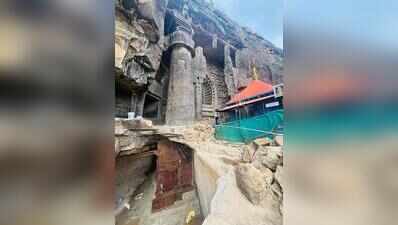
Pune: Conservation work at the Great Chaitya in Karla Caves has revealed a hidden cavity beneath the base of its iconic Lion Pillar, prompting the Archaeological Survey of India (ASI) to undertake structural stabilisation to protect the nearly 2,000-year-old monument from possible future damage.The cavity has left the rock beneath part of the pillar’s base discontinuous, raising concerns over its long-term stability. Officials said the intervention was preventive and carried out before any visible structural distress developed.“When conservation work around an old water tank began, we found a cavity beneath the Lion Pillar. It meant the stone beneath the pillar was no longer continuous. We therefore strengthened its base by providing additional support so that any future stability issues could be arrested,” said Abhijit Ambekar, superintending archaeologist, ASI’s Mumbai Circle.Calling it one of the most significant components of the monument, Ambekar said the freestanding pillar carries an inscription and is crowned by four lions facing the four cardinal directions. “It is a very important pillar. We wanted to ensure its structural stability for the future,” he said.Gajanan Mandaware, a senior conservation assistant with ASI’s Mumbai Circle, said that while removing the raised construction over an old cistern that had obscured the view of the cave, the conservation team discovered a hollow beneath the monolithic Lion Pillar.
Weathering and erosion had also affected the cistern, leaving a void below the pillar’s base. To improve the long-term stability of the monument, the team strengthened the foundation beneath the surface by providing structural support.“Had we not taken up the work now, the pillar could have become unstable in the future. It could have developed cracks or undergone settlement over time. However, there was no movement in the pillar when we intervened.
We acted as a precaution before any damage occurred,” Mandaware told TOI.He said the conservation team stabilised the structure by constructing a reinforced support beneath the base to redistribute the pillar’s load and improve its long-term stability.The Lion Pillar stands outside the entrance to Cave No. 8, the Great Chaitya, the largest surviving rock-cut Buddhist chaitya hall of its period. Carved from a single block of stone, the pillar follows a design tradition reminiscent of the Mauryan pillars and is crowned by four lions seated back-to-back, a motif that bears a striking resemblance to India’s national emblem. At its base is an inscription recording the donation of the monument by Gotamiputa Agimitanaka of the Maharathi family, making it an important source of information on the political and religious history of the Deccan during the early historic period.






 English (US) ·