

 1 hour ago
4
1 hour ago
4
ARTICLE AD BOX
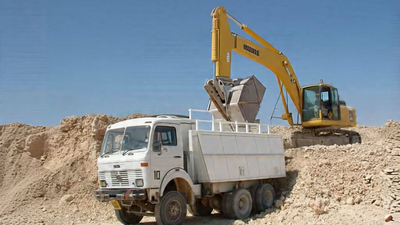
JAISALMER: Due to the ongoing intense tensions in the Middle East, millions of tonnes of limestone destined for India from Gulf countries have been stranded as the Strait of Hormuz remains blocked.
As a result, leading steel companies in India have now been forced to turn to Jaisalmer to meet their limestone requirements.At present, there has been a sharp rise in demand for steel-grade limestone produced from the Sonu Mines by Rajasthan State Mines and Minerals (RSMM), a state government undertaking. In March, this demand saw a significant surge. Against the usual dispatch of around 60 railway rakes per month, as many as 86 rakes of limestone were sent to various companies during March.The rising demand for Jaisalmer’s limestone across the country is benefiting the railways and is also leading to a significant increase in revenue.In India, steel companies require large quantities of high-quality limestone every year for steel production. Major companies such as Tata, SAIL, ArcelorMittal, and JSW primarily depend on Gulf countries like Oman, Dubai, and the UAE to meet their limestone requirements.
India imports nearly 60 million tonnes of limestone annually from these countries, which translates to about 5 million tonnes per month arriving via cargo ships.Currently, due to the severe conflict between the United States and Iran in the Middle East, maritime routes through the Strait of Hormuz have been disrupted. Several cargo ships loaded with limestone are stranded there, creating a major raw material crisis for Indian steel companies.Confirming this, Ashish Parihar, Manager of Sonu Mines (RSMM), Jaisalmer, said that around 80% of steel-grade limestone demand of major Indian steel companies is usually met through imports from Gulf countries. However, due to the disruption in foreign supply chains amid the conflict, companies have immediately turned to RSMM in Jaisalmer, as high-grade steel limestone of this quality is found only here in India.
He explained that limestone used in steel production must have low silica content.He further stated that limestone from Jaisalmer mines contains only about 1.5% silica, making it one of the best quality limestone sources in the country. With foreign supplies halted, pressure on RSMM mines in Jaisalmer has increased sharply, and demand from major companies has surged. For instance, SAIL, which earlier procured around 20,000 tonnes of limestone from RSMM, purchased nearly 100,000 tonnes in March due to supply disruptions from Gulf countries.Typically, RSMM mines in Jaisalmer used to dispatch around 250,000 to 300,000 tonnes of limestone every month to various steel plants. However, due to the current crisis, demand has increased so rapidly that, for the first time in 40 years, 86 railway rakes were loaded in a single month. Around 430,000 tonnes of limestone were transported via rail to companies. This month, approximately 90 to 95 rakes are expected to be loaded, amounting to nearly 450,000 tonnes.
Additionally, 83,000 tonnes have been transported directly by trucks.Shankar Lal Jhingonia, Unit Head Manager of RSMM Jodhpur, stated that due to the ongoing US-Iran conflict and the blockage of the Strait of Hormuz, many companies are unable to import limestone. As a result, leading companies across the country are turning to Sonu Mines in Jaisalmer. However, production is currently limited to existing capacity.
Under existing MoUs, limestone is being supplied primarily to SAIL and other companies, while plans are being prepared to increase production.It is noteworthy that the base price of limestone extracted from Jaisalmer mines is around Rs700 per tonne. However, railway freight to transport it to companies costs about Rs3,200 per tonne, bringing the total cost to around Rs3,900 per tonne. In contrast, limestone imported via sea routes from Gulf countries costs companies approximately Rs3,100 per tonne, even after reaching Indian ports.For a railway rake with a capacity of 4,000 tonnes, companies incur an expense of about Rs1.75 crore, whereas the same quantity from Gulf countries costs around Rs1.45 crore.





 English (US) ·