

 38 minutes ago
4
38 minutes ago
4
ARTICLE AD BOX
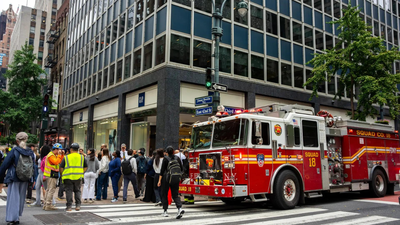
A firetruck is parked at the intersection of 3rd Avenue and East 42nd Street after buildings in the area were evacuated
The temporary suspension of one of New York City's largest office-to-residential conversion projects after steel columns buckled this week has drawn attention to the engineering complexities of transforming ageing office buildings into housing, a strategy increasingly being embraced by cities facing housing shortages and changing workplace trends.The incident occurred at the former Pfizer headquarters in Midtown Manhattan, where developers are converting two office buildings into nearly 1,600 apartments. Authorities evacuated the site after two steel columns buckled on the 21st floor of one of the buildings, prompting an investigation into the cause. Temporary supports have since been installed, and no injuries were reported.While the setback has raised questions about the risks involved in such projects, structural engineers say it should not undermine confidence in adaptive reuse, but instead highlights the technical demands of converting commercial buildings designed decades ago into modern residential spaces.Why office-to-housing conversions are on the riseOffice conversions have gained momentum across several cities since the Covid-19 pandemic reshaped workplace habits, leaving many commercial buildings underutilised while housing shortages continued to worsen.Cities including New York have responded with zoning reforms and tax incentives to encourage developers to repurpose vacant office buildings rather than demolish them and start from scratch.
According to the New York City Comptroller's Office, the city has 44 adaptive reuse projects that have either been completed, are under construction or are eligible to move forward.The former Pfizer headquarters is among the largest such developments, combining a 1909 building with a newer office tower from the 1960s.Far more complex than new constructionUnlike purpose-built residential projects, office conversions require engineers to redesign buildings that were never intended for apartment living.Older structures often need significant modifications to accommodate plumbing, ventilation, natural light, residential layouts and additional structural loads. In this project, the century-old building is also set to support a much taller addition, further increasing engineering complexity.Ben Schafer, a structural engineering professor at Johns Hopkins University, said such projects involve creating entirely new structural systems while ensuring the original building continues to safely carry its own weight.
"I don't think it really brings into question our understanding of how to do something like this," Schafer said, adding that failures during construction do not necessarily indicate flaws in the broader concept of adaptive reuse," as quoted by Associated Press.Emily Guglielmo, a structural engineer based in California, said the buckling could have resulted from additional structural loads, design assumptions or construction-stage issues.
She noted that adding floors to existing buildings is common in dense urban centres but requires extensive analysis of the original structure before construction begins.Why developers are choosing reuse over demolitionDespite the engineering challenges, experts argue that demolishing office buildings should remain a last resort.Beyond the high costs of demolition in dense cities, reusing existing structures also reduces environmental impacts.
Buildings and construction account for around 40 per cent of global energy-related carbon emissions, making adaptive reuse an increasingly important sustainability strategy."Tearing buildings down is a terrible waste," Schafer said.James LaFave, a structural engineering professor at the University of Illinois Urbana-Champaign, said steel-framed office buildings from the 1960s often provide a strong foundation for residential conversions when properly assessed.A setback, not a setback for the sectorExperts said the New York incident is unlikely to slow the broader shift towards office-to-residential conversions, but it may prompt developers and regulators to revisit engineering reviews on similar projects.Joshua Harris, director of Fordham University's Real Estate Institute, described the work as "very, very complicated surgical procedures being done to very old buildings.""If this building has a problem, all the other projects that have been sort of greenlit, they're going to want to review to make sure that it's not something similar," he said.Even so, engineers emphasised that such incidents remain rare because of stringent building codes, inspections and construction standards in the United States.As cities continue searching for ways to address housing shortages without expanding urban footprints, the New York project serves as a reminder that while office-to-housing conversions offer significant long-term potential, delivering them safely requires extensive planning, engineering expertise and careful execution.









 English (US) ·