

 1 hour ago
3
1 hour ago
3
ARTICLE AD BOX
India Today spent a day at the Punjab border near Ludhiana to capture how the Army's air defensive shield operates around the clock. This is now the backbone of India's response to drones and missile threats from Pakistan.

India now has a layered air defence system at its Punjab border
New Delhi,UPDATED: Apr 22, 2026 18:01 IST
Nearly a year after Operation Sindoor, India Today reached Ground Zero on the Punjab border to track how the Army's upgraded guns, missiles and integrated radar network blunted Pakistan's retaliatory air offensive. India Today found that at the Punjab border, the Army's air defence grid stands sharper, faster and more integrated - built to detect, track and destroy aerial threats before they cross deep into Indian territory.
Pakistan responded to Operation Sindoor by sending a swarm of drones and missiles. The targets were not limited to military infrastructure. Civilian areas were also under threat. However, India was up to the task. India responded with a coordinated defence using older upgraded guns, portable missile systems, indigenous radars and a real-time command network linking the Army and Air Force.
India Today spent a day at the Punjab border near Ludhiana to capture how the defensive shield operates around the clock. Platforms like the ZU-23, L-70, Igla-S and Akash missile system are now the backbone of India's response to drones and missile threats. 
IGLA-S: MOBILE KILL OPTION
The Igla-S man-portable air defence system adds a mobile layer to this shield. The system, which can be carried and fired from the shoulder, allows soldiers to quickly engage enemy drones, helicopters and aircraft without depending on heavier launch platforms.
With a strike range of 5 to 6 km and the ability to hit targets flying up to 3.5 km high, the Igla-S is built for low-altitude threats. Its infrared seeker locks on to engine heat, making it especially lethal in active combat conditions and difficult for hostile platforms to evade.
L-70 ANTI-AIRCRAFT GUN
The L-70 anti-aircraft gun, originally developed by Bofors, has undergone a major transformation. Now produced in India, the 40 mm gun has been fitted with radar, electro-optical sensors and auto-tracking systems, allowing it to respond more effectively to fast-moving aerial targets.
With a firing rate of 240 to 330 rounds per minute and a range of up to 4 km, the L-70 is now being positioned as a major anti-drone weapon, particularly against drone swarms. In a conflict increasingly shaped by low-cost unmanned threats, as we saw during the Iran war, this upgrade has become critical. 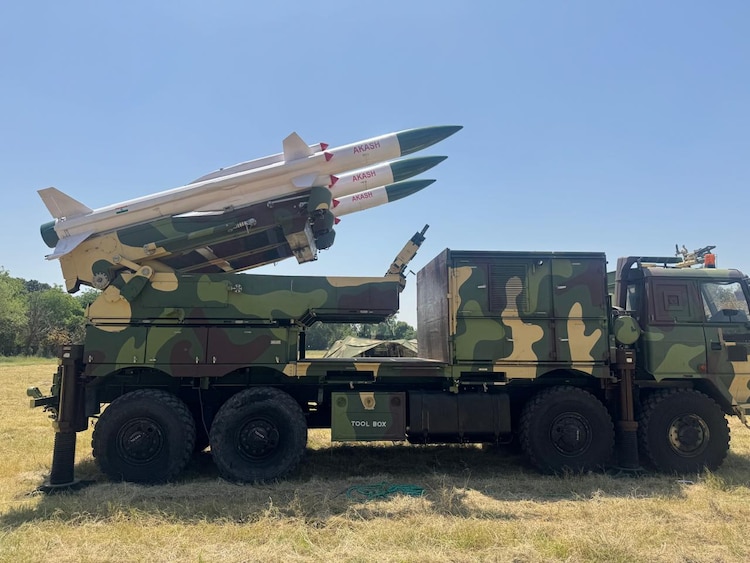
AKASH AND AKASH TEER - THE REAL BACKBONE
The real backbone, however, is the Akash missile system and the Akash Teer command-and-control network. During Operation Sindoor, India activated this defence grid to intercept aerial threats across sectors, including one reported interception in Sirsa, Haryana, far from the border belt.
The Akash missile, with a 25 km strike range and 55 kg warhead, provides a powerful short-to-medium range defence cover. Supporting it is a BEL-built multi-functional radar that can track enemy aircraft up to 80 km away, feeding real-time targeting data into the system.
The real force multiplier is Akash Teer, which integrates the Army's and Air Force's radars and satellite feeds into one live battle picture. This allows commanders to instantly decide which system will engage which incoming threat. It is this integrated response that reportedly helped India stop hundreds of aerial threats and kept Pakistani aircraft from breaching Indian airspace during the operation. 
INDIA'S OWN IRON DOME
India's air defence setup is now increasingly being described as an "Iron Dome-like shield" pioneered by Israel. It is a layered, networked defensive umbrella capable of knocking out threats in the air before they hit ground targets.
From upgraded anti-aircraft guns to indigenous missiles and an integrated command network, the Punjab border deployment shows how India has reworked its air defence posture in just one year.
On the anniversary of the Pahalgam attack, the message from Ground Zero is clear: India's western air shield is no longer reactive - it is alert, layered and battle-ready.
- Ends
Published By:
Abhishek De
Published On:
Apr 22, 2026 18:01 IST
Tune In









 English (US) ·