

 1 hour ago
5
1 hour ago
5
ARTICLE AD BOX

At the Nasscom Technology & Leadership Forum (NTLF) last month, we organised a panel discussion titled 'India GCCs as the second headquarters of global enterprises’. The first time many of us heard the term ₹second headquarters’ in the context of global enterprises was in 2007, when then CEO of Cisco, John Chambers, sent his senior-most executive, Wim Elfrink, to Bengaluru to establish what the company called its 'second headquarters’.
About four years later, when Elfrink was preparing to return to the US, he told us the plan had been accomplished. From a handful of people, Cisco in India had grown to over 6,000. A strong R&D base had begun innovating for the world. Business leaders here were helping implement projects across Asia. Elfrink’s target was to ensure that a fifth of Cisco’s senior executives would be based in Bengaluru, and he indicated that too had been achieved.
Today, there are a number of GCCs in India that could claim to be their parents’ second HQ, with core business and AI decisions being shaped from these centres. SAP’s largest R&D hub outside Germany is in India, with over 17,000 employees, and SAP Labs India MD Sindhu Gangadharan said a quarter of the company’s patents come out of India. That’s an indication, she said, of how much of product leadership is today driven by the centre here.
Sachin Kulkarni, president of Fiserv Global Services, said that in just the past six years, the financial technology company had increased the number of product owners in the India GCC from a handful, to about 100 – people who are today defining the target addressable market, analysing competitive intelligence, deciding go-to-market strategy, pricing strategy, and understanding newer spaces to enter. He noted that his predecessor is now the global CIO for Fiserv, and his erstwhile COO is one of the division CIOs.
“This CXO pipeline of leadership coming out of India is a litmus test of whether we are second headquarters or not,” he said.
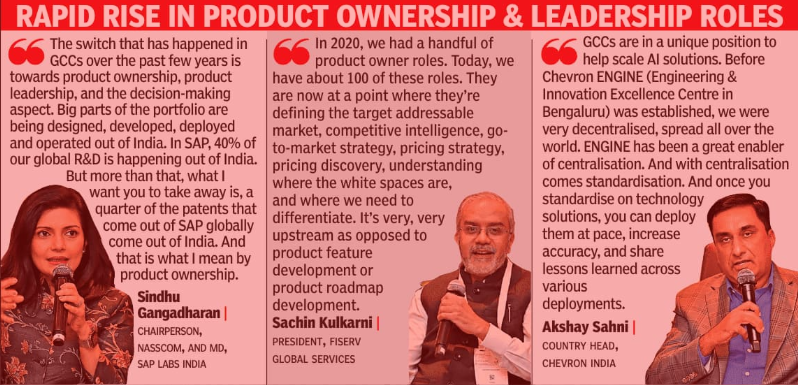
Rapid rise in product ownership and leadership roles
Such is the confidence now in India, that some newer GCCs are pulling out all the stops. The 147-year-old oil & gas giant Chevron launched its GCC in Bengaluru just 15 months ago. Akshay Sahni, country head at Chevron India, said the centre – named ENGINE (Engineering and Innovation Excellence Centre) – represents Chevron’s largest investment by far in technology capacity and capability building outside North America.
We had an opportunity to see the centre earlier, and we discussed it at NTLF. The investment has gone into a stunning office setup with things like large 3D digital-twin screening rooms that employees can walk into to understand exactly how an oil rig in the middle of an ocean looks, feels and works. It’s gone into talent that’s integrating sensors into drones and robotic dogs, and building the software to collect, stream and analyse the data from these sensors.
These systems can do things like high-end thermal imaging and vibration analysis to enable preventive maintenance.“The work we do at ENGINE is really meaningful, impactful and cutting-edge,” Sahni said, noting that it’s all directed towards providing the world affordable, reliable and ever cleaner energy.So, what are the lessons in this for GCCs that are looking to quickly become their enter-prise’s second HQ?India’s big advantage, Kulkarni noted, is that our talent possesses general intellectual curiosity, analytical rigour, and an attitude of embracing tech tools – including now AI tools – as opposed to getting overwhelmed by them.
While companies will still need to help them upskill, everyone underscored the importance of GCCs rapidly building domain expertise. Chevron does that with its digitaltwin rooms, and flying in their topmost leaders and subject matter experts.
Gangadharan said domain expertise and entrepreneurial energy is particularly critical now when you are trying to build AI solutions – because AI has to be applied in the context of a business process.Kulkarni said that with all the concerns around AI ethics and governance, it is also becoming critical for GCCs to invest in skills around social sciences. “If we don’t have enough legal and ethics expertise sitting in our GCCs, we will never be able to bring that end-to-end product development from our headquarters into GCCs,” he said.









 English (US) ·