

 1 hour ago
3
1 hour ago
3
ARTICLE AD BOX
The alleged leak of the NEET-UG paper has revived a crucial question - why were earlier warnings and reform recommendations by a parliamentary standing committee in 2025 ignored?
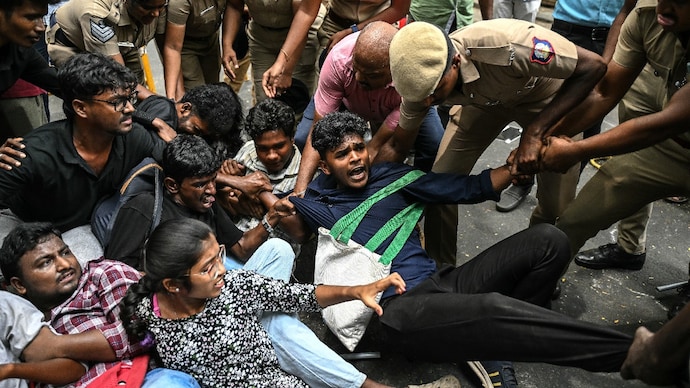
The alleged leak of the NEET-UG 2026 paper has triggered protests by students
New Delhi,UPDATED: May 15, 2026 18:11 IST
Days after the alleged leak of the NEET-UG paper led to the cancellation of the exam, Union Minister Dharmendra Pradhan took responsibility for the fiasco and announced that it would be reconducted on June 21 in a much-awaited press conference. However, the elephant in the room was not addressed - why were recommendations of the 2025 parliamentary standing committee on exam reforms not implemented?
When this was raised by India Today, Pradhan dodged the question, saying he won't respond to "political issues".
"I will not comment on Parliament Standing Committee red flags. I will speak about the High-Level Committee of Experts (HLCE)/Radhakrishnan Committee. The Parliament Standing Committee has members from the opposition. They write things in a certain manner, you also know that. Hence, I won't speak on the standing committee," the minister said.
The NEET paper leak, which saw the National Testing Agency (NTA) cancel the May 3 exam, has triggered widespread anger among aspirants. Opposition leaders like Arvind Kejriwal have urged the students to protest peacefully. Meanwhile, the Centre has ordered a CBI probe into the alleged leak.
THE 2025 HOUSE PANEL REPORT
However, the controversy has revived a crucial question - why were earlier warnings and reform recommendations ignored?
Previously, both the parliamentary standing committee and the High-Level Committee of Experts (HLCE) constituted by the Centre flagged structural flaws and suggested major reforms. These included leak-proof Paper and Pen Tests (PPT) and Computer-Based Tests (CBT).
"The NTA's performance in the last year has not inspired much confidence," the parliamentary panel noted in its December 2025 report. It had urged the NTA to "get its act together" to ensure the sanctity of examinations was not compromised.
WARNING ON BLACKLISTED FIRMS
The panel also made a slew of scathing observations.
One of the most alarming findings mentioned in the report was that several firms involved in paper setting, exam administration, and answer-sheet evaluation were blacklisted by certain states or organisations. Despite this, they managed to secure contracts from other states.
"The committee is of the view that such blacklisted firms must not be engaged for any entrance test by the NTA or the states," the parliamentary standing committee on education stated in its 371st report.
The panel recommended that the Education Department compile a nationwide list of blacklisted firms to prevent them from securing future contracts.
Notably, the Centre-appointed HLCE in October 2024 had also recommended that "testing centres with records of past malpractices must be blacklisted".
NTA'S TROUBLED RECORD
The report also highlighted the NTA's troubled record in 2024.
Out of the 14 competitive examinations conducted by the NTA that year, at least five faced major disruptions. Three exams -- UGC-NET, CSIR-NET, and NEET-PG -- had to be postponed. NEET-UG faced allegations of paper leaks, while CUET (UG/PG) results were delayed.
The panel also noted repeated delays in CUET result declarations over the past few years.
2024 also saw nationwide protests over the May NEET paper leak. Then, Dharmendra Pradhan had promised a complete clean-up of the system.
In June 2024, the Union Education Ministry constituted a high-level committee (HLCE) to recommend reforms for exam mechanisms, data security protocols, and the structure and functioning of the NTA.
The committee, chaired by former ISRO chief K Radhakrishnan, submitted its report in October 2025. The parliamentary committee relied heavily on its findings and recommendations.
HYBRID EXAM MODEL
When asked about the proposed hybrid model, where encrypted question papers are digitally transmitted and printed directly at exam centres, Pradhan said most recommendations of the Radhakrishnan panel had already been implemented.
The HLCE had recommended a hybrid version of the traditional Paper and Pen Test. Under this model, encrypted question papers would be sent to secure servers at testing centres, similar to CBT systems. The papers would then be decrypted and printed on-site using high-speed printers under strict supervision.
According to the committee, this system could eliminate vulnerabilities linked to printing, storage, and transportation of physical papers.
To prevent leaks at printing presses, the committee recommended banning mobile phones inside these facilities, mandatory CCTV monitoring with recordings preserved for at least a year, and strict documentation and destruction of misprinted papers.
GEO-TAGGED TRANSPORTATION OF PAPERS
For the transportation of question papers, the HLCE recommended sealed trunks with geo-tagging. The committee also argued that the NTA should use its surplus funds to build its own infrastructure and reduce dependence on private testing agencies and centres.
On Friday, Pradhan said NEET would shift to an online format from next year. However, this recommendation had already been made by the Radhakrishnan committee.
While the HLCE supported eventual migration towards an online format, the parliamentary panel expressed greater faith in traditional pen-and-paper exams.
"Pen and paper exams offer more opportunities for paper leaks, while computer-based tests (CBT) can be hacked. Between the two, the committee supports a greater focus on pen-and-paper examinations given that there are several models of such examinations which have been leak-proof for several years - including CBSE and UPSC," the standing committee said in its report.
- Ends
Published By:
Abhishek De
Published On:
May 15, 2026 18:11 IST






 English (US) ·