

 1 hour ago
7
1 hour ago
7
ARTICLE AD BOX
Last Updated:June 22, 2026, 16:12 IST
Gurindervir Singh, India's fastest man at 10.09 seconds, chases Commonwealth Games sprint history, driven by Punjabi grit.


Gurindervir Singh (Picture credit: Instagram @gurindervir_singh)
About a month back, Gurindervir Singh captured the imagination of the entire country when he ran the men’s 100m sprint final at the Federation Cup in Ranchi in 10.09 seconds, becoming the first Indian athlete to dip below 10.10 seconds.
Gurindervir clocked a time faster than the Athletics Federation of India’s 2026 Commonwealth Games qualifying mark of 10.16 seconds, strengthening his case as one of India’s leading medal contenders at the marquee multi-sport event.
In the heats of the 2022 CWG, Sri Lanka’s Yupun Abeykoon had clocked 10.06 seconds, the best timing. In the semifinal heats, South Africa’s Akani Simbine clocked 10.10 seconds.
It was Kenya’s Ferdinand Omanyala who won gold in the final with 10.02 seconds.
Going by those standards, Gurindervir’s 10.09 would put him in strong contention for a podium finish if he can maintain or better the timing.
“The atmosphere will be no different. There are several quality athletes here, including Animesh, who is an Asian champion, so I don’t see any issue in adapting," Gurindervir said while speaking to News18 Sports on the sidelines of the AFI awards ceremony in New Delhi.
“I have been preparing mentally for this for a long time. When I step onto the track, I want to compete with all my heart, enjoy every moment and give 100% in every second," Gurindervir added.
The 25-year-old believes he can run faster than he did on this occasion, noting that he has yet to reach peak condition this season.
“I know I can run faster than I did today because this is not yet my peak season. These were only my first few competitions of the year. As I race more, my maturity and confidence will grow and I expect my performances to keep improving," Gurindervir said.
When asked how he defines a peak season, he added: “As I compete more, I will continue to mature and improve. Each competition helps me understand my weaknesses and identify how I need to prepare myself, both mentally and physically."
“Once I have a clearer understanding of those aspects, I believe I can deliver a strong performance at the Commonwealth Games. There are also certain training methods, such as overspeed work, that I haven’t yet incorporated into my routine, and I expect those to help me improve even further," he added.
Gurindervir had earlier spoken about being discouraged from taking up the 100m sprint, with claims that ‘Indians did not have the genes’ to compete at the highest level.
What, then, kept him going?
“Growing up in Punjab, I was raised on stories of courage and resilience, with a strong belief that we come from a warrior lineage. As Punjabis, we are taught never to underestimate ourselves," Gurindervir said.
“The spirit of ‘Sawa Lakh Se Ek Ladaun’, that one Sikh can stand against countless opponents, has always inspired me. My family instilled that mindset in me from a young age, and it’s something I continue to build on every day," he added.
Gurindervir is now the fastest Indian man, set to compete in the CWG, with the country hoping for a historic gold in the men’s individual sprint.
Does that add pressure?
“Being called India’s fastest runner sounds nice, but I once came across a quote that said staying a winner is the toughest part. Winning once isn’t enough; you have to keep winning to remain a winner," Gurindervir said.
“That is the burden that comes with success. The pressure is not during competition; it is during preparation. If I don’t train properly, sleep well or take care of my diet, I won’t be able to win again," he added.
At the Federation Cup last month, Gurindevir made a statement after crossing the finish line at the Birsa Munda Stadium. Tearing off his bib, he showed the cameras a handwritten message: “Task isn’t finished yet. 10.10. Wait. I am still standing."
A statement like that reflects immense self-belief. How does Gurindervir push himself to that level?
“I was confident about my performance due to the timings I had been clocked in training. When I enter competition mode, my body tells me how ready I am to run," Gurindervir said.
“I get a strong feeling that I am prepared, that I will run well and I will win. I also have a fair idea of the kind of time I can achieve. This is not the first time that I have run as fast as I believed I could," he added.
Gurindervir recalled how, before clocking 10.2 seconds at the Indian GP in Bengaluru earlier this year, he had told his coach James Hillier that he would soon touch the mark.
“I have complete faith in myself and in the work I have put in. More importantly, I trust the training I have committed to with all my heart," he said.
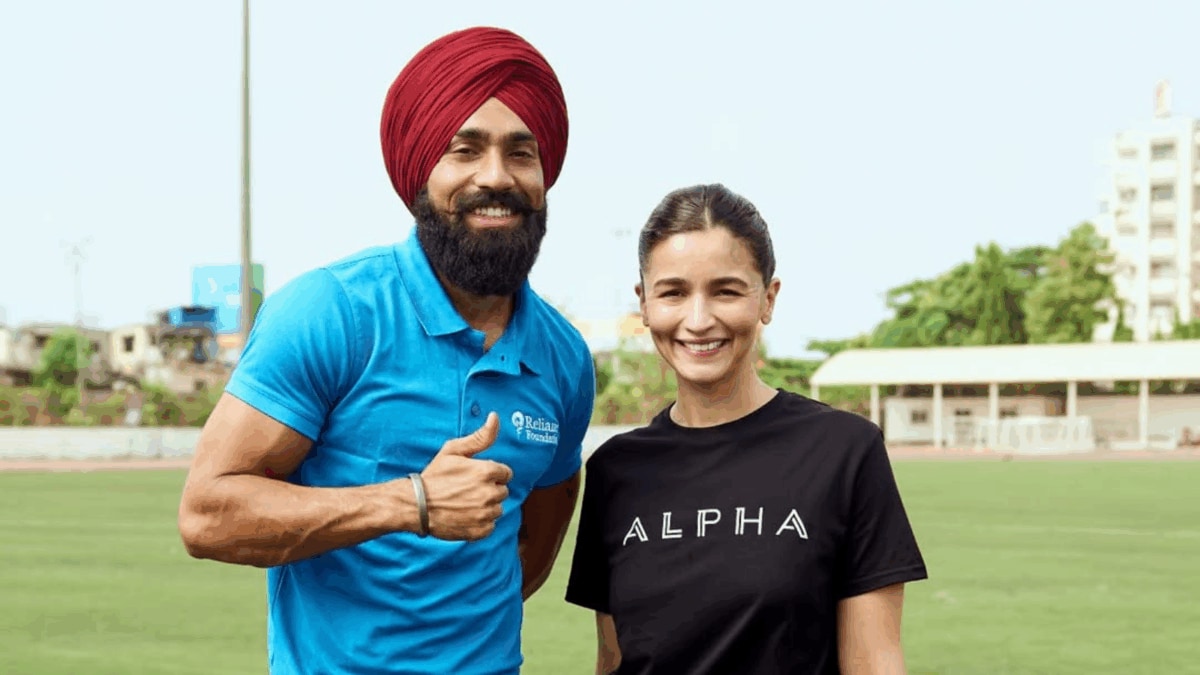
Gurindervir credits Reliance Foundation for his growth.
“I give a lot of credit to the Reliance Foundation. First and foremost, I am grateful to my family, who supported me and taught me to dream. I also owe a lot to my first and second coaches," he said.
Reliance Foundation was also honoured with two top awards at the event.
Gurindervir’s Grit Against The Odds
Gurindervir recalled how lack of proper facilities back in Punjab proved to be a big challenge early on.
“But in Punjab, I didn’t have access to proper facilities; there was no structured diet support, no physiotherapy and no access to good psychologists. There was a lot of pressure and I didn’t know how to handle it at the time," he added.
Gurindervir faced multiple difficulties and was even hospitalised during a tough phase in his career.
“Earlier, I used to think about which flight to take, which was the cheapest, and which hotel was the most affordable, because I had to stay for 4–5 days. If I had to compete in five competitions a year, I would end up spending around Rs 10,000 on flights per event, sometimes Rs 10,000–Rs 15,000 depending on the trip," he said.
“On top of that, hotel stays would cost another Rs 15,000–Rs 20,000 per competition. Then there were additional expenses like food and travel, and all of this used to create a lot of stress for me," he added.
Gurindervir also spoke about sacrificing personal comforts.
“I never attended any functions as I didn’t have proper clothes. Even now, I only have two pairs of pants, which I rotate between occasions," he said with a smile.
“My wishes had to be set aside for a long time, but I plan to fulfil them gradually. Since joining Reliance, I no longer feel the same stress. Now, I can focus on my training," he added.
Gurindervir now has structured support.
“I just have to take care of myself, ensuring I sleep and eat well. The atmosphere is excellent, with many athletes to train alongside," he said.
“Earlier, I used to train alone. Now, even if I have a headache, there is a medical team available. If I get injured on the track or experience pain, a physio is always there," he added.
“I have a dietitian to help maintain my physique, an SNC to build my strength and a coach. I am getting everything that is available," he said.
India won its first athletics medal at the CWG in 1958, when Milkha Singh bagged gold in the men’s 440-yard race. India competed in at least 12 athletics events, but it was that iconic performance that stood out.
68 years have passed since then, and while India has won medals in the women’s 4×400m relay, the men’s and women’s 4×100m relays, and the women’s 10,000m, a medal in the men’s individual sprint remains elusive.
Will Gurindervir break the decades-long drought? The country will be watching.
Handpicked stories, in your inbox
A newsletter with the best of our journalism
News sports other-sports 'I Can Run Faster': Gurindervir Singh Sparks Hopes Of Historic CWG Gold Medal | Exclusive
Disclaimer: Comments reflect users’ views, not News18’s. Please keep discussions respectful and constructive. Abusive, defamatory, or illegal comments will be removed. News18 may disable any comment at its discretion. By posting, you agree to our Terms of Use and Privacy Policy.
Read More






 English (US) ·