

 5 days ago
6
5 days ago
6
ARTICLE AD BOX
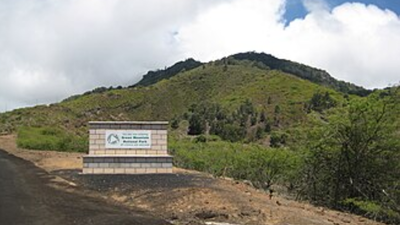
Green Mountain is a common name for "The Peak", the highest point and a stratovolcano on Ascension Island, which has gained some fame for claims that it is one of very few large-scale artificial forests. Image Credit: Wikipedia
A tiny rock in the South Atlantic became the site of a remarkable nineteenth-century ecological experiment. Ascension Island, a harsh terrain of volcanic origin, was just another hot mass of cinders and ashes earlier.
However, now when people ascend to the top of the mountain, they find a verdant and misty haven populated by a variety of ferns, mosses, and trees rather than an empty crater at its summit.Green Mountain is one of the rare instances of man-made cloud forests.A daring strategy for a barren islandIt started from necessity. When the British Empire established a military base on Ascension Island in 1815, the land offered an extremely difficult environment.
There were no trees or other forms of plant life, and obtaining enough drinking water was a serious problem for the people stationed there. This area is isolated, and there is no nearby mainland ecosystem that could naturally provide seeds and plants.In the mid-1840s, the British scientist and naturalist Joseph Hooker proposed an ambitious idea. Instead of regularly delivering fresh water and food supplies, Hooker offered a truly daring idea of importing huge numbers of trees and shrubs from all around the world in order to transform the environment of the island dramatically.
As is stated in a comprehensive report published by the NASA Earth Observatory, the main purpose of such an aggressive action was quite clear. The British planners expected the vegetation to act like a giant sponge and increase moisture in the air.Creating an ecosystem from scratchA wide range of non-native vegetation was brought to the island, including bamboo, eucalyptus and Norfolk Island pine. It was a bold step taken towards ecological engineering.
The planners wanted to modify the atmospheric and soil conditions of the islands to ensure that the newly engineered ecosystem could survive in places where the natural vegetation was either sparse or significantly destroyed.The effectiveness of the venture depended greatly on the geographical features of the island. Green Mountain rises above 800 meters above sea level, allowing it to intercept cool, humid winds moving over the Atlantic Ocean.
It is because of its particular altitude that this environment emerged.Before the trees were planted, the top of the mountain was cool and windy, but it was unable to retain moisture. But after the arrival of the foreign vegetation, it all changed. As the introduced trees matured, their leaves collected moisture right from the air.This created a cycle in which the growing vegetation kept the soil moist, reduced runoff and helped create a wetter climate, allowing more sensitive species to grow under the trees.An actual forest with a rich historyGreen Mountain interests contemporary scientists because it challenges conventional ideas about conservation and ecology. On the one hand, the forest is fully natural, while on the other, it is fully human-made.From a functional point of view, the modern forest works exactly like the old one did thousands of years ago. According to a scientific study available on PubMed, the summit of the mountain over 660 meters is now considered a cloud forest zone.
This high-altitude zone is dominated by ferns and bryophytes, including mosses and liverworts, which thrive in the shaded, moist environment.However, the same study notes that this environment was not always intact. Before the cloud forest was established, visitors had already altered the area by introducing grazing animals such as goats, sheep and donkeys. The modern-day cloud forest is built above a heavily impacted and fragmented land.Green experiment lessonsThe story of Ascension Island is an excellent illustration of the way in which the ecosystems react when humans change their environmental conditions. The Victorians achieved improved water supply and soil conditions, while the cloud forest appears to have emerged as an unintended result.Currently, Green Mountain occupies an interesting middle ground between the artificial and natural worlds. This is a landscape formed by exotic species that totally depend on the natural pattern of Atlantic mist and the elevation for survival. For researchers studying climate change and habitat restoration, the isolated island offers a useful case study.









 English (US) ·