

 1 hour ago
5
1 hour ago
5
ARTICLE AD BOX
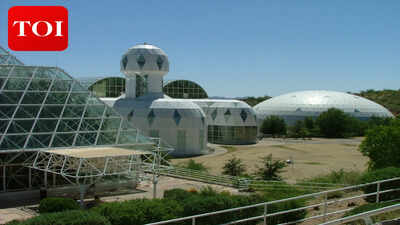
Biosphere 2, artificial closed ecological system. Image Credit: Wikimedia Commons
Eight people stepped into an airlock in the Arizona desert on the 26th of September, 1991, and stepped into something that was to be an example of the human future. Biosphere 2 was a massive enclosed system designed to test whether people could survive in a self-sustaining environment.
It included forests, agriculture, water systems, and other species. The project also included human participants. People were meant to survive for two years.This is one of the most interesting science stories of the 1990s. In the next 16 months, the percentage of oxygen in the system decreased greatly and reached 14 percent, while it was around 21 percent before. The reasons turned out to be unexpected.An ambitious attempt to create a miniature EarthBiosphere 2 was constructed near Oracle, Arizona, as a closed ecosystem that was to simulate various processes taking place on Earth.
The construction got its name because the planet Earth was referred to as Biosphere 1, and the one in Arizona as Biosphere 2.On 26 September 1991, four men and four women entered the structure and sealed themselves off from the rest of the world to test whether people could survive in a closed ecosystem, an idea often linked to future space stations. Reportedly, the closed ecosystem comprised several mini-ecosystems, including rainforest, desert, savannah, ocean, and agricultural land, which were intended to help feed the crew.
At first, the experiment appeared to be going smoothly. But then something happened to the atmosphere.The puzzle of the disappearing oxygenAs scientists monitored the experiment, they found that oxygen levels continued to fall. The issue was severe enough for the participants to experience symptoms that result from low levels of oxygen, such as exhaustion and lack of stamina.A landmark paper published in Advancing Earth and Space Sciences, available through ResearchGate, documented the phenomenon in detail. Scientists revealed that the level of oxygen decreased from the natural atmospheric level of around 21 percent to 14 percent within the first 16 months.The strange thing was that there were numerous plants inside the facility, which were supposed to be producing oxygen.
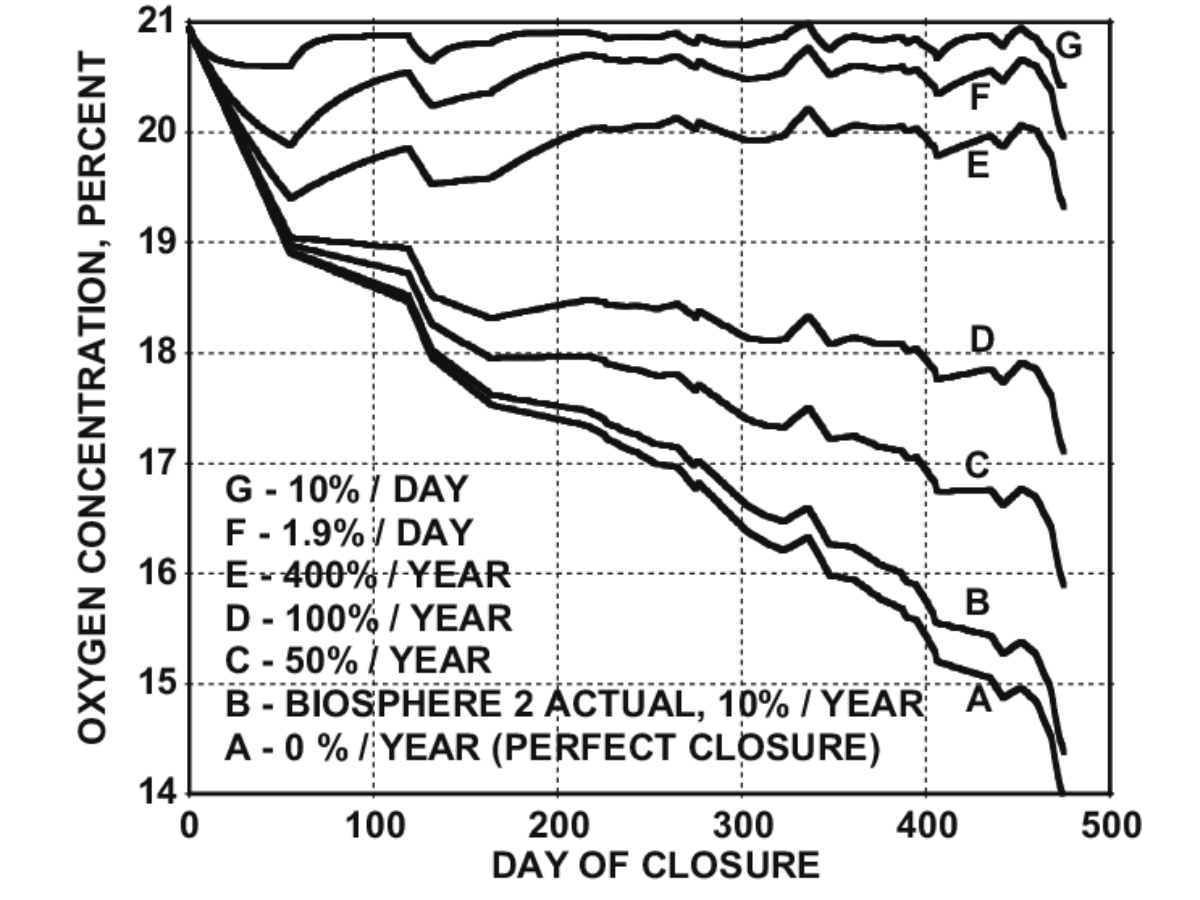
Oxygen concentration in Biosphere 2, actual and simulated for six other leak rates. Image Credits: ResearchGate
Unforeseen function of microorganisms in the soilThe answer began in the soil. According to the 1994 study, large amounts of organic matter had been added to the soil in Biosphere 2. The microorganisms acting upon the organic matter used up oxygen as they released carbon dioxide during respiration.Normally, the carbon dioxide released should have remained in the atmosphere and helped balance oxygen consumption and production.
However, something else was happening simultaneously.The role of concrete in making the problem even more complicated According to the researchers, most of the carbon dioxide generated by microorganism respiration did not stay in the air.It was interacting with concrete elements in the building that were exposed to the air inside. As it turned out, there is evidence in the scientific paper that carbon dioxide interacted with components of the concrete to form calcium carbonate and thus was taken away from the atmosphere.
Since the carbon dioxide was trapped this way, the ecological system was unable to replenish the consumed oxygen.To put it simply, oxygen was consumed during the process of microorganism respiration, and the resultant carbon dioxide was, at least partially, absorbed by concrete through chemical interactions.Thus, the levels of atmospheric oxygen gradually started decreasing. Later on, scientists referred to this event as an illustration of the complexity of closed ecosystems.
Even such seemingly trivial construction materials can affect atmospheric processes when isolated from the external environment.A lesson that is still applicable even todayEven though Biosphere 2 was known for the challenges that occurred, many scientists do not consider the project to be unsuccessful. Biosphere 2 taught a lot about the dynamics of ecosystems, the atmosphere, as well as the complexity of creating self-sufficient biospheres.More than three decades later, those lessons remain valuable as space agencies and scientists studying future Moon or Mars settlements examine how closed environments operate. Perhaps the main thing that scientists have learned from Biosphere 2 is the fact that biological systems are extremely complicated. In other words, a closed ecosystem is not simply a combination of people, animals, and plants but also of building materials, microorganisms, soil chemistry, and so forth.
Eight individuals went into the Arizona desert in order to prove that humans can create a small-scale Earth.But they learned how difficult it is to replicate the balance that allows humans to survive on this planet.








 English (US) ·