

 3 hours ago
3
3 hours ago
3
ARTICLE AD BOX
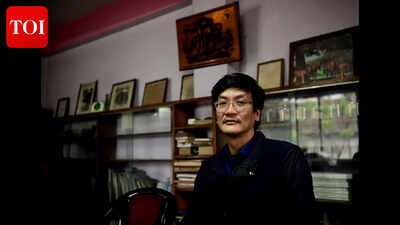
In Tinsukia, Assam, the legacy of Chinese tea workers echoes quietly. Once marked by conflict during the 1962 war, their descendants now cast ballots with a focus on local matters rather than ethnic affiliations. Over generations, the blend of fear and assimilation has woven them into the fabric of Assamese society, where their unique history remains a hushed remnant.
Makum (Tinsukia): In Makum, a small township in Assam’s Tinsukia district about 500 km east of Guwahati, election season arrives with the usual noise. But for the 20 Assamese-Chinese families still identified as the town’s “original Chinese families,” the mood is markedly different.
Their ballots are cast quietly, concerns folded into the larger concerns of the town and their identity rarely spoken of in public anymore.These are families whose ancestors were brought from China by the British to work in the tea industry. Their story in Assam stretches back generations, but so does their trauma. During the 1962 Indo-China war, Indian Chinese communities were targeted because of their ethnicity.
In Makum, that memory has not disappeared. It has simply gone inward.Today, members of the Assamese-Chinese community say they do not seek separate recognition at election time. They vote, but without raising demands tied to their origin.Wei Laim Lee, of Chinese origin and manager of C M Ho & Co. in Makum, which manufactures tea-sorting machines, says, “Like other Assamese people, our people also vote. We have no separate issues for Chinese-origin people.
Our people just go and vote with the same set of agenda like voters from other communities living in Makum.”That sentiment reflects a striking shift. Makum was once known for efforts by Assamese- Chinese residents to organise and assert a distinct identity. But time, assimilation and inherited fear have changed that. The older generation that lived through the colonial era and the Sino-Indian conflict has largely passed on.
Their descendants, shaped by those memories but unwilling to relive them publicly, have chosen a different path — to live as ordinary Assamese citizens and to vote as such.Lee said, “Our people go to vote with other community people, focussing on local issues like the civic issues etc. We do not have any issues from the Chinese-origin point of view.”In homes and businesses, Assamese is now commonly spoken, along with Hindi in workplaces and markets.
Many younger people no longer know Chinese. Over the years, marriages with other communities and the gradual blending into Assamese society have further softened visible markers of difference. Yet the shadow of suspicion has not fully lifted.That shadow dates back to one of the darkest chapters in the community’s history. More than 1,500 Chinese-Assamese were labelled “Chinese spies” and “enemies” during the 1962 war and rounded up under the Defence of India Act.
Many were taken from Makum and sent to detention camps at Deoli in Rajasthan and Nagaon in Assam. For many families, the rupture was permanent. A large number later left India for Hong Kong and other parts of the world.
Others returned to Assam and rebuilt their lives quietly.About one-and-a-half decades ago, around 500 Chinese-Assamese were said to be scattered across Tinsukia, Dibrugarh, Sivasagar and Sonitpur districts in upper and northern Assam.
Their numbers have since thinned in public visibility, if not always in lineage. In Makum, what remains is a community that has learned to survive by keeping its head down.That caution is still palpable in nearby Tinsukia town. There, too, people of Chinese origin are reluctant to speak to the media about identity or politics. The fear of being watched, questioned or misunderstood has endured across generations.Tian Ann Wang, a young boy of Chinese origin who runs a restaurant in Tinsukia with his father, did not want to discuss what his family expects from the election.
“Nowadays, we do not want to speak about our origin or anything political. A few years ago, people from intelligence agencies came and asked lots of questions as Chinese embassy people visited us,” said Tian.His family runs the restaurant in Chirwapatty, once known as Chinapatty, where several Chinese-origin families still live. The old name lingers like a trace of a fuller past. But the political aspirations once associated with a distinct community identity have largely faded. What remains are everyday concerns — business, civic issues, stability, belonging.






 English (US) ·