

 1 day ago
4
1 day ago
4
ARTICLE AD BOX
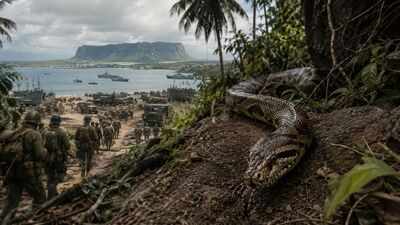
For most of its history, Guam's forests developed without large tree-climbing snakes hunting birds in the canopy. Native wildlife adapted to an environment where many species nested with little need to defend themselves against such predators.
That balance changed after the Second World War, when a single accidental introduction quietly altered the island's ecological future. Hidden among military cargo travelling across the Pacific, the brown tree snake arrived from its native range and found conditions almost impossible to resist. Food was plentiful, competition was limited, and very little stood in its way. What followed was not an immediate disaster but a slow transformation that unfolded over decades.
Today, the brown tree snake has become one of the world's best-known examples of how an invasive species can reshape an island's wildlife, economy, and daily life in ways that continue long after its arrival.
The accidental snake invasion that took over the island in Guam
The brown tree snake (Boiga irregularis) is naturally found across parts of Papua New Guinea and northern Australia. Sometime during the years following World War II, it is believed to have travelled unnoticed aboard a military transport bound for Guam in the western Pacific.
That journey proved unusually significant. Guam offered exactly what the species needed to establish itself. There were abundant prey animals, warm conditions throughout the year, and almost no predators capable of keeping snake numbers under control. Instead of remaining an isolated introduction, the species spread across nearly the entire island.Reportedly, within a few decades, the population had grown into the millions.
In some areas, researchers have estimated extraordinarily high densities, making the brown tree snake one of the most concentrated snake populations ever recorded.
How the brown tree snake became one of Guam's most effective predators
At first glance, the snake does not appear especially unusual. Most adults measure between about one and two metres in length, although larger individuals can exceed that. Their brown colouring, broken up with darker bands, blends naturally into woodland and tree trunks.The species is only mildly venomous to people. Bites are usually painful rather than life-threatening, although swelling and discomfort can follow. Small birds, reptiles, and mammals face a much greater danger. Scientists studying its movement identified a climbing technique unlike any previously described in snakes. Instead of relying solely on familiar forms of movement such as sidewinding or concertina motion, the brown tree snake can wrap itself into a loop around narrow vertical objects, anchor its tail against its own body, and gradually work upwards.
The movement resembles a slow mechanical lift, allowing the animal to reach places that were once thought inaccessible to snakes.That behaviour helps explain why the species is so effective at raiding nests and reaching birds sheltering high above the ground.
The bird populations that disappeared from Guam's forests
Island ecosystems often evolve in isolation, and Guam's native birds developed without needing to cope with an agile tree-dwelling snake. Their nesting habits reflected that history.Once the brown tree snake became widespread, eggs, chicks and adult birds all became targets. Populations began shrinking year after year.The losses eventually became devastating. Most of Guam's native forest birds disappeared from the wild, with several species becoming locally extinct. Birds that had once played important roles in seed dispersal and pollination vanished from large parts of the island, leaving forests noticeably quieter than they had been only a few generations earlier.The snakes did not limit themselves to native wildlife either. Introduced birds also suffered heavy predation, although the impact on Guam's original species was especially severe because many had never evolved behaviours that might have helped them avoid snake attacks.
The damage spread far beyond birds
Removing so many birds altered much more than the island's wildlife list.Many flowering plants and fruit-bearing trees depend on birds and fruit bats to move seeds or transfer pollen between plants.
As those animal populations declined, natural regeneration changed too. Some plant species became less successful at reproducing, gradually altering parts of the forest.Meanwhile, animals that would normally have been eaten by birds experienced far less predation. Insects became much more abundant in some habitats, while spider numbers increased dramatically compared with nearby islands where brown tree snakes never became established.Researchers have also discovered another unexpected consequence of the snake's hunting behaviour. A recent study suggested that these predators frequently attack birds too large to swallow. Many animals are therefore killed without becoming food, adding to the ecological cost of their presence.
How the brown tree snake disrupts everyday life in Guam
The brown tree snake has affected residents as well as wildlife. The snakes occasionally enter buildings through small openings, including drainage systems and ventilation spaces, leading to encounters inside homes.
Although bites rarely become serious medical emergencies, they have led people to seek treatment over the years.Electricity infrastructure presents another problem. The snakes regularly climb poles and power equipment, sometimes bridging electrical components and triggering short circuits. These incidents have caused repeated blackouts across Guam for decades, disrupting homes, businesses, and public services while creating ongoing repair costs.Recent figures from the Guam Power Authority’s Facebook post on 12 February, show 77 snake outages in a single year, with certain communities experiencing repeated interruptions.
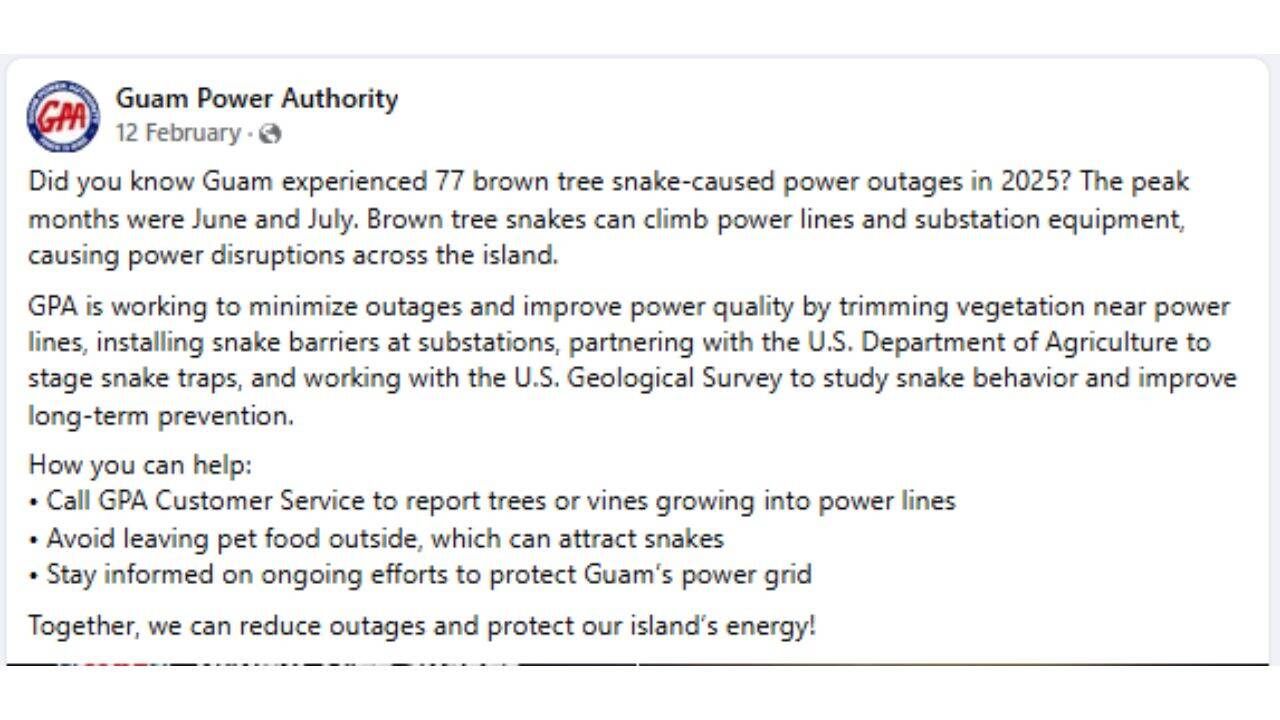
Facebook Post
Preventing history from repeating itself
The brown tree snake's ability to survive without food for extended periods makes it especially difficult to contain. Individuals can remain hidden inside shipping containers, aircraft cargo or freight long enough to reach new destinations.That possibility has worried neighbouring Pacific islands for many years. Hawaii has intercepted brown tree snakes on several occasions before they could establish breeding populations, avoiding the kind of ecological crisis experienced on Guam.To reduce the risk, inspection programmes now operate at ports and airports. Detector dogs are used to search cargo, while traps, toxic baits and fumigation continue to form part of broader control strategies. Federal funding has supported these efforts for decades because preventing the snake from reaching new islands is considered far less costly than trying to remove an established population later.









 English (US) ·