

 2 days ago
9
2 days ago
9
ARTICLE AD BOX
4 min readNew DelhiFeb 19, 2026 06:19 AM IST
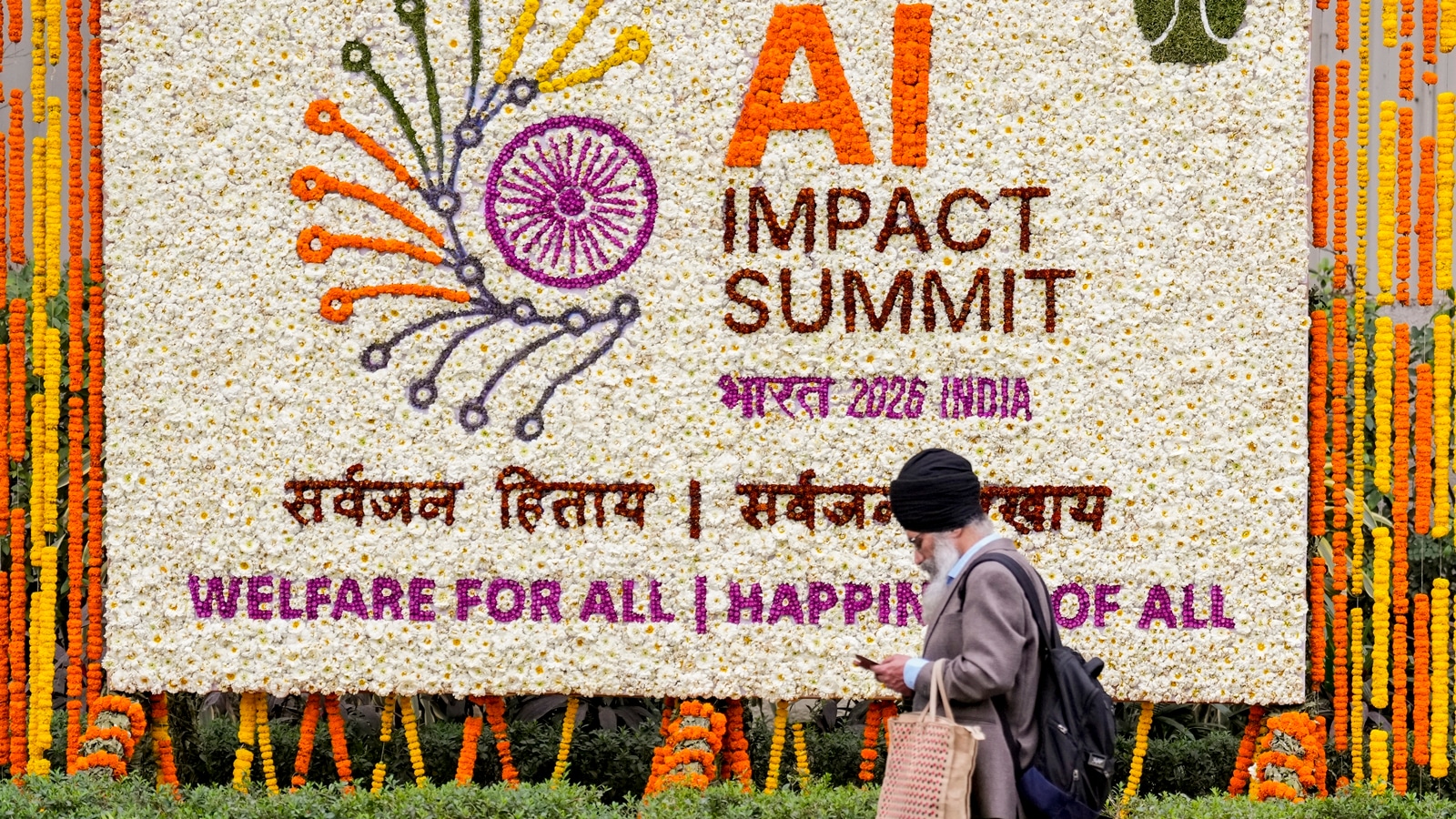 A man walks past a signage board of AI Impact Summit, in New Delhi, Wednesday, Feb. 18, 2026. (PTI)
As the exhibits of the India AI Impact Summit 2026 came under the spotlight after the Galgotias University allegedly showcased a China-made robotic dog as its own, The Indian Express visited some of the booths of the government universities to find out what they were showcasing and their future projects.
IIT Kanpur
A team, supported by the Airawat Research Foundation, which is the national Centre for Excellence for Sustainable Cities based out of IIT Kanpur, is building urban flood intelligence systems using AI. Currently the decisions regarding flood management are made very slowly, says Project Manager Raavi Patel. AIResQ ClimSol Private Limited, using its advanced AI models, tells cities for any incoming rainfall, where it will flood, how much flooding and for what duration. The system is also able to calculate ideal travel routes and which schools and hospitals might get cut off. “The goal is to give hyperlocal, real-time flood intelligence so that decision making can happen in real time and in the long term, we want to make our cities urban flood resilient,” Patel says. The project has been piloted in Gurugram and the system has been purchased by the Gurugram Metropolitan Development Authority (GMDA).
Another project on display at the booth which is supported by the CoE is Avartan Labs, which is an early-stage deep-tech startup aimed at making solid waste management more efficient using AI-ML solutions. Waste is still segregated manually at material recovery facilities in India, and a lot of it which can be recycled goes unused due to high monitoring costs.
Avartan’s system, VIRA (Vision Intelligence for Recovery Augmentation) deploys computer vision to find out the amount of a particular kind of waste in a batch of mixed waste. “This leads to up to 30% higher recovery of recyclable material, increased incomes for waste workers and diversion of waste away from landfill,” said Madhuvanti Kale, co-founder of the company.
IIT Bombay
Oceans have chlorophyll hotspots where plankton are found in higher density, which further attracts smaller fishes that feed on plankton and bigger fishes feeding on the smaller fishes. Since these hotspots change locations, they can’t be located with accuracy due to gaps in satellite coverage and reflection from the water surface. “Our system uses the past seven days of satellite imagery as well as older information to predict the chlorophyll hotspots of the next day,” says Suyash Bire, Assistant Professor, Centre for Climate Studies, IIT Bombay.
This information is valuable for fishermen who can get to know where to fish the next day to get a better catch. “We will probably give this system to a government organisation, which can send alerts and information to small fishermen,” Bire says. When asked about commercialising the technology, he says the system was conceptualised to help small fishermen, not the big ones who would exploit these resources.
IIT Bombay also has a system of urban flood predictive management, which has successful trial runs for two years. An additional feature is that through its app, people themselves can report on the level of flooding they are experiencing in their locality, which leads to a granular, crowdsourced layer of data to the system.
IIT Madras
Story continues below this ad
The Centre for Responsible AI (CERAI) at IIT Madras ensures there are openly available benchmarks and metrics available to categorise AI as responsible. The metrics are explainability, transparency, inclusivity and cultural sensitivity, among others. While there might be many international standards that can be used for English models, CERAI’s standards can do so for large language models in Assamese, Hindi, Tamil, Bodo, Bengali and Sindhi. It is also working on privacy preserving models.
Also on display was Bodhan AI, which was launched last week by Education Minister Dharmendra Pradhan. The non-profit company, which was developed at the Centre for Excellence in Education at IIT Madras, will work on research to build AI capabilities for Indian languages, and develop assets like automatic speech recognition and speech synthesis.

Devansh Mittal is a Correspondent at The Indian Express, based in the New Delhi City bureau. He reports on urban policy, civic governance, and infrastructure in the National Capital Region, with a growing focus on housing, land policy, transport, and the disruption economy and its social implications. Professional Background Education: He studied Political Science at Ashoka University. Core Beats: His reporting focuses on policy and governance in the National Capital Region, one of the largest urban agglomerations in the world. He covers housing and land policy, municipal governance, urban transport, and the interface between infrastructure, regulation, and everyday life in the city. Recent Notable Work His recent reporting includes in-depth examinations of urban policy and its on-ground consequences: An investigation into subvention-linked home loans that documented how homebuyers were drawn into under-construction projects through a “builder–bank” nexus, often leaving them financially exposed when delivery stalled. A detailed report on why Delhi’s land-pooling policy has remained stalled since 2007, tracing how fragmented land ownership, policy design flaws, and mistrust among stakeholders have kept one of the capital’s flagship urban reforms in limbo. A reported piece examining the collapse of an electric mobility startup and what it meant for women drivers dependent on the platform for livelihoods. Reporting Approach Devansh’s work combines on-ground reporting with analysis of government data, court records, and academic research. He regularly reports from neighbourhoods, government offices, and courtrooms to explain how decisions on housing, transport, and the disruption economy shape everyday life in the city. Contact X (Twitter): @devanshmittal_ Email: [email protected] ... Read More
Stay updated with the latest - Click here to follow us on Instagram
© The Indian Express Pvt Ltd







 English (US) ·