

 1 hour ago
6
1 hour ago
6
ARTICLE AD BOX
INS Aridhaman is the third indigenous submarine inducted into the Navy and follows the earlier induction of INS Arihant (2016) and INS Arighaat (August 2024).
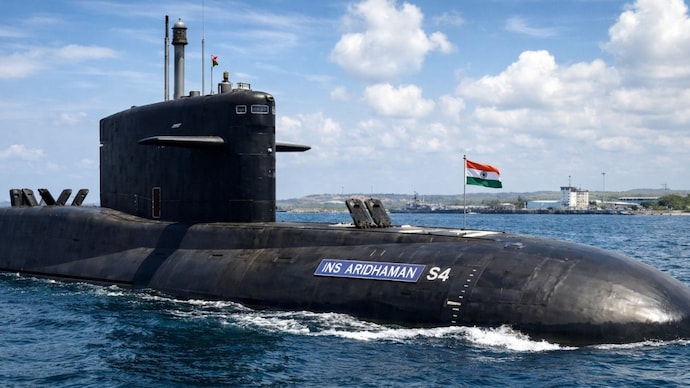
INS Aridhaman is slightly larger than its predecessors and features a more streamlined hull designed to improve stealth and acoustic performance. (Image: X/ @JM_Scindia)
New Delhi,UPDATED: Apr 3, 2026 18:00 IST
In a major boost to India’s strategic deterrence capabilities, Defence Minister Rajnath Singh on Friday commissioned the indigenously built nuclear-powered ballistic missile submarine (SSBN) INS Aridhaman into the Indian Navy.
The submarine, also known as S4, is the third in India’s indigenous SSBN programme and follows the earlier induction of INS Arihant (2016) and INS Arighaat (August 2024). Its commissioning marks a significant step in strengthening the naval leg of India’s nuclear triad — the ability to launch nuclear weapons from land, air and sea.
INS Aridhaman has completed its final phase of sea trials and is expected to join the Strategic Forces Command, which oversees India’s nuclear arsenal. The programme remains one of the country’s most closely guarded defence projects.
BIGGER, QUIETER, MORE LETHAL
At around 7,000 tonnes, INS Aridhaman is slightly larger than its predecessors and features a more streamlined hull designed to improve stealth and acoustic performance — a critical factor for underwater survivability.
The submarine is powered by an upgraded 83 MW pressurised water reactor (PWR) developed by the Bhabha Atomic Research Centre (BARC), underscoring India’s growing indigenous technological capability in nuclear propulsion.
A key upgrade lies in its firepower. Unlike earlier boats, INS Aridhaman is equipped with eight vertical launch tubes, doubling the missile capacity of INS Arihant. This allows it to carry either:
- Up to 8 K-4 ballistic missiles with a range of about 3,500 km, or
- As many as 24 K-15 missiles with a range of around 750 km
STRENGTHENING NUCLEAR DETERRENCE
The induction of INS Aridhaman is expected to significantly enhance India’s ability to maintain a “continuous at-sea deterrence” — ensuring that at least one nuclear-armed submarine remains on patrol at all times, a key element of credible nuclear deterrence.
India is among a select group of countries — including the US, Russia, the UK, France and China — that operate nuclear-powered submarines.
While India has already demonstrated land- and air-based nuclear capabilities, the expansion of its submarine fleet signals a clear focus on strengthening its underwater nuclear posture.
WHAT LIES AHEAD
The Navy is already working on the next submarine in the series, referred to as S4*, as well as the more advanced S5-class submarines, which are expected to be significantly larger, with an estimated displacement of around 14,000 tonnes.
The commissioning of INS Aridhaman comes amid a broader push towards defence self-reliance and indigenous military capability, reinforcing India’s position as an emerging maritime power in an increasingly complex security environment.
- Ends
Published On:
Apr 3, 2026 18:00 IST








 English (US) ·