

 1 week ago
11
1 week ago
11
ARTICLE AD BOX
With India’s batting superstars returning for, and only playing, the ODI format, the hype around the dying breed of traditional 50-over batting masters has once again caught fire. These are the batters that blend conventional strokeplay with big hits while showing the temperament to play long innings, never letting the middle-overs phase stall the scoreboard with crafty manipulations of the field. It is a template that Virat Kohli and Rohit Sharma have mastered and showcased over a long period of time.
As the 50-over format continues to take more of a backseat in the modern cricket fan’s consciousness, those talents don’t quite have such high demand anymore. But with another fine century (137 from 131 balls) in Indore on Sunday, Daryl Mitchell proved that its few remaining torch-bearers need to be valued.
Mitchell’s innings was a well-paced effort that showed his mastery of the situation, against spin and pace, while in defence or attack. It took his aggregate for the three-match series to 352 runs. It also underlined just how much he loves batting against India, and on their territory no less.
In 11 ODI innings against India, he has now scored 741 runs at an average of 74.1. Six of his last seven innings against India have been 50+ scores, four of them on these shores. His ninth ODI hundred on Sunday took his average to nearly 60 in 59 matches.
ALSO READ | Daryl Mitchell hits second straight ODI ton, fourth consecutive 50-plus score vs India during Indore game
All of these attributes speak to a true ODI specialist who hasn’t quite broken through in the other two formats and has, hence, flown slightly under the radar. But he has been a consistent nemesis of this Indian side. That’s because he enjoys a unique attribute among batters touring the subcontinent: a very potent repertoire of shots to target the spinners. It was on full display during his match-winning 131 not out in Rajkot on Wednesday, on a slowish surface where the ball was staying low. Mitchell is an assured sweeper and reverse-sweeper, and has the quick footwork to charge down and attack as well. He did the latter on the very first ball of spin, in the 17th over from Kuldeep Yadav.
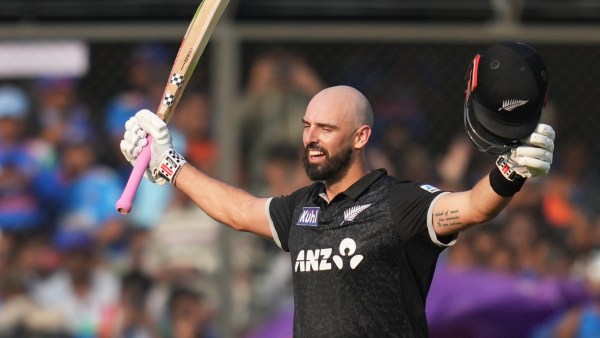 New Zealand batter Daryl Mitchell celebrating his century against India during 3rd ODI in Indore. (PHOTO: AP)
Perhaps that, and a true pitch without much assistance for spinners, is why skipper Shubman Gill had stayed away from the tweakers for so long. Ravindra Jadeja was handed the ball only in the 30th over, by which time Kuldeep had bowled just three overs. The two combined for a total of 12.
Story continues below this ad
But Mitchell’s task at hand was a lot more than just going on the offensive against spin. Coming to the middle in the second over at 5/2 meant he had to do much of the spadework for New Zealand to not capitulate. He constructed two crucial partnerships.
By the time he departed, the Kiwis were on their way to an 300+ score thanks to his 219-run stand with Glenn Phillips, the all-rounder also hitting an excellent century after a few dropped catches. But Mitchell did much of the legwork in the middle overs.
WATCH | Virat Kohli playfully pushes Daryl Mitchell out of ground after century vs India in Indore
Both batsmen accelerated in such a manner that it scrambled India’s under-strength bowling attack, which looked bereft of options to find the breakthrough.
Story continues below this ad
Mitchell’s innings indicated that the rumours of the decline of the ODI specialist have been highly exaggerated.
Mixed bowling
Despite the imposing-looking total, New Zealand actually ended a few dozen runs short of where they could have been because of India’s new-ball exploits in what was otherwise quite a mixed bowling performance.
Two wickets in the first seven balls helped. The positive impacts of Arshdeep Singh’s inclusion were there to see barely a few balls into the innings as he got Henry Nicholls to chop an out-swinging length ball onto his stumps. Harshit Rana sent Devon Conway back with a peach that pitched on off and threatened to deviate but held its shape, prompting a tentative prod to the slips. The two kept up the threat for the rest of the Powerplay.
But once the ball aged, neither Rana nor Arshdeep could find much bite. With Gill’s reluctance to throw it to the spinners, the responsibility fell on Mohammed Siraj and Nitish Reddy; the former the pick of the bunch and the latter delivering reasonably well under recent pressure and criticism. Both had a similar template: bowling stump to stump and finding the requisite grip from the surface with the occasional slow bouncer.
Story continues below this ad
Reddy, though, was eventually carted to all parts but a few late wickets ensured the score was not bigger on an Indore belter. But it was another less-than-satisfactory performance with the ball, three for three this series.
Brief scores: New Zealand 337/8 in 50 overs (Mitchell 137, Phillips 106; Arshdeep 3/63) vs India







 English (US) ·