

 59 minutes ago
5
59 minutes ago
5
ARTICLE AD BOX

The drought-resistant sorghum and millet germplasm from Hyderabad is ready to improve agriculture in Indonesia's drylands
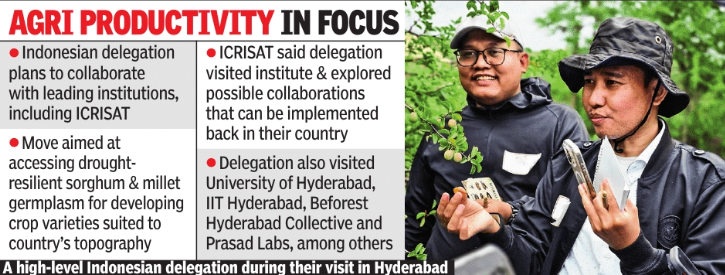
HYDERABAD: Sorghum and millet germpalsm (seed varieties) from Hyderabad may soon find their way into the drylands of Indonesia.A high-level Indonesian delegation currently in Hyderabad told TOI that it plans to collaborate with leading institutions, including the International Crops Research Institute for the SemiArid Tropics (ICRISAT), to access drought-resilient sorghum and millet germplasm for developing crop varieties suited to the country’s topography.The initiative is part of Indonesia’s efforts to improve agricultural productivity in areas facing water stress and challenging agro-climatic conditions.Members part of the delegation said they chose Hyderabad because its semi-arid conditions and dryland farming practices are similar to those found in parts of Indonesia.
New varieties
“The most prominent ones that we can use are millet and sorghum. We already grow them in Indonesia, butthe problem is the germplasm is limited.
So, if we can have collaboration with ICRISAT, we can bring all the germplasm needed and release new varieties,” said Hafith Furqoni, secretary, department of agronomy and horticulture, IPB University.Furqoni said that Indonesian researchers will select 10 to 20 crop germpalsms from ICRISAT’s massive collection -among the largest in the world, that are best suited to their conditions. “We can use them for a breeding programme in Indonesia and then release new varieties.
We have already got ICRISAT’s consent,” he added.The delegation, comprising representatives from Indonesia’s ministry of highereducation, science and technology, ministry of state secretariat and leading universities, will return home this week and present its findings to the govt.Based on the visit, Indonesia plans to draw up an action plan next year to implement projects in three identified locations, with funding already earmarked for the initiative.“Three locations in Java, Kalimantan and the Nusa Tenggara region, which have extensive dryland areas, have been identified where insights gathered during the Hyderabad visit will be applied and adapted,” said I Ketut Adnyana, director of research and community Service (directorate general of research and development), ministry of higher education, science and technology.ICRISAT officials confirmed that a delegation from Indonesia visited the institute and explored possible collaborations that can be implemented back in their country.The delegation also visited the University of Hyderabad, IIT Hyderabad, Beforest Hyderabad Collective and Prasad Labs, among other institutions.Members said the permaculture and regenerative agriculture practices demonstrated at Beforest (a firm building collective living spaces and self-sustaining ecosystems) could offer useful lessons for restoring degraded drylands in Indonesia.They were particularly impressed by how a barren tract of land had been transformed into a self-sustaining ecosystem within about two years, and said some of the concepts could be adapted to local conditions back home.








 English (US) ·