

 1 hour ago
4
1 hour ago
4
ARTICLE AD BOX
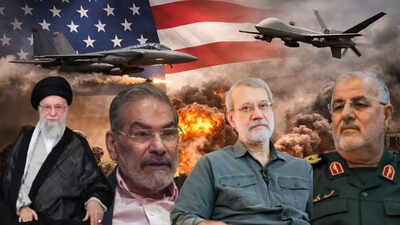
NEW DELHI: A series of US-Israeli strikes since February 28 has killed several of Iran’s most powerful political and military figures, dealing an unprecedented blow to the Islamic Republic’s leadership and intensifying a conflict that is now reverberating across the Middle East.The strikes, carried out during ongoing nuclear talks between Washington and Tehran mediated by Oman, mark the most significant direct assault on Iran in decades. They follow a prolonged shadow war and a 12-day conflict in June 2025, pushing the region into a new phase of instability that has disrupted energy markets and key shipping routes.At the centre of the upheaval is the killing of Iran’s Supreme Leader, Ayatollah Ali Khamenei, who died at the age of 86 in a U.S.-Israeli
air strike on his compound in Tehran on February 28. His death represents a historic rupture in Iran’s political system, where he had wielded ultimate authority since 1989.Khamenei’s rule was defined by a consolidation of power through Iran’s security institutions and a consistent posture of resistance towards the United States and Israel. Under his leadership, Iran expanded its regional influence through allied groups and strategic positioning, even as tensions over its nuclear programme repeatedly brought it into confrontation with Western powers.
The strikes also eliminated several senior officials closely tied to Iran’s decision-making apparatus. Among them was Ali Shamkhani, a key adviser to Khamenei and an influential figure in both security and nuclear policymaking, who was killed in the February 28 attacks on Tehran. Shamkhani, a former defence minister, had recently returned to a central role in wartime strategy after surviving an earlier attack during the June conflict.Ali Larijani, secretary of the Supreme National Security Council and a veteran political operator, was killed on March 17 in an air strike in the Pardis area of Tehran. Iranian media reported that his son and a deputy were also killed in the strike. Larijani, who had previously served as a Revolutionary Guards commander and nuclear negotiator, was regarded as a bridge between Iran and Western interlocutors and played a crucial role in shaping foreign and security policy.The military leadership has been equally affected, with multiple top commanders killed in what appears to have been a coordinated effort to dismantle Iran’s command structure. Mohammad Pakpour, commander-in-chief of the Islamic Revolutionary Guard Corps, was among those killed in the February 28 strikes. A veteran officer, he had risen to lead the Guards after his predecessor Hossein Salami was killed during the June war.Aziz Nasirzadeh, Iran’s defence minister and a senior air force officer, was also killed in the same wave of strikes targeting Tehran’s leadership. Known for his role in defence planning and military coordination, Nasirzadeh had previously served as air force commander and deputy chief of staff of the armed forces.Abdolrahim Mousavi, chief of staff of Iran’s armed forces, was killed during what Iranian media described as a high-level meeting of senior leadership in Tehran on February 28.
As a career army officer and former head of the regular army, Mousavi was responsible for overseeing coordination across Iran’s military branches.In a subsequent strike on March 17, Gholamreza Soleimani, commander of the Basij paramilitary force, was also killed. As head of the Basij, Soleimani oversaw a force central to Iran’s internal security and enforcement of state authority, particularly during periods of unrest.Beyond these high-profile figures, reports indicate that multiple senior commanders from the Revolutionary Guards, the regular army, and intelligence services were killed, particularly in the initial February 28 strike that targeted a gathering of Iran’s top leadership. The scale and precision of the attacks suggest a concerted attempt to decapitate Iran’s military and political hierarchy.The implications of these killings are far-reaching. The removal of both political heavyweights and senior military commanders in rapid succession has created a leadership vacuum at a critical moment, raising questions about succession, internal stability, and Iran’s ability to coordinate its response.The timing of the strikes during sensitive nuclear negotiations has further complicated diplomatic efforts. Oman-mediated talks between Washington and Tehran were already fragile, and the escalation is likely to harden positions on both sides, reducing the prospects for a near-term agreement.Regionally, the conflict has intensified volatility, with fears of wider escalation involving Iran’s network of allied groups across the Middle East.
Disruptions to shipping lanes and energy infrastructure have already had knock-on effects on global markets, underscoring the broader economic stakes of the crisis.For Iran, the loss of figures who shaped its strategic doctrine for decades represents not only an operational challenge but also a symbolic blow. The deaths of Khamenei and other senior leaders mark a turning point that could redefine the country’s political trajectory and its approach to both domestic governance and international engagement.As the situation continues to evolve, attention will focus on how Iran restructures its leadership and whether it opts for retaliation or recalibration in the face of one of the most severe challenges to its ruling establishment in recent history.


 English (US) ·