

 1 hour ago
6
1 hour ago
6
ARTICLE AD BOX
Varanasi Municipal Corporation's decision to relocate meat, fish and poultry shops to the city's outskirts has triggered debate over access and livelihoods in the temple city. Officials said it would promote cleanliness and spirituality, while residents argued that the move could reshape their diets.
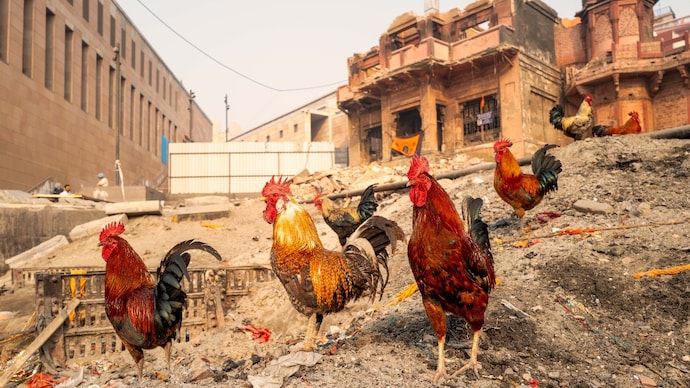
Roosters at the Manikarnika Ghat, Varanasi's biggest cremation site. The Uttar Pradesh city is known as a place for attaining moksha. (Image: Getty)
When Om Prakash Singh's family gathered last Sunday at their home in Varanasi's Sigra neighbourhood to celebrate a family occasion, the menu was exactly what one would expect at a traditional feast in eastern Uttar Pradesh. Fish, chicken, mutton, pork, and an assortment of other delicacies, veg and non-veg. But arranging that feast was not as easy as it used to be.
A member of the Thakur community, Singh grew up in a household where meat had always been a regular part of the diet. Chicken and mutton are typically cooked three times a week — on Wednesdays, Fridays and Sundays. "I would normally have picked up the meat from nearby Lallapura, barely a kilometre from my home near Sigra Stadium," said Singh. This time, however, "I had to travel across the Ganga, to Ramnagar". Buying meat, not just for the feast, but in general, was a quick errand. Now, to get different varieties of proteins, Singh needs planning.
The shops in Lallapura, where Singh had been a regular customer for decades, have already begun shutting down. All meat shops within the Varanasi Municipal Corporation (VMC) limits would be relocated to the city's outskirts over the next six months, said the city's Mayor, Ashok Tiwari.
Varanasi is not becoming a vegetarian city, but meat shops have been barred from operating within city limits. At present, Palitana in Gujarat remains the only town in the world that is strictly vegetarian. In Palitana, which houses several Jain shrines, sale and consumption of meat, even at homes, is strictly prohibited.
In Varanasi, Singh's struggle is increasingly becoming the norm for the city's residents, as it's moving ahead with a major civic decision of relocating meat, fish and poultry shops from the city's core to its outskirts.
Earlier this month, the VMC approved a plan to shift around 350 to 400 meat-related businesses in phases over the next six months. The shops will be moved to five designated localities outside the city — Ramnagar, Sujabad, Ganeshpur, Awaleshpur and Shivpur — with authorities hoping to complete the process before Diwali (in November this year).
Municipal officials say the objective is cleaner streets, better waste management and less congestion in one of India's most important temple towns. VMC's Public Relations Officer, Sandeep Srivastava, last week described the move as part of a broader effort to make Kashi more organised while preserving its cultural and spiritual character.
Varanasi, a city in Uttar Pradesh, is known for the Kashi Vishwanath temple and the ghats by the Ganga. Two of the ghats, Manikarnika and Harishchandra, are used for cremation. The city attracts devotees who believe it to be the site to attain moksha (liberation from the cycle of births and deaths).
Over the past decade, the city has undergone a dramatic transformation, with redeveloped ghats, widened roads around the Kashi Vishwanath Corridor, and major infrastructure projects designed to modernise one of the world's oldest continuously inhabited cities.
VARANASI, A CITY OF MANY COMMUNITIES, MANY FOOD TRADITIONS
While popular perception says that non-veg should be prohibited in Shiva's Kashi, Varanasi is also a city of many communities and food traditions.
While Kashi is often associated with vegetarianism because of its religious significance, the reality of everyday life is more diverse. Meat and fish remain part of the diet for significant sections of the population, including many Thakur families, Muslims and Bengalis, whose culinary traditions have long included fish, chicken and mutton.
Varanasi has historically been home to a sizeable Muslim population (including the weaver community). As a result, the relocation of meat, fish and poultry shops is likely to affect not just traders but also a substantial number of residents who regularly consume non-vegetarian food.
Two statisticians India Today Digital spoke to said determining exactly how many people from each community live within the city's municipal limits was difficult because the last Census was conducted in 2011. There is no recent community-wise or caste-wise population data available for the urban area, which is about 82 sq km compared to the Lok Sabha constituency's expanse of over 1,500 sq km, which includes over 1,200 villages.
However, according to projections based on subsequent fertility trends and urban growth patterns, these broad proportions have remained relatively stable into 2026, with Hindus forming the majority at roughly 68-72% and Muslims accounting for around 27-30%, while other communities make up the rest.
According to estimates from the 2014 general election, the Varanasi Lok Sabha constituency had 3 lakh Muslim voters among a total electorate of 14 lakh.
The city's Bengali community, though small and concentrated around localities such as Bangali Tola and Dashaswamedh, has for generations maintained a strong culture of fish-based cuisine.
WHAT ABOUT VARANASI'S LIQUOR, BHAANG OUTLETS, ASK RESIDENTS
The municipal corporation is not banning meat consumption, and these residents will still be able to purchase meat, fish and poultry, but from designated markets located on the city's periphery. The debate, therefore, is about access.
Ground reports by India Today Group's sister outlet UP Tak suggested a mixed reaction. Some residents supported the move, arguing that it could improve hygiene and reduce inconvenience during major religious festivals. Several others pointed out that routine purchases will now require significantly longer journeys.
A resident of Varanasi's Sundarpur, Saumya Singh, speaking to India Today Digital, questioned the rationale behind the move.
"Meat shops are being relocated, but what about liquor outlets and bhaang shops, which often create greater inconvenience, especially for women and foreign tourists? And what about the open consumption of marijuana in the name of Aghori traditions? Meat is consumed inside homes. The issues I've mentioned are visible in public spaces and, in my view, cause far more disruption than a plate of chicken korma or biryani," Singh told India Today Digital.
Mayor Tiwari did not respond to India Today Digital's queries over the meat ban within the city limits.
IS VARANASI GOING THE AYODHYA, HARIDWAR, TIRUPATI WAY?
The development in Varanasi has inevitably drawn comparisons with other religious cities in India.
Perhaps the most striking example is Palitana in Gujarat, often described as the world's first vegetarian city. Since 2014, the sale of meat, fish and eggs has been prohibited there because of its status as a major Jain pilgrimage centre and the centrality of ahimsa, or non-violence, to Jain belief.
Varanasi is not taking such a step. But the relocation of meat markets reflects a similar attempt to balance urban administration with the sensitivities of a sacred landscape centred on the Ganga and the Kashi Vishwanath temple.
Other pilgrimage towns have adopted their own versions of this balancing act. Haridwar has long restricted meat and liquor sales near important ghats and pilgrimage routes.
Andhra Pradesh's Tirupati enforces strict vegetarian norms around the Venkateswara temple precinct. Ayodhya, too, has imposed restrictions on the sale and delivery of non-vegetarian food within key zones around the Ram Temple.
In each case, authorities have sought to reconcile the needs of residents with the expectations of millions of visiting devotees.
But in the case of Varanasi, not everyone is convinced the transition will be seamless. Locals India Today Digital spoke to argued that greater consultation should have preceded such a significant shift. For now, however, adaptation appears to be underway.
Banarasiyas like Om Prakash Singh are adjusting to the new reality even before the move takes complete effect around Diwali. Saumya Singh argued that other issues in the city like sanitation, traffic congestion and overcrowding needed attention. She said that what people call "Banarasi alharpana" — a carefree, even reckless public culture — often leads to harassment and disorder. Meat consumption, in her view, is a private matter that causes no public harm.
Officials have promised that adequate facilities would be developed at the new sites and that consumers will continue to have access to certified meat products. Despite the new rule, Banaras is unlikely to lose its centuries-old ability to adapt and evolve.
- Ends
Published By:
Anand Singh
Published On:
Jun 25, 2026 10:08 IST






 English (US) ·