

 1 hour ago
2
1 hour ago
2
ARTICLE AD BOX
In weeks' time, India has changed the mood on trade deals. From being portrayed as a loser by Trump aide Howard Lutnick, New Delhi now seems to have the upper hand in India-US trade negotiations. It has finalised the India-EU FTA and will be hosting the Canadian PM in March. This after sealing an FTA with New Zealand.
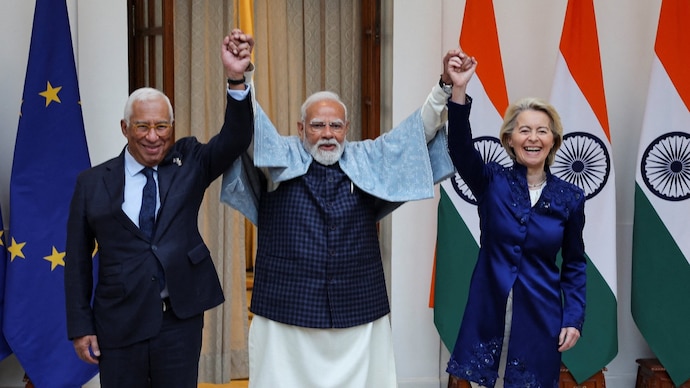
European Council President Antonio Costa (L), Prime Minister Narendra Modi, and European Commission President Ursula von der Leyen during their meeting at the Hyderabad House in New Delhi. (Image: Reuters)
India, a cricket-worshipping nation, knows this all too well. It ain't over till the last ball has been bowled. Matches can swing, and the trailing team can suddenly emerge victorious. The rules of the cricket field apply in many ways to diplomacy. That will be the takeaway from two weeks of January as an India, which was seen to have lost out in the US trade deal, suddenly swamps with good news on trade negotiations.
India and the European Union (EU) on Tuesday announced that negotiations on a free trade agreement (FTA) had been concluded. This comes after an FTA was finalised between India and New Zealand, which was one of the fastest-negotiated deals. Earlier, India inked trade deals with the UK and Oman.
The mood suddenly seems upbeat and is quite different from when Howard Lutnick, President Donald Trump's aide and US Commerce Secretary, faulted India for missing the opportunity in negotiating the trade deal with the US. Lutnick said India was given "three Fridays" to finalise the terms and all that was needed was Prime Minister Narendra Modi to call Trump, who closes all deals.
The opposition Congress too joined in to mock the Modi government.
"Hug hag na raha, post post na raha, kya se kya ho gaya bewafa tere dosti mein," Congress MP Jairam Ramesh posted on X, sharing Lutnick's comments.
Now, Trump might have played an unlikely catalyst for the India-EU FTA with his tariffs on India and threats to European countries, especially over the Greenland takeover issue.
"Donald Trump deserves some of the credit. Without his adventurism, his predilection for tariffs and his habit of alienating allies, the two big democracies might not have found the courage to strike a deal," posted The Economist.
However, India's Commerce and Industry Minister denied Trump even that credit, saying his tariffs weren't the "unifier".
| Trade Deal Partner | Signing Date | Negotiation Start Date | Time Taken to Finalise |
| UK | July 24, 2025 | January 2022 | 3.5 years |
| Oman | December 18, 2025 | November 2023 | 2 years and 1 month |
| New Zealand | December 22, 2025 | March 2025 (stalled in 2015, relaunched in 2025) | 9 months (post-relaunch) |
| European Union | January 27, 2026 | 2007 (relaunched 2022; accelerated 2025) | 3 years (post-relaunch) |
| US | No deal signed yet | February 2025 | Process underway |
Even though the EU-India FTA might not have been spurred by Trump or his tariffs and threats, the timing couldn't have been better.
"We have concluded the mother of all deals. We have created a free trade zone of two billion people, with both sides set to benefit," said Ursula von der Leyen, President of the EU Commission, in New Delhi on Tuesday. "This is only the beginning," she added.
The EU-India FTA has been branded the "Mother of all Deals" because it is the biggest-ever signed by any of the two sides and comprises 25% of the global GDP, and accounts for one third of international trade.
India was attacked as a slow mover by the US, but Goyal had in October said India does not do trade agreements in a hurry or with a "gun to our head".
India has concluded fast deals with partners that are accommodative. The India-New Zealand trade negotiations, after being stalled in 2015, began afresh in March 2025 and were concluded in December, a record time. Contrast this with India's trade talks with the US, which started in February 2025 and still hangs fire.
India has painstakingly negotiated trade deals keeping an eye on domestic sectors, especially agriculture and dairy. The deal with the EU came after 20 years. The one with the UK came after three years of discussions.
The India-UK Comprehensive Economic and Trade Agreement, signed in July 2025, provides duty-free access for 99% of Indian exports, particularly benefiting labour-intensive sectors like textiles, leather, and gems. In return, India reduced tariffs on British goods like Scotch whisky and automobiles.
In October 2025, the India-EFTA Trade and Economic Partnership Agreement (TEPA) came into force after ratification by Switzerland, Norway, Iceland, and Liechtenstein. The pact, signed in March, is historic for its "Investment Chapter", which includes a binding commitment from the EFTA nations to invest $100 billion in India over 15 years, aiming to create one million direct jobs.
Other than the FTA with New Zealand, India also inked a trade deal with Oman in December during PM Modi's visit to Muscat. The India-Oman Comprehensive Economic Partnership Agreement provides immediate zero-duty access for 98% of Indian goods, including agricultural products, exported to Oman.
There's more coming in the months ahead.
Canadian Prime Minister Mark Carney is likely to visit India in March, during which he is set to sign key deals on uranium, energy, minerals, artificial intelligence (AI), and education, according to Reuters.
Carney's visit comes as Canada seeks to diversify its trade relations after he took on the Trump administration at the World Economic Forum in Davos and spoke of building "coalitions to shape a fairer, more resilient world".
The flurry of deals, including the most significant EU-India FTA that allows over 99% of Indian exports preferential entry into European nations, give New Delhi an upper hand in its trade negotiations with the US.
That the EU-India FTA made the Trump administration go ballistic. "We have put 25% tariffs on India for buying Russian oil. Guess what happened last week? The Europeans signed a trade deal with India," said US Treasury Secretary Scott Bessent on the eve of the announcement of the EU-India FTA.
In a world where sentiments and mood determine markets and negotiations, India seems to have suddenly gained momentum in negotiations.
"I thought India was going to be first or early to have a great trade deal in place with the US post liberation day and it fell apart. A shame Europe beat us to this," wrote Jeremy Schwartz, Global Chief Investment Officer of WisdomTree Funds.
Experts agree New Delhi has created a trade leverage, especially with the FTA with the EU.
"India doesn't have to rely solely on China or the US. It just inked a deal impacting two billion people," Derek J Grossman, national security and Indo-Pacific analyst, said on X.
That's the beauty of diplomacy. Just like cricket, when one seems to be trailing, just a good over changes the game. Just weeks ago, the Indian government was being criticised, now it seems the trade winds are blowing in its favour.
- Ends
Published By:
Anand Singh
Published On:
Jan 28, 2026
Tune In


 English (US) ·