

 1 week ago
12
1 week ago
12
ARTICLE AD BOX
West Bengal CM Suvendu Adhikari announced the recruitment of more than 1,000 Gorkha youths into the Eastern Frontier Rifles, which Darjeeling MP Raju Bista said, was "killed by the Mamata Banerjee government". So, what is the Eastern Frontier Rifles? Why does it have a special place in the Gorkha community?
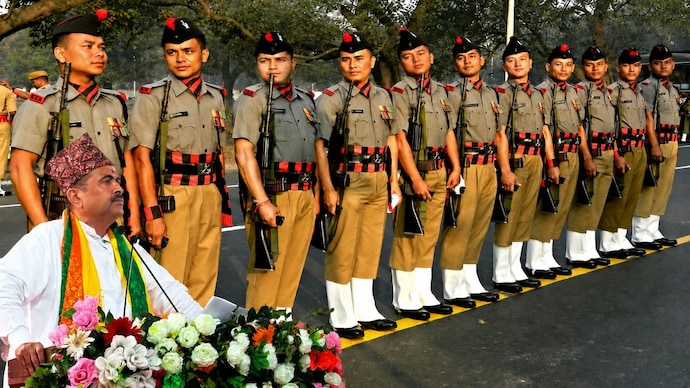
West Bengal CM Suvendu Adhikari announced that 1,000 youths will be recruited for the Eastern Frontier Rifles. (Image: EFR/Facebook)

New Delhi,UPDATED: Jun 17, 2026 14:50 IST
The Eastern Frontier Rifles (EFR), the crown jewel of the Darjeeling Hills' Gorkha community that served in the World Wars and the 1971 War against Pakistan, is set to be infused with fresh blood. Just weeks after the BJP's historic victory in West Bengal, Chief Minister Suvendu Adhikari has announced the recruitment of more than 1,000 Gorkha youths into the Eastern Frontier Rifles (EFR), which is a part of the West Bengal Police.
Adhikari's announcement, during his first visit to the Darjeeling hills, has political, historical and emotional importance in the North Bengal region, where the EFR is seen more than a force. The pre-Independence colonial-era force is associated with the Gorkha community.
The BJP, especially MP Raju Bista, had for years voiced for its revival. Bista in January alleged that then-Bengal CM "Mamata Banerjee killed it [EFR]". Now, after CM Adhikari's promise, Bista has framed the move as the revival of a force, which he said was neglected under Mamata's Trinamool Congress government.
The EFR has long occupied a unique place in the hills of northern Bengal. The specialised force that fought the Naxals, Chinese and Pakistanis, historically provided employment and status to generations of Gorkha families in Uttar Banga.
So, what exactly has Bengal CM Suvendu Adhikari said on the revival of the EFR? How is he going to do that? Why does the BJP claim Mamata Banerjee "killed the force"? And, most importantly, what's special about the EFR?
SUVENDU'S PROMISE TO REVIVE BENGAL'S GORKHA FORCE
The development surrounding the Eastern Frontier Rifles (EFR) comes weeks after the BJP formed the government in Bengal.
While addressing a gathering in West Bengal's Kurseong on Tuesday, Chief Minister Suvendu Adhikari announced the recruitment of more than 1,000 Gorkha youths into the EFR.
"In the coming months, 1,000 youths will be recruited into the Eastern Frontier Rifles, and 30 per cent of the jobs will go to women," the Bengal CM said.
The announcement was immediately welcomed by BJP leaders in the hills.
"Most grateful to Honourable Chief Minister Sh Suvendu ji for announcing the recruitment of over 1000 Gorkha youths in Eastern Frontier Rifles and West Bengal Police," BJP's Darjeeling MP Raju Bista wrote on X on Tuesday.
"For the past many years, I have been working to revive the EFR, but the TMC government repeatedly stopped the proposal," Bista added.
Referring to the BJP's election promise, Bista said, "Honourable CM Suvendu ji had assured me, as soon as the BJP forms the government, we will revive EFR. Today, he has made this historic announcement from Kurseong".
Incidentally, the Minister of the Department of Home and Hill Affairs in West Bengal is CM Suvendu Adhikari. He is assisted by Bishal Lama, who serves as his deputy in these two departments. He represents the Kalchini assembly constituency in northern Bengal's Alipurduar district.
BJP CLAIMS MAMATA BANERJEE KILLED EASTERN FRONTIER RIFLES
Unlike the demand for Gorkhaland, which has dominated headlines and political negotiations in northern Bengal, the future of the Eastern Frontier Rifles remained a quieter but significant political issue in the hills ahead of the 2026 Assembly elections.
In January 2026, Darjeeling BJP MP Raju Bista met representatives of the force and alleged that the then TMC government had neglected the institution.
"There has been no fresh recruitment conducted since 2010, despite over 2,000 Riflemen vacancies remaining unfilled," Bista wrote on X.
He further alleged, "Instead of modernising and strengthening this historic force, the Government of West Bengal has opted to merge three battalions into two". In January, calling the situation "deeply concerning", Bista alleged that the West Bengal Government was "trying to kill the force of such repute".
While the BJP said Mamata Banerjee government failed to protect institutions associated with the Gorkha community, the TMC consistently rejected the BJP accusations of neglecting the hills. It highlighted its own welfare and development initiatives in the region.
WHAT IS THE EASTERN FRONTIER RIFLES FORCE OF WEST BENGAL?
The Eastern Frontier Rifles traces its origins to a frontier protection force raised during the East India Company era. While its lineage stretches back to the 18th-century, it has carried the name Eastern Frontier Rifles since 1907.
The EFR is currently an armed unit under the West Bengal Police and is headquartered at Salua in West Midnapore's Kharagpur, far from the hills of northern Bengal.
Over the decades, the EFR has participated in several military and internal security operations. Its role during the First and Second World Wars, the 1962 India-China conflict, the 1965 India-Pakistan War, the 1971 Bangladesh Liberation War, and later anti-Naxalite and anti-Maoist operations, have been noted in various reports.
The force also shares a historical connection with what eventually became Bangladesh's paramilitary force, the Border Guards Bangladesh (BGB).
After the Partition in 1947, the EFR was divided between India and Pakistan. The Pakistani component later evolved into the East Pakistan Rifles and subsequently Bangladesh Rifles, now known as Border Guards Bangladesh, according to a 2021 report in The Darjeeling Chronicle, a pro-Gorkhaland media outlet.
HOW IS EFR LINKED TO GORKHAS?
The EFR has historically drawn heavily from the Gorkha community that inhabit the hills of northern Bengal.
Its insignia is the khukuri, the traditional Gorkha knife that remains a symbol of identity and military service of the community. Generations of youths from Darjeeling, Kalimpong and adjoining hill regions have served in the force. As a result, the EFR gradually became intertwined with the social and political aspirations of the hills.
The 2021 article in The Darjeeling Chronicle described the force as being "deeply associated with the sentiments of Gorkhas", arguing that its decline had become a matter of concern for many in the community. The article backed the demand that the EFR be converted into a Central Armed Police Force (CAPF), like the CRPF and the BSF.
For many families in the hills, service in the EFR carries prestige similar to recruitment into the Army, paramilitary forces and police services.
For people outside the hills of northern Bengal, Suvendu Adhikari's promise could look like a recruitment drive. But in Darjeeling, the EFR has a history, a memory and a sense of pride that runs deeper than government jobs. Rightly so, the BJP is betting that reviving the EFR and its legacy would strengthen its bond with the Gorkha community.
- Ends
Published By:
Sushim Mukul
Published On:
Jun 17, 2026 14:50 IST




 English (US) ·