

 49 minutes ago
1
49 minutes ago
1
ARTICLE AD BOX
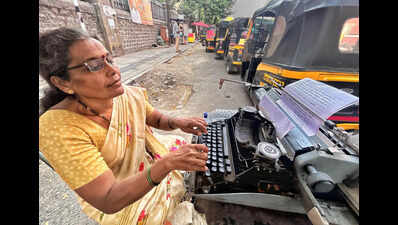
Nanda Doifode’s typewriter is largely silent these days after the use of computers increased. She was part of a thriving community of 20 to 25 typists working outside Shivajinagar Court in Pune. Now, on a good day, a single customer might stop by for a single page, leaving her with a meagre ₹50 a day.
Pune: Beneath the vibrant canopy of a street umbrella, amid the relentless honking of vehicles and the hurried footsteps of lawyers and litigants, 53-year-old Nanda Doifode’s fingers dance across the ink-stained, mechanical keys of an old typewriter—a rhythmic clack-clack-clack that echoes like a heartbeat from a bygone era.For 33 years, Nanda has been a fixture outside the Shivajinagar district court. Since 1993, she has translated the grievances, disputes, and hopes of thousands into official documents. But now, her typewriter is largely silent for days on end. She is in the digital age.“Since the use of computers has increased, the number of people coming for manual typing has decreased,” Nanda said with quiet resignation. In the 1990s, Nanda was part of a thriving community of 20 to 25 typists lining the pavement outside Shivajinagar court, delivering 40 to 50 neatly typed pages a day, earning ₹200 to ₹300.Now, she sits alone. Her peers have either retired, changed professions, or passed away. But even though she is the last typist in or around this court, she fiercely holds on to her craft, one keystroke at a time. On a good day, a single customer might stop by for a single page, paying her ₹50. That’s all the earnings for the day.Why not switch to a computer? “I never had the financial means to learn,” she said. While the world rapidly upgraded to sleek monitors, high-speed internet, and laser printers, the cost of training and hardware remained insurmountable for Nanda. She stayed with what she knew, and what she could afford: Her loyal, heavy iron Godrej typewriterThe machine needs servicing once a month. “It costs around Rs.
400. Currently, only one or two people in Pune can repair it,” Nanda said. She has a son and a daughter, both married, and her husband is an autorickshaw driver.The digital tide has taken over legal systems, transitioning courts into paperless ecosystems, and Nanda’s skills are no longer in demand. Yet, every morning, she sets up her makeshift workstation on the pavement.She carefully rolls a clean sheet of paper into the carriage, adjusts her glasses, and waits.
Even if it is just for that lone customer who prefers the typewriter over a digital printout, or someone who cannot afford the higher rates of a modern cyber café.For Nanda, the rhythm of the city has completely flipped. There was a time when the city moved with a gentle hum, while her life was frenetic. “ Now the city has grown hectic and my work is almost silent,” she said.She sees the cars, towering flyovers, and sleek Metro trains but remembers what Pune once was. “When I started here, there were only bicycles on the road. Two-wheelers and cars were rare. The streets belonged to cyclists. The city’s air was clean, and every place was green. Now, in this rush of motorised vehicles, bicycles are not visible, and neither is old Pune,” she said.






 English (US) ·