

 3 days ago
13
3 days ago
13
ARTICLE AD BOX
Last month, Liverpool legend Steven Gerrard requested Arne Slot, his club’s incumbent manager, to stop complaining about “low block”. The phrase has recurred in most of Slot’s deconstruction of his team’s travails this season and a title defence scattered askance. But Slot dwelled on the phrase again, and retorted: “I can only agree with him, that I speak a lot about low blocks, because we face a lot of low blocks.”
Gerrard’s contention was that teams defending deep in a compact shape is not a novel tactic. It has existed as long as the game itself, even though the phraseology has changed. From the blanket term “anti-football” to the more polished word of “catenaccio” and the gnomic “park the bus”, a term Jose Mourinho used rather derisively at an ultra-defensive Tottenham Hotspur in his earliest Chelsea avatar and which he himself later gloriously adopted to vivisect Barcelona’s tiki taka, defensive football has worn different garbs.
Each one, though, has its own nuances and uniqueness. Park the bus often connoted full-throttle and cynical defending with little intentions to attack. Catenaccio was tactically nuanced defending, wherein a libero roved behind the diamond-shaped back four to clean up any ball that seeped through the four-man wall. Low block refers to a narrow and compact shape when out of possession, stubbornly protecting the defensive third of the pitch, often occupying the space close to the goal, disrupting the build-up play, and blocking all possible paths to goal. Often, they line up in three clustered columns.
The back five sits the deepest, guarded by a midfield four and two attackers upfront. They don’t press, like Brighton under Roberto de Zerbi used to, but let the opponents keep possession and frustrate them by not letting them intrude to the box. The opponent forwards, thus, are forced to shoot far from, from tight angles and long distance, or cross into a crowded penalty area, both of which carry a relatively low probability of scoring.
A handful of teams have employed the tactic effectively. No team has mastered it like Sunderland, who have lost only one of their 13 games at home. Arsenal, Manchester City and Aston Villa have all returned from the Stadium of Light with points lost. Ironically, the low-block moaning Liverpool is the only team to have toppled them this season. But all they managed were three shots on goals, the winner eventually coming from a pugnacious header from Virgil van Dijk. The promoted side has gone off the boil away from home, but at their best they combined low-block defending with rapid counterattacks, orchestrated by their wide men. Brentford, who lie sixth, is another side that has masterfully embraced the tactic, even though the devotion is blind.
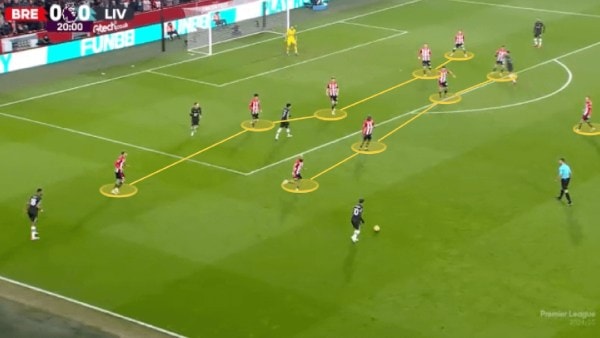 Low block refers to a narrow and compact shape when out of possession, stubbornly protecting the defensive third of the pitch, often occupying the space close to the goal, disrupting the build-up play, and blocking all possible paths to goal. (PL screengrab)
Keith Andrews’ side has been canny shapeshifters, and is able to press high and hard. It’s a growing fetish not just for mid-table dwellers or relegation warriors, but even clubs in the top tier occasionally resort to such methods. Mikel Arteta employed it against Manchester City after going down to 10 men last season; Pep Guardiola reciprocated it when they met this season. But it was an aberration, as no other team has played as high up the pitch than City this season.
Naturally, the tactics have a domino effect. The goals per game this season has dropped to 2.78, from last edition’s 2.93. It’s an alarmingly downward curve from 3.28 in the 23/24 season. A couple of low-goals seasons don’t invoke concern in isolation, but presented with other variables, the fear of football getting stale in England is justifiable. For instance, set-piece goals have seen a 31 percent increase (.8 a game this season), long throws to bypass congested defences, are back in vogue after fighting years of scorn from modern managers. Even Guardiola is viewing dribblers with glee. The January fetch, Antoine Semenyo, was the latest of proficient dribblers he has stacked his team with.
Story continues below this ad
Slot knows how to foil low blocks, except he doesn’t possess the personnel. “To create chances against a low block, you need pace, individual special moments to create an overload,” Slot said in January. “You don’t see a lot of 15-20-pass goals against low blocks. Another way is to create a counter-attack or win the ball high up the pitch when they want to bring the ball out from the back.”
It’s exactly how Aston Villa have been unlocking low-block defensive structures. They have belted 19 goals in such situations, a lot depending on the long-shooting prowess of Morgan Rogers. Long-rangers have allied Manchester United too this season, even though breaking down low-flung defences has proved tough for them. As the season enters the frenetic backend, with Arsenal, Villa, and City in a tantalising title race, low-block would have high stakes in the outcome, directly or indirectly.
Like with all tactics, it would be fascinating to watch the further evolution of long blocks, or whether it would, like many tactics, fade away and then bounce back again, like long sideburns and bell bottom trousers.








 English (US) ·