

 1 hour ago
7
1 hour ago
7
ARTICLE AD BOX
A shocking video from Uttar Pradesh's Lakhimpur Kheri shows a man clinging to a speeding car's bonnet after a dispute between taxi drivers.
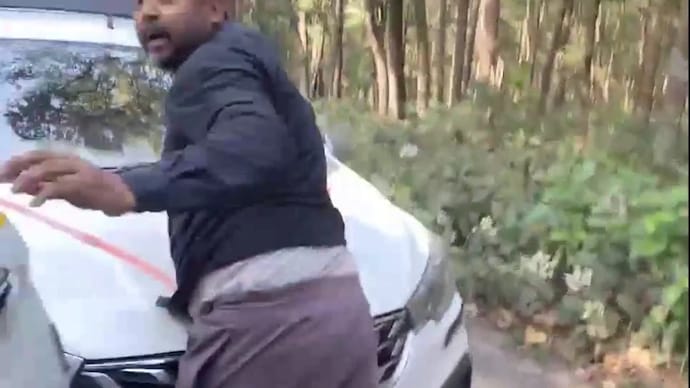
The car eventually spotted after dragging the man on bonnet for several kilometers.
Lakhimpur Kheri,UPDATED: Mar 28, 2026 22:05 IST
A taxi driver was seen hanging onto the bonnet of a moving car that was allegedly driven at speeds of up to 100 kmph for nearly four kilometers in Uttar Pradesh’s Lakhimpur Kheri district..
The incident occurred near the India-Nepal border, and its video has since gone viral on social media.
According to reports, the incident stemmed from a dispute between rival taxi operators active along the border. The argument reportedly broke out over picking up passengers. A taxi from Lucknow had arrived to take passengers when local drivers objected, claiming it was not allowed to operate there.
During the confrontation, a local taxi driver, identified as Rambaksh Gupta from Palia, climbed onto the bonnet of the Lucknow-registered taxi in an attempt to stop it from taking passengers.
However, the situation escalated when the driver of the Lucknow taxi allegedly sped away with Gupta still on the bonnet. In the viral video, the car can be seen moving at high speed while Gupta clings to the bonnet, holding onto the wipers to save himself.
Other local drivers chased the vehicle and eventually managed to stop it, rescuing Gupta safely.
Speaking about the incident, Gupta said that the car was driven at a very high speed for around four kilometres. He claimed he had to hold onto the wiper to avoid falling off.
Police have taken note of the viral video. Circle Officer (Palia) Jitendra Singh Parihar said that a case has been registered under relevant sections of the law, and further investigation is underway.
- Ends
Published On:
Mar 28, 2026 22:05 IST









 English (US) ·