

 1 hour ago
5
1 hour ago
5
ARTICLE AD BOX
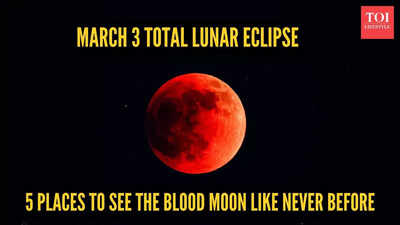
Here’s something exciting for everyone who loves looking at the sky! On March 3, 2026, the Moon will move completely into Earth’s shadow, making a total lunar eclipse. During this, the Moon will look deep red, which is why people call it a “blood moon.
” Just imagine looking up and seeing the moon glow like that. It is a sight you will not forget.The best places to see it will be Australia, the Pacific region, and western North America. If you are in India, you can still watch it live online or through astronomy apps. And the best part is that it is completely safe to watch. You do not need any special glasses like for a solar eclipse.
Why the Moon turns red
During a total lunar eclipse, Earth comes between the Sun and the Moon.
This blocks sunlight from directly reaching the Moon. The only light that gets through passes through Earth’s atmosphere. The atmosphere bends and filters this light, giving the Moon a reddish-orange glow. That is why people call it a blood moon.
How the best viewing spots are chosen
Experts look at historical cloud cover and light pollution maps to pick locations with the clearest skies. Weather forecasts are not very reliable so far in advance, so past averages for early March are used to find spots where the sky is usually clear.
According to Space(dot)com, this information comes from sources like Eclipsophile(dot)com and Time and Date, which provide data on historical cloud cover and open skies. Space(dot)com used this data to curate a list of locations around the world that give the best chance of seeing the blood moon clearly.
Top 5 spots around the world
Even though these are outside India, these locations are considered the best for seeing the full blood moon:
Grand Canyon National Park, USA
Totality: 4:04 am to 5:02 am MSTAverage cloud cover: 63%Open views from Mather Point, Hermit’s Rest, and Rim Trail make it ideal for watching the moon turn red.
Horsetooth Mountain Open Space, USA
Totality: 4:04 am to 5:02 am MSTAverage cloud cover: 60%A public stargazing event runs from 3:30 am to 5:30 am MST. It is organised by the Northern Colorado Astronomical Society and promoted by NASA.
Arkaroola Wilderness Sanctuary, Australia
Totality: 9:34 pm to 10:32 pm ACDTAverage cloud cover: 24%A remote and quiet location with dark skies and very few clouds. It is perfect for seeing the Moon turn deep red.
Warrumbungle Dark Sky Park, Australia
Totality: 10:04 pm to 11:02 pm AEDTAverage cloud cover: 45%Australia’s first Dark Sky Park, home to Siding Spring Observatory.
Its inland location gives clearer skies and an unforgettable view.
Saguaro National Park, USA
Located in the Sonoran Desert east of TucsonRecognised as the ninth Urban Night Sky Place in the world. Nearby observatories like Kitt Peak, Mount Graham, and Mount Lemmon make it a favourite for stargazers.
Tips for watching from India
The Moon may not show the full eclipse in India, but you can follow live streams or use astronomy apps to track it. Check the weather a few days before the event to make sure the skies are clear.
No glasses are needed. Binoculars can help you see more details on the Moon.This total lunar eclipse is rare and will not happen again anywhere on Earth until New Year’s Eve 2028 to 2029, according to Space(dot)com. Find a good spot, get comfortable, and enjoy one of the most beautiful sky events of the decade.Thumb image: Canva (for representative purposes only)







 English (US) ·