

 2 days ago
9
2 days ago
9
ARTICLE AD BOX
From anonymous hookups to open relationships beyond marriage, over 4.5 crore Indians, almost the population of Argentina, have explored a growing ecosystem of "secret" dating apps. A closer look reveals who use them, what they seek and how platforms monetise desire.
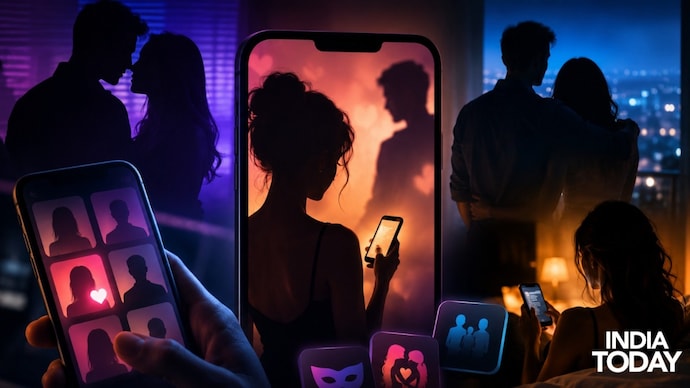
Over 4.5 crore Indians have joined or explored “secret” dating apps in the past five years, with more than 1.6 crore signing up in the last year alone. (AI-generated image)
In a time when even the most private confessions are willingly published on social media, there remains a layer of desire still considered “ignoble”, something many hesitate to acknowledge openly, but not so much to explore in silence.
Over 4.5 crore Indians have joined or explored “secret” dating apps in the past five years, with more than 1.6 crore signing up in the last year alone, a number that continues to rise. 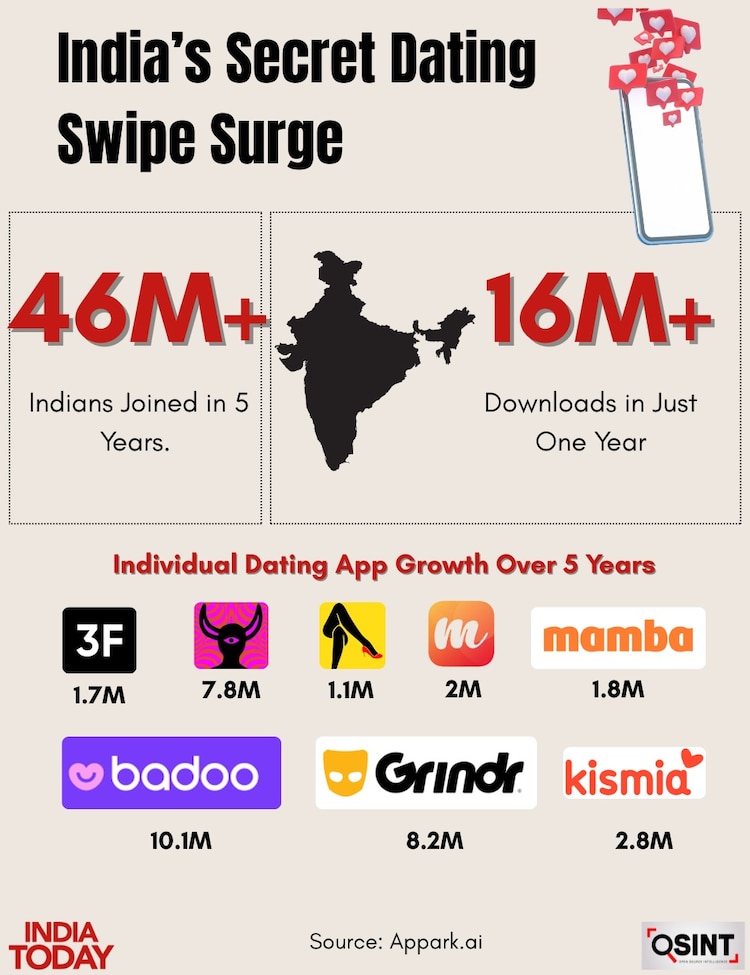
These are not dating apps in the conventional sense. By “secret dating apps”, we refer to platforms that openly market themselves as spaces for “anonymous dating”, “discreet hookups”, “open-minded connections”, and “relationships beyond marriage”, making them fundamentally different from mainstream dating apps aimed largely at singles.
Within this vast user base, a significant share appears to be married and seeking extramarital relationships. Some platforms cater specifically to gay dating, while others are used by married couples looking for a third partner.
To understand how this world operates, India Today’s Open Source Intelligence (OSINT) team scanned nearly 30 such apps, including mainstream platforms. We also created accounts on apps such as PURE, 3Way, and Nymph to examine who uses them, how platforms monetise intimacy, and what users encounter once inside.
MAINSTREAM VS "SECRET" DATING APPS
The Indian dating market appears to be undergoing a societal shift. What was once centred on compatibility, emotional support, reliance, and, at times, casual relationships largely among bachelors, is now increasingly intersecting with anonymity, intent-driven interactions and alternative relationship models. 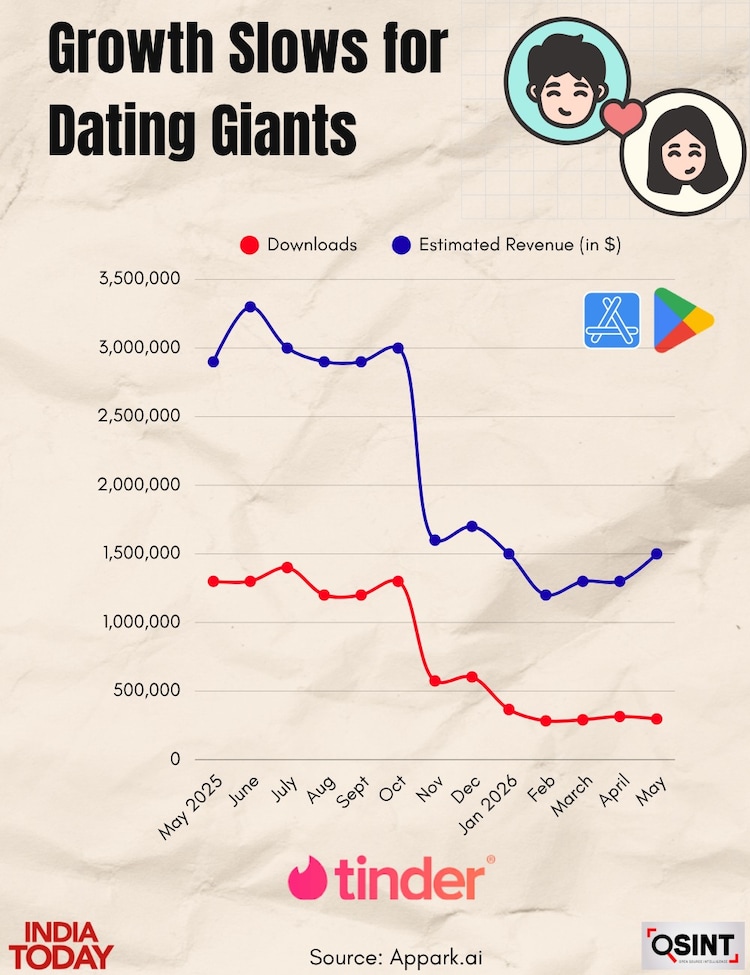
Married individuals, couples, and others are actively exploring connections in more discreet and anonymous ways. Platforms, also, have strategically tapped into user vulnerability and monetised human emotion, need, and desire with calculated precision.
Mainstream dating apps like Tinder and Bumble continue to command significant scale due to their early entry into the Indian market and large installed user base, but trend analysis indicates a decline in their download numbers over the past year.
In contrast, platforms often perceived as “secret” or niche – such as 3Fun: Open-Minded Dating App and 3Way: Couples & Singles Hookup – have recorded a steady upward trajectory in downloads during the same period.
The divergence becomes even more visible in monetisation patterns. PURE, a dating app that markets itself as a space for “curious creatives” to show up in their “most playful version,” encourages users to “be open with intentions,” “explore new thrilling experiences,” and “let passions run free.” In doing so, the platform appears to position itself within a more discreet, adult-leaning and boundary pushing segment of the dating ecosystem. 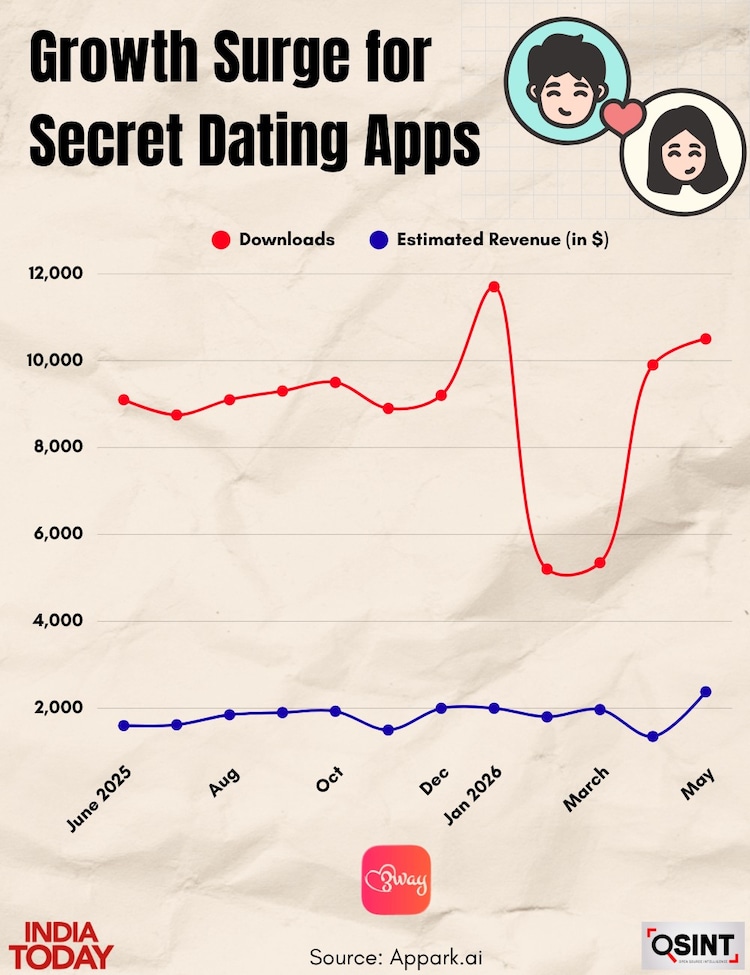
Interestingly, despite a decline in total downloads, PURE appears to have recorded a rise in revenue. The divergence between falling installs and increasing earnings suggests improving monetisation efficiency, likely driven by subscriptions, premium gating, or in-app purchases, indicating that a smaller but potentially higher spending user base may be generating greater value.
Further analysis and in-app testing conducted by our team indicate that paid access does not necessarily translate into user satisfaction.
WHO ARE THE USERS, WHAT ARE THEY LOOKING FOR?
The India Today team created accounts on five dating apps, including Tinder, PURE, 3Way, and Nymph to study user behaviour and examine how the underlying models vary.
For instance, PURE, which describes itself as “the best dating app for open-minded people,” our observations were striking. An account created with an anonymous female username and a random faceless display picture attracted over 500 likes (connection requests) within the first hour. The profiles appeared to belong to real individuals, with individuals’ pictures but often without original names, and represented varied backgrounds: married, employed, unemployed, bisexual, and self-described open-minded users.
We also tested how users responded to suggestive engagement and vulnerability cues. A significant number were willing to engage further, seeking relationships – from emotional to beyond, although married, some directly and others more cautiously. Several users voluntarily shared personal details such as their job, location, and marital status. Notably, a large proportion identified as married, with some openly expressing frustration within their marriages.
Tinder offered a clear contrast to the more discreet or “secret” dating apps we examined. Unlike these platforms, where anonymous usernames, faceless profiles, and immediate interaction were easily possible, Tinder’s facial verification requirement created a barrier to entry. Since we were unable to complete verification, our account could not move forward and was eventually shadow-banned. In comparison, the other apps were significantly easier to access, allowing accounts with minimal identity disclosure to quickly enter spaces where users openly discussed relationships, intimacy, and personal circumstances, often while remaining partially anonymous.
HOW THE APPS ARE "SELLING" DESIRE
Most of these apps offer limited free access, while meaningful interaction is locked behind tiered subscription plans. Users are notified that several profiles have liked them, but viewing or responding requires payment.
Our review analysis on one such platform, Nymph, reflects growing dissatisfaction among users. One user reported that despite a successful payment, the subscription was not activated, and customer support remained inaccessible due to repeated redirects and technical glitches. Another wrote that even days after purchasing premium access, no profiles were shown, with constant prompts to upgrade filters or reset preferences instead of delivering matches.
The pattern suggests a monetisation-heavy model where payment does not necessarily guarantee visibility or engagement. Yet, the contrast between mainstream and niche platforms lies not only in pricing, but also in expectations. On mainstream dating apps, the chances of immediately finding what one is looking for may be lower.
On similar but bolder niche platforms, however, it often appears more instantly available. While there is no guarantee users will ultimately find what they seek, the environment creates a strong perception that they are in the right place and more likely to encounter others seeking similar experiences.
- Ends
Published By:
bidisha saha
Published On:
Jun 9, 2026 18:52 IST







 English (US) ·