

 1 day ago
3
1 day ago
3
ARTICLE AD BOX
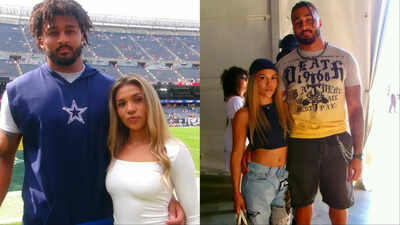
(Image via Instagram: Marshawn Kneeland and Catalina Mancera)
Marshawn Kneeland's family has some heartbreaking news to share, and they're doing it to help others. The former Dallas Cowboys defensive end, who died by suicide in November 2025 at just 24, has been posthumously diagnosed with stage 1 CTE (chronic traumatic encephalopathy).
Late Cowboys star Marshawn Kneeland's brain showed early-stage CTE
The diagnosis came from researchers at the Boston University CTE Center, after Kneeland's family donated his brain for study.
His girlfriend, Catalina Mancera, who was pregnant when he died and gave birth to their son last month, released a statement alongside the findings, saying the diagnosis doesn't undo the tragedy, but it does add context to what he may have been going through.
What the diagnosis actually means
CTE has four stages, and stage 1 is the mildest, but it's still serious.
Doctors say it can show up as headaches, mood swings, aggression, trouble concentrating, and depression. Dr. Ann McKee, the BU CTE Center's director, said she wasn't shocked by the finding. Her team has found the disease in nearly half of athletes under 30 they've studied after death, a stat that says a lot about the toll repeated head hits take, even without documented concussions.
Here's the bit that matters most, though: researchers were firm that CTE should not be treated as the cause of Kneeland's death.
Suicide, they said, is complex and shaped by many factors; a CTE diagnosis isn't a proven risk factor for it. Kneeland's family echoed that same message, saying they wanted to raise awareness about what NFL players and other contact-sport athletes might silently struggle with, rather than let his death define who he was.
One diagnosis, one family's mission: Marshawn Kneeland's legacy now extends beyond football
Kneeland was a second-round pick for the Cowboys in 2024, out of Western Michigan, and played 18 games across two NFL seasons before his death.
Records later showed his mental health struggles went back years as far as 2020 in college, when concerns about his well-being led to a hospitalisation. On the night he died, Kneeland was involved in a high-speed police chase in Frisco, Texas, reportedly reaching speeds over 145 mph, before crashing and fleeing on foot.
He was found hours later.His story has become part of a much bigger conversation the NFL keeps circling back to - better helmets, new kickoff rules, tighter concussion protocols but as Dr. Chris Nowinski of the Concussion & CTE Foundation pointed out, none of it seems to be slowing CTE rates down. Because CTE, unlike a single concussion, comes from repeated hits over years, the kind that are baked into the sport itself.









 English (US) ·