

 1 hour ago
5
1 hour ago
5
ARTICLE AD BOX
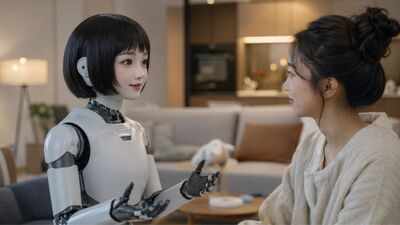
The idea of a humanoid robot in an ordinary home has often belonged to science fiction rather than everyday life. That distinction is beginning to blur as manufacturers move beyond warehouses and production lines in search of new customers.
Chinese robotics companies have spent years refining machines for industrial work, but attention is slowly shifting towards products designed to share living spaces with people instead of factory floors. UBTech's latest release reflects that wider change. Rather than concentrating on lifting, sorting or repetitive labour, the company has built a full-sized humanoid intended for conversation, companionship and long-term interaction inside the home. The launch signals another stage in China's expanding robotics industry, where advances in artificial intelligence, hardware design and manufacturing are making increasingly sophisticated personal robots commercially available.
China's UBTech introduces a humanoid companion for the home
Shenzhen-based UBTech has introduced the U1, a full-sized humanoid robot aimed at adults seeking an interactive companion rather than an industrial assistant. Unlike most existing humanoid machines, which are designed to complete repetitive tasks in controlled workplaces, the U1 has been developed with everyday household environments in mind.
According to South China Morning Post (SCMP), the robot is available in both male and female versions, measuring 183cm and 168cm respectively. Buyers can choose between Lite, Pro and Ultra models, with prices beginning at 119,800 yuan and reaching as high as 990,000 yuan for the premium version.Instead of presenting itself as another productivity tool, the U1 focuses on communication. It has been designed to maintain eye contact during conversations, respond naturally to users and spend extended periods interacting with people inside domestic settings.
Human-like design meets on-device artificial intelligence
A large part of the robot's identity comes from its appearance. UBTech has covered the U1 with silicone skin intended to create a more human-like exterior than the exposed mechanical designs commonly seen on industrial robots.SCMP reported, that inside the machine contains 88 servo joints that allow a broad range of movement. Its artificial intelligence runs locally on Rockchip's RK3588 processor, allowing many interactions to occur directly on the device rather than relying on remote cloud processing.The company has also emphasised privacy. User information remains stored on the robot itself rather than being routinely uploaded online, an approach that addresses growing concerns about personal data within connected home devices.
How UBTech engineered more natural human expressions
Creating movement was only part of the challenge. According to UBTech executives, reproducing believable facial expressions required a far more complicated engineering process than simply fitting motors into a humanoid body.Thousands of individual components are housed inside the robot's head, working together with artificial intelligence models that synchronise facial movements with spoken language. The objective was to avoid the mismatch that often makes humanoid robots appear unnatural when speaking.Engineers also faced the difficulty of fitting these complex systems into proportions similar to those of a human while maintaining reliable performance across large-scale production rather than isolated prototypes.
Why home environments pose a greater robotics challenge
The consumer market presents a very different set of demands from industrial robotics. Factory robots typically operate in predictable surroundings where layouts rarely change and safety zones are carefully controlled.Homes are far less structured. Furniture is moved, pets wander through rooms and family members of different ages create constantly changing conditions. A domestic robot therefore has to navigate spaces that are far less predictable while interacting safely with people over long periods.
China's robotics companies are widening their ambitions
Many of the world's leading humanoid robot developers continue to earn most of their business from industrial customers. Tesla's Optimus programme remains focused largely on manufacturing applications, while Figure AI has concentrated on warehouse work through enterprise partnerships.Chinese developers have followed a similar route. Firms including Unitree Robotics and AgiBot have prioritised industrial deployments while scaling up production capabilities.UBTech is attempting to maintain that industrial business while gradually opening a second market centred on consumers. The U1 represents one of the company's clearest moves towards personal robotics rather than workplace automation alone.









 English (US) ·