

 3 days ago
8
3 days ago
8
ARTICLE AD BOX
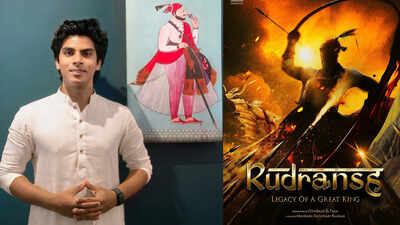
With his ambitious upcoming epic Rudransh: Legacy of a Great King entering production stage, Kolhapur-based director-producer Mandarr Kaadam represents a new wave of Indian filmmakers committed to research-led storytelling and long-term creative thinking.In an industry that increasingly rewards speed over substance, Mandarr Kaadam has chosen the opposite path. The filmmaker, who works under the names Mandar Kadam and Mandarr Kaadam, has spent the past five years preparing a single film- no teasers, no casting announcements, no first-look reveals. Just years of quiet research, screenplay refinement, and creative groundwork on what would become Rudransh: Legacy of a Great King.Now, with production finally beginning, Kaadam represents something larger than just one film - a small but significant shift in how a new generation of Indian filmmakers approaches historical cinema. "There is no shortcut to a story this big," Kaadam said in a recent conversation, adding, "If you are going to bring Chhatrapati Shivaji Maharaj and Chhatrapati Sambhaji Maharaj to life on screen, you have a responsibility to do it with all the seriousness their stories deserve.
Five years of research is the only way to tell this story honestly. We owe that to the history we are putting on screen, with evidence."That kind of patience, in an industry where historical films are routinely announced one year and released the next, is almost unheard of. It is also, in many ways, the defining characteristic of how Kaadam works.
A different approachUnlike many directors who move from film to film, Kaadam approaches cinema as a long-form creative project.
He founded his production banner OthBrok Production not as a vehicle for a single film, but as a studio with a defined visual identity, a long-term storytelling vision, and an editorial sensibility that runs across everything the company produces. This kind of studio-first thinking is rare in independent Indian cinema.
Most filmmakers begin with a single project. Kaadam began with the idea of building a creative house.“My idea was never to make one film. It was to build a place where a certain kind of film could be made. Rudransh is the first major statement of what OthBrok Production stands for. There will be more," he explained. His business background may explain part of that approach. Before entering filmmaking full-time, Kaadam spent several years in brand development. That experience, by his own account, shaped how he thinks about creative work today.
Ideas, he believes, are not just made. They are built, refined, sharpened, and presented to the public over time.The artist behind the directorKaadam's creative biography begins much earlier than cinema. He trained as a fine artist at R.S. Gosavi Kalaniketan Mahavidyalaya in Kolhapur, one of Maharashtra's well-regarded fine arts institutions. That foundation in painting, composition and visual design continues to shape how he constructs every frame.
Industry professionals familiar with his work say that influence is visible in everything from his shot composition to his attention to costume detail and set design. “You can always tell when a director comes from a fine arts background,” a Pune-based cinematographer noted, adding, “The reference images are different.
The colour palette is different. The way space is used inside a frame is different. With Mandarr, that is very visible.”That artistic background, combined with years in brand work, gives Kaadam an unusual creative profile. He is, simultaneously, a painter who thinks in pictures, a strategist who thinks in long arcs, and a filmmaker who thinks in stories.
Putting Kolhapur on the global cinema mapWhat makes Kaadam's positioning even more interesting is that he is operating from outside the traditional centres of Indian filmmaking.
Mumbai, Hyderabad, Chennai. These are the cities that dominate the Indian film industry. Kaadam has chosen to remain based in Kolhapur, building a creative studio out of Maharashtra's cultural heartland rather than relocating to the country's media capitals. That choice, he says, is deliberate.
“The stories I want to tell come from this part of India. The history, the language, the visual references, the cultural depth, all of it lives here.
I do not need to leave Kolhapur to tell these stories. If anything, staying here makes my work more honest.”That decision has implications beyond his own filmmaking. With Rudransh now positioning itself for a six-language pan-India release followed by a worldwide rollout in multiple international languages, the film carries the possibility of placing Kolhapur on the global cinema map in a way few recent Indian productions have attempted.A new generation of multi-hyphenate filmmakersKaadam belongs to a small but visibly growing group of Indian filmmakers who refuse to be confined to a single role. He is a director. A writer. A producer. An entrepreneur. And an artist. The combined identity is no longer unusual in the new generation of Indian cinema. But few have integrated those layers as visibly into a single project as Kaadam has done with Rudransh: Legacy of a Great King.
The film, scheduled to enter production shortly and target a theatrical release in late 2026 or early 2027, is being mounted as one of the most ambitious upcoming Indian historical features currently in development.
If the project lands the way Kaadam intends, it may not just succeed as a film. "It may shift how the next generation of Indian historical cinema is built. For now, the work continues quietly, the way it has for the past five years. Cast announcements, first-look material and additional creative team disclosures are expected to be released in the coming months," says Kaadam. Until then, Kaadam remains where he has always been: at his desk, in Kolhapur, finishing the work.






 English (US) ·