

 1 hour ago
6
1 hour ago
6
ARTICLE AD BOX
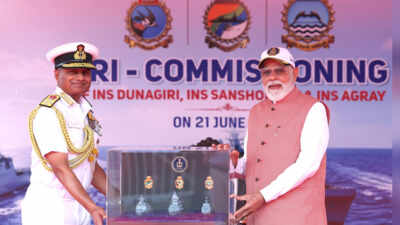
PM Narendra Modi commissioned three indigenous frontline naval platforms
NEW DELHI: In a landmark moment for India’s indigenous defence capability, PM Narendra Modi on Sunday commissioned three indigenous frontline naval platforms — advanced stealth frigate INS Dunagiri, a survey vessel (large) INS Sanshodhak, and an anti-submarine warfare shallow-water craft INS Agray — into the Indian Navy in Kolkata.
These state-of-the-art platforms will significantly enhance the nation’s operational capabilities, maritime security against geopolitical threats, and domain awareness.Addressing a gathering at the commissioning, PM Modi said, “The event represented an important milestone in the journey towards an Aatmanirbhar Bharat, a secure India and a developed India.” Congratulating the Indian Navy, scientists, engineers and workers, the PM said the achievement reflected India's growing technological and maritime capabilities.
“No nation can emerge as a major power without strong maritime capabilities.
Development, security and prosperity are closely linked to the oceans. Most of the world's trade moves through sea routes, while vast global data networks operate beneath the oceans”, he stated while emphasising the importance of maritime strength in the modern world. He further noted that critical minerals, deep-sea resources and future sources of energy will increasingly be connected to the maritime domain.
Therefore, he said, a nation's economic and strategic influence is directly linked to the strength of its maritime sector.Modi said India fully understands this reality and is preparing itself accordingly. “The commissioning of the three naval platforms stands as testimony to the country's growing capabilities and skills”, he said. Recalling the commissioning of INS Vikrant, he said that it had marked the beginning of a new chapter in India's maritime journey and announced India's growing naval strength to the world.
He said the journey from INS Vikrant to the commissioning of INS Agray, INS Dunagiri and INS Sanshodhak is not merely a story of new warships but also a reflection of India's increasing self-reliance.
“All three vessels symbolise India's commitment to indigenous design, manufacturing and innovation. Designed and built in India, the vessels showcase the talent of Indian industries, the expertise of Indian engineers and the hard work of Indian workers”, he added.“The strength of the nation's military cannot be measured by its dependence on global markets but by its ability to become self-reliant. India seeks to become a producer and a manufacturer, because nations that manufacture become decisive players on the global stage”, he added. He noted that more than 40 indigenously built warships and submarines have been inducted into the Indian Navy over the past few years. He remarked that nearly every few weeks, the Navy has received a new capability, while 45 major naval platforms are currently under construction.
These figures, he said, are not merely statistics but indicators of India's industrial capacity and future potential.PM on development in maritime sector:Underlining the immense employment-generating potential of the maritime sector, Modi said, “The govt views the maritime sector not as an isolated industry but as a major engine of employment and economic growth for a developed India. A modern ship requires large quantities of steel, electronics, machinery and thousands of components, creating opportunities across extensive industrial supply chains”.
Referring to the three commissioned vessels, he noted that more than 200 MSMEs contributed to their construction, generating substantial employment and economic activity across the country.The PM said the time has come for India to enter the next phase of maritime development, and the govt has adopted a new vision for the shipbuilding sector and has introduced several policy reforms in recent years to enhance domestic manufacturing capabilities.
“The Rs 70,000-crore incentive package announced for the shipping sector is not merely an economic measure but an investment in India's maritime future and industrial expansion.
Initiatives such as Sagarmala reflect this comprehensive vision and are helping reduce logistics costs, accelerate industrial growth and create new opportunities in coastal regions” he stated.
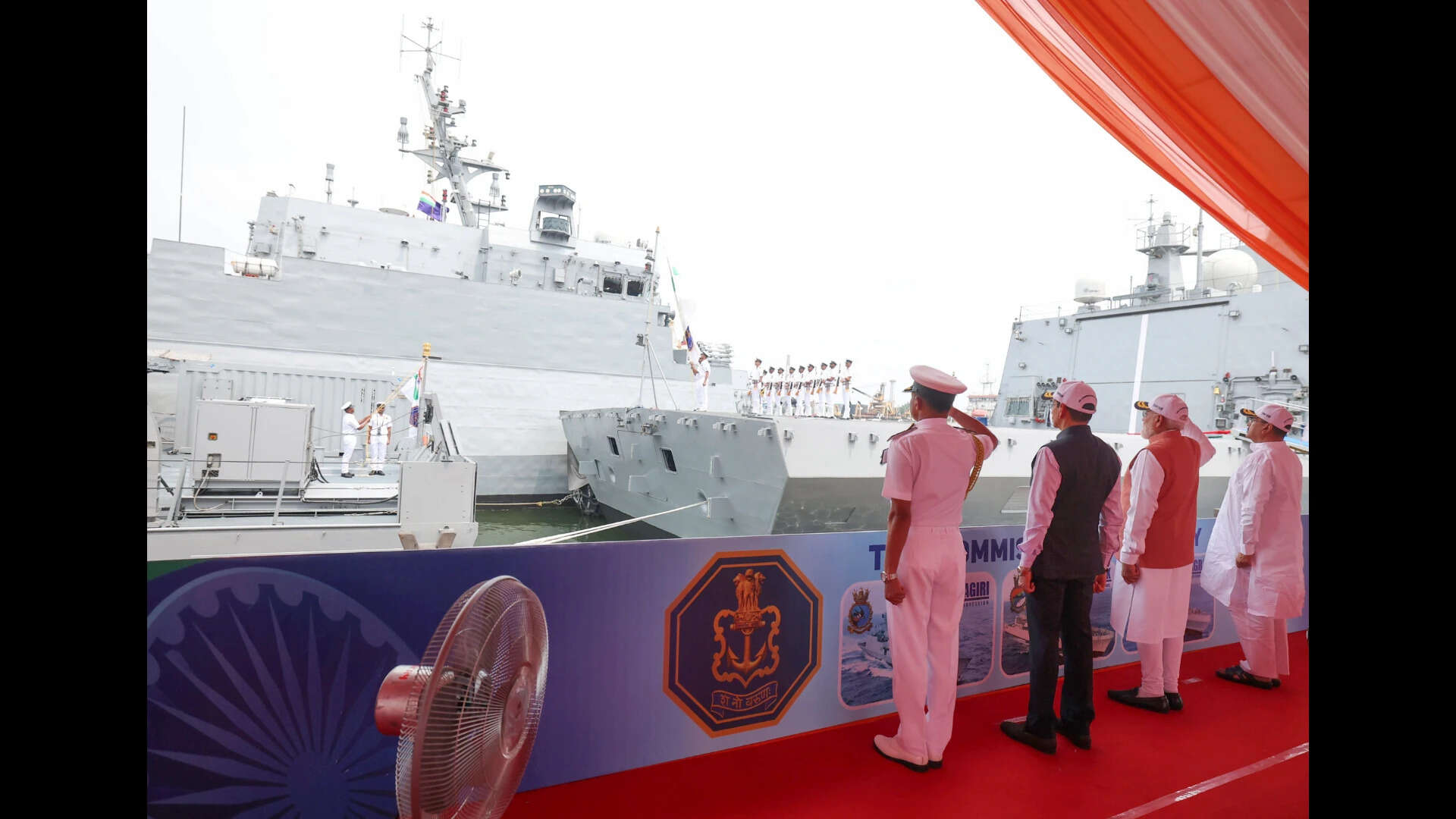
The PM also pointed out that June 21 is also observed globally as World Hydrography Day and described it as a remarkable coincidence that India's most advanced hydrographic survey vessel, INS Sanshodhak, is commissioned on the same day.He said the commissioning ceremony has coincided with the International Day of Yoga being celebrated across the world and expressed happiness at having the opportunity to visit the historic land of Bengal, which has played a pivotal role in shaping India's intellectual, cultural and national renaissance and has connected India with the world through maritime routes for centuries.Modi on self-reliance in defence manufacturing:Following the formation of his govt in 2014, Modi said a determined effort was made to change this situation through major policy reforms and a strong emphasis on self-reliance in defence manufacturing.
“These efforts have opened new opportunities in defence design, manufacturing and exports. While India's total defence production stood at around Rs 40,000 crore in 2014, it has now risen to nearly Rs 1.8 lakh crore, demonstrating the significant progress made towards building a strong, self-reliant and globally competitive defence industry”, he said.
Modi emphasised that the progress made over the past 12 years demonstrates how transformative change becomes possible when policies are clear, direction is correct, and all stakeholders work together with a shared commitment towards national development.The PM reiterated that India has always viewed the oceans as a medium for cooperation and connectivity. “Security is indispensable for protecting prosperity, while self-reliance is necessary for building the future. INS Agray, INS Dunagiri and INS Sanshodhak embody these very ideals and symbolize a nation that is increasingly aware of its capabilities, confident in its strengths and determined to move forward with renewed energy and purpose in the twenty-first century” he emphasised.In a post on X, defence minister Rajnath Singh described the tri-commissioning as a defining moment in India's maritime capability development. “These state-of-the-art platforms are a testament to our robust defence manufacturing ecosystem and our unwavering resolve towards Aatmanirbhar Bharat. They now stand ready to safeguard our national interests and ensure a secure Indian Ocean,” he wrote. West Bengal governor Shri RN Ravi, CM Suvendu Adhikari, Navy chief Admiral Krishna Swaminathan, other senior officers of the Indian Navy, and representatives of Garden Reach Shipbuilders & Engineers (GRSE), which built the ships, were among the dignitaries who attended the ceremony.Navy chief Admiral Swaminathan said this tri-commissioning in Kolkata, comes just 17 months after independent India’s first tri-commissioning in Mumbai, and shows that India's warship-building capability is gaining new speed in modern technology, self-reliance, and self-confidence. He added that these ships will greatly boost the Indian Navy’s capabilities and make its efforts to protect the nation's maritime interests much more powerful and effective.
The Navy chief said, “GRSE has long been a trusted partner of the Indian Navy in ensuring maritime security. On this occasion, I would like to congratulate the GRSE team. I would also like to congratulate our industry partners and MSMEs who have helped us achieve this success.”Builder of three ships: Garden Reach Shipbuilders & Engineers: Reinforcing its technological leadership, GRSE is the only PSU shipyard to receive the Defence Minister's Award for Excellence in the defence and aerospace sector for designing the most silent ship for anti-submarine warfare (ASW) operations for the Indian Navy.
From building 05-ton boats to 24,600-ton fleet tankers, GRSE has demonstrated unmatched versatility and established itself as a pioneer warship builder of the nation.
Since 1960, GRSE remains the only Indian shipyard to have delivered over 100 warships and is also the first Indian shipyard to have built a fleet replenishment tanker. Moreover, it is the first shipyard in independent India to build a seaward defence boat (SDB), the builder of the first-ever patrol vessel for the Indian Coast Guard, the first-ever indigenous survey vessel and the first Indian shipyard to export a warship — CGS Barracuda — to Seychelles.






 English (US) ·