

 1 day ago
8
1 day ago
8
ARTICLE AD BOX
Mumbai's Mrinaltai Gore flyover extension is like a metaphor for the city's collapsing infrastructure promises. It took eight years to build this wonder, and after multiple cost escalations and vigilance warnings, the ribbon-cutting shows one of BMC's most iconic works.
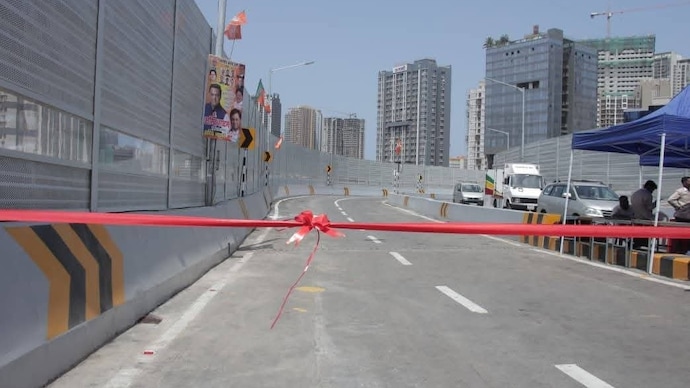
Mrinaltai Gore flyover extension took eight years and Rs 248 crore to build just 750 metres, roughly Rs 33 lakh per metre. (Image: X via We Work Foundation)
Mumbai,UPDATED: Jun 10, 2026 18:48 IST
It usually takes at least the first week of Mumbai's monsoon for roads to begin resembling a war documentary. Tyres disappear into potholes, asphalt peels away like old wallpaper, and motorists start memorising crater locations better than traffic signals. This year, however, Mumbai has managed something remarkable. In Goregaon, a flyover inaugurated on June 6 has beaten the rains to the job.
Barely days after its grand opening, the Rs 248-crore Mrinaltai Gore flyover extension is ageing like milk. In fact, its surface already has the texture of curdled milk.
I barely visit Goregaon, but after all the hullabaloo, I decided to. When I rode on my motorcycle across the bridge on the morning of June 9, the structure, built to ease modern urban mobility, already seemed as though it had survived several monsoons and a mild earthquake.
The flyover extension is fatigued, just like the daily commuters who brave Bengaluru's Whitefield-like traffic but refuse to admit 'cause "spirit of Mumbai" doesn't let them.
The road surface carried tyre marks embedded in the asphalt, possibly from the heavy earthmovers and trucks used to build it.
Near one stretch, a reporter from Lokmat Times parked his motorcycle only to watch its bike stand slowly sink into road, like it had been parked on sand.
This is the same project whose inauguration was celebrated with political pomp after years of delays and repeated deadline extensions.
And that is perhaps the reason behind the public anger. The flyover is a true symbol of Mumbai's back-to-back mega-project announcements, and a crumbling execution.
MRINALTAI GORE FLYOVER COST Rs 33 LAKH A METRE, EIGHT YEARS TO BUILD 750 METRES
The 750-metre extension, meant to improve east-west connectivity between Ram Mandir, SV Road, Link Road and the Western Express Highway corridor, was commissioned in 2018 and expected to be completed within two years. Instead, it dragged on for nearly eight years, with costs swelling from around Rs 170 crore to Rs 248 crore.
Within 24 hours of inauguration, videos of uneven surfaces, visible joints and patchwork began circulating online. Opposition quickly pounced on it.
Congress MP Varsha Gaikwad mocked the BMC's attempt at damage control, posting on X, "The official handle of @mybmc has posted an aerial shot of the Mrinal Tai Gore flyover extension rather than an on-ground close up shot. But even from this height, the shoddy work, the uneven surface is quite visible. Shame!"
Social activist and commentator Zoru Bhathena, in his classic style, said, "What are they celebrating? That they were able to complete it after taking 8 years? Normal people would hang their head in shame. But. My BMC. They are celebrating their own incompetence."
The most politically loaded criticism came from NCP-SP spokesperson Anish Gawande, who tied the controversy to the legacy of the woman after whom the bridge is named.
"The flyover is named after the iconic Mrinal Tai Gore, who spent her whole life fighting so ordinary Mumbaikars got a life of dignity. After seven years, three cost revisions, and a daily penalty on the contractor — this is all they could come up with to honour her?" Gawande said.
"But kya karein. This is the standard now under the triple-engine sarkar. Cut the ribbon. Click the photo. Leave the potholes for us. Bajao taali," the NCP-SP leader said.
MRINALTAI WAS ONE OF THE FIERCEST GRASSROOTS VOICES IN MAHARASHTRA POLITICS
The invocation of Mrinaltai Gore's name is significant because she was not merely another politician to have infrastructure named after her. The veteran socialist leader, remembered as "Paniwali Bai" built her reputation by fighting for basic civic rights in suburban Mumbai, especially water access in Goregaon.
A former corporator and MLA, she became one of Maharashtra's fiercest grassroots voices for workers, women, Dalits, tribals and the urban poor.
Senior journalist Dhaval Kulkarni also reminded people on X that it was protests led by socialist corporators like Mrinaltai Gore, George Fernandes and Shobhnath Singh that pushed the BMC to replace English with Marathi as its official language decades ago.
That legacy now sits awkwardly atop a flyover facing allegations of shoddy execution.
The BMC, meanwhile, has defended the structure. In a clarification posted online, the civic body said the visible joints were "part of the technical construction process". According to the Bridges Department, the mastic asphalt used can initially appear rough and patchy, especially where manual work is involved, but supposedly evens out as vehicles begin using the road.
That explanation, however, has struggled to convince critics, especially after reports emerged that BMC's own vigilance department had flagged potential structural issues years ago.
According to an internal vigilance report prepared in June 2021, officials had already warned about the possibility of cracks developing on the road surface after opening. The report, which has resurfaced amid the controversy, also pointed to multiple concerns in the project’s execution.
NOT THE FIRST TIME MUMBAI HAS SEEN SHODDY INFRASTRUCTURE WORK
Opposition leaders are now demanding independent quality audits. Shiv Sena (UBT) leader Kishori Pednekar has called for third-party inspections, including Core Tests, UPV Tests and Rebound Hammer Tests to examine the quality of concrete and road layers.
Yet, perhaps the most frustrating part for Mumbaikars is how familiar this entire episode feels.
Just earlier this year, a newly built Rs 100-crore double-decker flyover in Mira-Bhayandar sparked public outrage after its four-lane stretch suddenly narrowed into two lanes.
Two years ago, the Gokhale bridge and the CD Barfiwala flyover became infamous because their heights and alignments did not properly match.
Even the Atal Setu, India's longest sea bridge and among the country's biggest prestige infrastructure projects, made headlines over patchwork repairs shortly after opening.
Across the harbour in Navi Mumbai, roads on a newly built flyover in Turbhe (next to ibis Hotel), did not survive even a single monsoon cycle.
Ribbons were cut with much pomp and show for all these projects. Even clean drone shots were uploaded by the authorities. But the ground reality has always been different.
At the Mrinaltai Gore flyover extension, motorists have no other option but to use the bridge because, in Mumbai, people rarely have the luxury of waiting for perfection.
Usually, Mumbai's roads wait for rain before collapsing into headlines. Seems like this flyover had a fast local to catch.
- Ends
Published By:
Anand Singh
Published On:
Jun 10, 2026 18:48 IST


 English (US) ·