

 1 hour ago
4
1 hour ago
4
ARTICLE AD BOX
A group of educationists and activists under the People's Alliance for the Fundamental Right to Education has objected to the textbook's title, Krishna, arguing that naming school materials after Hindu deities reflects an attempt to introduce religious and mythological framing into education.
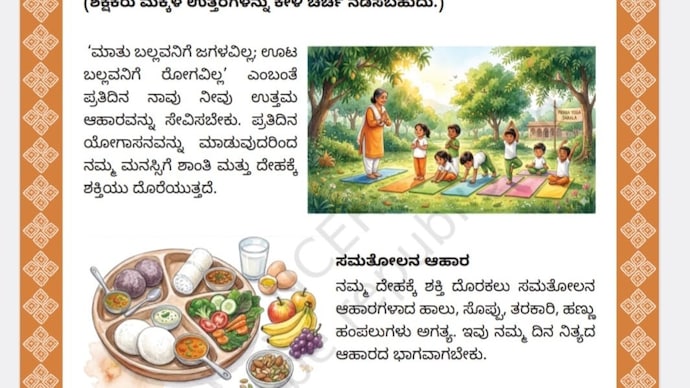
Karnataka textbook Krishna is at the centre of a lot of controversies

UPDATED: Jun 25, 2026 08:18 IST
The NCERT Class six Kannada third-language textbook titled Krishna has sparked a controversy in Karnataka, with educationists, writers and activists accusing it of promoting saffronisation, mythology-based framing and a biased portrayal of dietary practices.
A collective of educationists and activists under the People’s Alliance for the Fundamental Right to Education has objected to the textbook’s title, Krishna, arguing that naming school materials after Hindu deities reflects an attempt to introduce religious and mythological framing into education.
They allege this is part of a broader ideological shift under NEP-linked curriculum reforms.
Educationist Niranjanaradhya VP said the emphasis on Indian Knowledge Heritage amounts to saffronisation, adding that Karnataka’s educational identity should instead reflect thinkers such as Pampa, Kuvempu, Karanth and Basavanna.
Another major concern raised relates to a lesson titled ‘Health is Wealth,’ which describes a balanced diet as including milk, greens, fruits, vegetables and nuts. Critics argue that the absence of references to eggs, fish and meat promotes a vegetarian-centric view, ignoring the dietary habits of large sections of Karnataka’s population.
The issue has emerged alongside the rollout of the three-language policy under the National Education Policy (NEP) 2020 and the National Curriculum Framework for School Education (NCF-SE) 2023. The same Kannada R3 textbook, introduced for Class 6 CBSE students from the 2026–27 academic year, is also expected to be used for Class 9 students.
Activists have also alleged that the textbook fails to represent Karnataka’s regional diversity, saying that folklore, literature and cultural contexts from coastal Karnataka, north Karnataka, Malnad and old Mysore regions are missing. They further claim the content lacks age-appropriate stories, activities and illustrations for Class 6 students.
The group has questioned the involvement of CBSE in prescribing the same textbook for both Class 6 and Class 9, and criticised the alleged bypassing of Karnataka’s DSERT in its preparation.
Among their demands are the withdrawal of the current textbook, replacement with existing Kannada texts such as Savi Kannada, Siri Kannada and Tili Kannada, and revision of the diet chapter to include non-vegetarian food items. They have also demanded a change in the textbook title to better reflect Karnataka’s cultural identity.
Writer SG Siddaramaiah has also criticised the textbook, calling for withdrawal of the lesson and alleging attempts to impose a political narrative through curriculum content. Activists say education should reflect pluralism and regional diversity rather than a single ideological framework.
The textbook is part of the phased implementation of the NEP-linked curriculum in CBSE schools from the 2026–27 academic year.
- Ends
Published By:
Akash Chatterjee
Published On:
Jun 25, 2026 08:18 IST






 English (US) ·