

 1 hour ago
3
1 hour ago
3
ARTICLE AD BOX
Kottayam and Sikar are challenging India's traditional coaching strongholds. An India Today OSINT analysis of NEET UG 2024 results and Google Places data reveals a striking shift in where top medical aspirants are emerging from.
For years, Kota has been seen as the default destination for aspirants preparing for competitive examinations like JEE and NEET. Home to a vast coaching ecosystem and purpose-built student infrastructure, the city has long enjoyed the reputation of being India’s ‘coaching capital’, serving as the go-to hub for lakhs of students chasing a seat in a top engineering or medical college despite its well-documented flaws.
But that long-standing dominance now appears to be facing a challenge from other centres with dedicated coaching clusters for NEET-like examinations. Among them are Rajasthan’s Sikar and Kerala’s Kottayam, both emerging as strong alternatives and that too with flying colours. 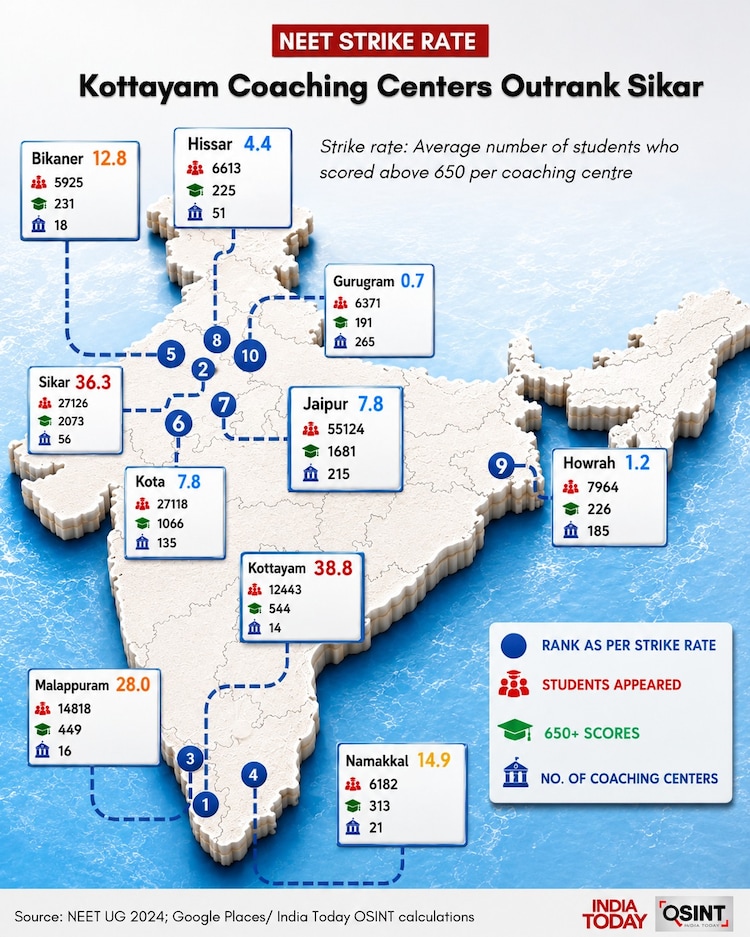
While Sikar outperformed centres like Kota in the proportion of students scoring above 650 in NEET UG 2024, Kottayam emerged as the strongest performer on a per-coaching centre basis, recording the highest average number of 650-plus scorers per centre.
India Today’s Open Source Intelligence team analysed NEET UG 2024 results alongside Google Places data to assess how major coaching hubs performed in cities with large pools of medical aspirants and established NEET and IIT-JEE training clusters.
The year 2024 was chosen as the benchmark for this analysis because city-wise candidate-level performance data for subsequent years is not publicly available. The release of such granular data in 2024 was an exception, made possible following an order by the Supreme Court.
The top 10 cities were selected based on their strike rate, calculated as the percentage of students scoring above 650 marks out of the total number of candidates who appeared for NEET UG 2024 in each city.
To add further context, we also compared the number of coaching centres in the select top 10 cities with the number of students scoring above 650 marks. This helped estimate the average number of top scorers produced per coaching institute.
A score of 650+ was used as the benchmark, as it is widely considered to improve the chances of securing admission to a government medical college.
The contrast is striking. Sikar emerged as the best-performing city in terms of strike rate, with 2,073 students scoring above 650 marks in NEET UG 2024 out of 27,216 aspirants. That means nearly 7.6 per cent of candidates crossed the benchmark, significantly ahead of Kota, which recorded 1,066 top scorers from a comparable pool of 27,118 students despite having a much larger coaching ecosystem of at least 135 centres.
However, strike rate alone does not tell the full story. When measured by the average number of top scorers produced per coaching institute, Kerala’s Kottayam outperformed even Sikar.
With just 14 publicly listed coaching institutes, Kottayam produced 544 students scoring above 650, translating to an average of 38.8 high scorers per institute, marginally higher than Sikar’s 36.3. This suggests that while Sikar leads in overall student performance, Kottayam’s coaching ecosystem appears more efficient on a per-centre basis.
The changing geography of NEET success
The analysis suggests that having a higher number of coaching institutes does not automatically translate into better NEET outcomes. Cities with relatively fewer institutes, such as Sikar (56), Kottayam (14), and Malappuram (16), recorded significantly higher strike rates and better averages than larger coaching hubs like Kota (135), Jaipur (215), Howrah (185), and Gurugram (265), suggesting that scale alone does not guarantee stronger performance.
Kerala’s coaching hubs stand out. Kottayam recorded one of the strongest strike rates at 6.4 per cent and the highest per institute average at 38.8, producing 544 students scoring above 650 marks from at least 14 institutes. Malappuram, meanwhile, posted a strike rate of 5.7 per cent and an average of 28.0, with 449 top scorers across at least 16 institutes. Together, the two cities accounted for over 27,000 NEET UG 2024 aspirants, pointing to smaller but tightly focused coaching ecosystems, possibly supported by Kerala’s strong academic culture and school education system.
Sikar’s performance reinforces the broader trend that a smaller coaching ecosystem does not necessarily mean weaker outcomes. Despite having just 56 institutes, the city recorded the country’s highest strike rate at 7.6 per cent and the second highest per institute average at 36.3, suggesting a concentrated but highly effective coaching model.
Yet, Sikar’s growing prominence this year has not been driven by results alone. Investigators traced a NEET UG 2026 guess paper containing questions similar to those asked in the exam to an MBBS student from Sikar studying in Kerala. According to Rajasthan’s Special Operations Group (SOG), the material was allegedly circulated among students in Sikar before reaching Jaipur and nearby areas ahead of the May 3 exam.
Back in the broader numbers, Kota presents a scale versus efficiency story. Despite being widely regarded as India’s coaching capital and hosting at least 135 coaching institutes, the city produced 1,066 students scoring above 650 marks out of 27,118 aspirants, translating to a strike rate of 3.9 per cent, nearly half of Sikar’s. Kota also recorded an average of just 7.8 toppers per institute in 2024. While the city remains a major producer of top scorers in absolute numbers, its lower strike rate and per institute average may reflect market saturation, where a larger number of institutes compete for students across varying performance levels.
Tamil Nadu’s Namakkal, with 313 students scoring above 650 marks from at least 21 institutes, recorded a strike rate of 4.3 per cent and an average of 14.9 toppers per institute. Rajasthan’s Bikaner, meanwhile, produced 231 top scorers through at least 18 institutes, translating to a strike rate of 4.8 per cent and an average of 12.8, with both cities outperforming larger coaching hubs on a per coaching centre basis.
Jaipur, despite producing 1,681 students scoring above 650 marks from a much larger pool of 55,124 aspirants, recorded a strike rate of 3.0 per cent and matched Kota’s average of 7.8 due to its far larger coaching footprint of at least 215 institutes.
At the other end, Howrah coaching centres recorded a strike rate of 1.6 per cent, with 226 top scorers across 185 institutes, resulting in an average of just 1.2 per institute. Gurugram performed weakest among major coaching hubs, producing 191 top scorers through at least 265 institutes, translating to a strike rate of 1.4 per cent and an average of only 0.7.
- Ends
Published By:
bidisha saha
Published On:
May 15, 2026 19:51 IST









 English (US) ·