

 1 hour ago
5
1 hour ago
5
ARTICLE AD BOX
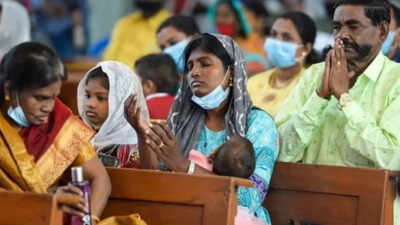
Dalit Christians in Kerala face discrimination despite converting, losing constitutional protections while caste prejudice persists (Photo credits: AFP)
Dalit Christians carry the burden of caste without the protection of the law. The JB Koshy Commission report says the state owes them moreLove or caste?” In May 2018, that was the question Sneha Susan posted on social media, reeling from the brutal killing of Kevin P Joseph, a 23-year-old dalit Christian from Kottayam, murdered for loving a Catholic woman.
For many, it was a shocking crime. For Sneha, it felt disturbingly familiar. Kevin’s death was not just an isolated act of violence. It exposed a deeper, quieter fault line, one that continues to shape the lives of dalit Christians in Kerala.Despite sharing a history of structural oppression with other scheduled castes, scheduled caste converts to Christianity (SCCC) occupy a precarious space. The moment they convert, they lose constitutional protections, even as castebased discrimination continues to define their social reality.
They are marooned between two worlds: Marked as “dalit” by society but largely ignored by the system that ties legal protections to religion rather than lived reality.The JB Koshy Commission report, submitted in 2023 and released last month, officially acknowledges this contradiction. It notes that dalit Christians in Kerala often fare worse socio-economically than the scheduled castes who have not converted.
It also identifies a “reconversion paradox”: State benefits are restored if individuals return to Hinduism; an implicit admission that caste identity persists beyond religious change.
Denying support based on faith, the commission argues, amounts to administrative injustice.The recommendations gain added significance in light of a recent Supreme Court ruling that persons professing religions other than Hinduism, Sikhism or Buddhism cannot be recognized as Scheduled Castes.
The court reaffirmed that conversion results in the loss of SC status, a position consistent with existing law.Justice (retd) JB Koshy noted that the commission received numerous representations from dalit Christians detailing their continued social disadvantage. “As long as this is the law, nothing can change unless it is amended. Our recommendation to the state was clear: Their social condition has not improved, and support must reflect that reality.
The state already offers some concessions, but these are insufficient.
It can either be increased, or benefits specific to them can be provided. It is up to the govt to take a call on that,” he said.The long-withheld report was finally released on Feb 28, 2026, just weeks before the state assembly elections were declared—a timing widely seen as politically calculated to appeal to sections of the Christian electorate.
Regardless of intent, its publication has pushed into the spotlight one of Kerala’s most under-addressed social justice questions, giving overdue visibility to a community long overlooked in political discourse.“I only thought of myself as a Christian,” Sneha recalls. That changed in Class VIII, when a teacher asked students receiving govt grants to stand up and went on to say that in the past, they couldn’t sit with others on benches, and had to study by sitting on the floor, while explaining why.
“I felt bad. I went home and asked about it more,” she says. Awareness soon turned into withdrawal. Sneha began concealing her identity, dropping “Christian-Cheramar” in favour of simply “Christian.
” Even when she heard disparaging remarks about her caste, she stayed silent. It took years, and exposure beyond her immediate surroundings, to reclaim that identity. Today, as an MSW graduate, she speaks of that journey as one of unlearning shame.
“Now, I say it with pride,” she says.Yet the structures that produced that silence remain intact.Dalit Christians are not outside the Church—they are embedded within it, across denominations: Syrian Christian, Mar Thoma, Latin and others. But belonging does not translate into equality. Marriage remains one of the clearest markers of this divide. Inter-community unions, even within the same denomination, are rare and often fraught.
According to Sneha, such alliances tend to occur under constraint, when men from dominant Christian communities fail to find matches within their own circles.Even when marriages do happen, they carry social costs. Families anticipate discrimination; some are gradually excluded from their daughter’s life. “There are cases where the bride’s family never visits the groom’s house after the wedding. In one instance, the groom’s family attended their baby’s naming ceremony early in the morning so they could leave before the feast,” she said.
“There are marriages that work,” Sneha says, “but often only when the couple moves abroad or when the bride is fair and financially stable.
”If discrimination is pervasive, collective resistance remains weak. George Pallithara, president of the Dalit Catholic Mahajana Sabha (DCMS) in the Trivandrum Latin diocese, points to fragmentation as a key obstacle. Dalit Christians are spread across denominations, like Orthodox, Jacobite and Mar Thoma Churches, with little coordination between them.
“Even within the Catholic fold, DCMS is active only in a handful of dioceses,” he said.
The coordination between these DCMS units is also not very good,” said Pallithara.This fragmentation has consequences. “Despite a significant presence in dioceses such as Vijayapuram, Neyyattinkara and Punalur, there has never been a dalit Christian bishop from Kerala. The absence of leadership at that level weakens the community’s negotiating power,” Pallithara said.
Caught between categories, they often miss out on both sides, excluded from scheduled caste benefits and unable to fully access advantages extended to other backward groups within Christian communities.For activist T M Sathyan, the issue is as much about state policy as it is about social discrimination. He sees the Koshy Commission’s most meaningful recommendation as the call for a detailed, data-driven study.
“It is the responsibility of the state to uplift communities through reservation,” he says. “The Church cannot do that.”He points to stark disparities: Families surviving on extremely low incomes, limited access to education quotas, and negligible employment reservation under the OEC category. Even the small share available in education is divided among multiple groups, further reducing access.“At least one percent reservation exclusively for dalit Christians could have made a real difference,” he said.Echoing the demand for state intervention, Fr Thomas Tharayil, deputy secretary general of the KCBC, says the report’s release, though delayed, must now translate into policy. “The backwardness stems from caste, and changing one’s faith does not solve it,” he said. “When someone converts, they receive support from their new religious community—but that alone cannot change their social situation. It is not right to make the Church solely responsible for that.
Govt support is essential and the Church has its limitations.”Beyond policy, there is also a psychological cost. Sneha, who now works with Student Christian Movement of India, says many young people from the community display confidence within familiar spaces—parish events, community gatherings—but retreat in mixed environments. Economic pressures deepen this challenge. Many students enter the workforce early to support their families, often at the expense of higher education and long-term mobility.
Efforts are underway within the community to address this—to build confidence, encourage participation, and expand opportunities. But progress is uneven.For Kevin’s father, Joseph, the debate is not abstract. Years after his son’s murder, the grief remains immediate. The courts have convicted most of the accused, but the family continues to pursue justice against those acquitted. “It was caste hatred,” he says. For the dalit Christian community, Kevin’s death remains the most violent expression of a deeper, quieter exclusion they endure every day.






 English (US) ·