

 1 hour ago
5
1 hour ago
5
ARTICLE AD BOX
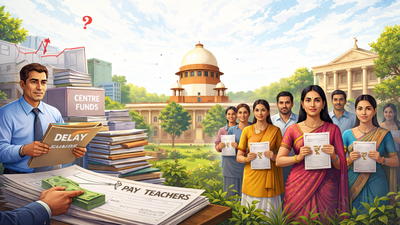
The Supreme Court said states must pay RTE-linked instructors on time, even if the Centre’s share is delayed, and recover funds later. Image: AI generated
For more than a decade, thousands of 'part-time' instructors in Uttar Pradesh’s upper primary schools have lived inside a familiar Indian paradox: The State’s schooling promise grows louder, but the people asked to deliver it are kept on a wage that barely moves.
Many were appointed around 2013–14 under the then Sarva Shiksha Abhiyan (now subsumed into Samagra Shiksha), paid a fixed honorarium of Rs 7,000 a month, and bound by a condition that they could not take another job.This week, the Supreme Court cut through the paperwork and the blame-shifting too. In a remarkable judgement, it held that a State cannot justify low or withheld honorarium by citing the Centre’s failure to release funds.
The Court invoked Section 7(5) of the Right to Education (RTE) Act, which places an overriding responsibility on State governments to provide funds for implementation and underlined a clear remedy: Pay first, recover later.
The case: A decade-long ‘temporary’ job that never ended
The dispute traces back to a 2013 Government Order through which Uttar Pradesh decided to appoint contractual instructors for upper primary schools (Classes VI–VIII) to teach physical education, art education and work education at a fixed honorarium of Rs 7,000 per month.
The appointments were made through an advertisement issued in February 2013, and teachers were engaged on 11-month contracts, renewed year after year.
The Apex Court has noted a critical clause in these contracts: Instructors were prohibited from taking up any other full-time or part-time employment.In real terms, this meant a worker described as “part-time” could be locked into a single income stream, however low, with no lawful way to supplement it.
A set of writ petitions reached the Allahabad High Court. A Single Judge directed payment of Rs 17,000 per month from March 2017, but the High Court’s Division Bench later limited that entitlement to 2017–18 alone.Both sides appealed. Instructors argued the hike could not be cut off, and the State argued it should not be made to shoulder the cost if the Centre did not pay its share.
What the Supreme Court ordered
The State has been told to stop treating this as a funding debate and start treating it as a payroll obligation:
- Instructors are entitled to Rs 17,000 per month honorarium from 2017–18 onwards (until revised by the PAB).
- Uttar Pradesh must start paying Rs 17,000 per month from 1 April 2026.
- Arrears must be cleared within six months, and the State may recover the Centre’s contribution later.
- The Court also emphasised that honorarium cannot remain stagnant and should be revised periodically, pointing to PAB’s role as the key authority for such decisions.
The money trail: From Rs 7,000 to approvals, then back again
The judgement pins down the timeline that governments prefer to blur.
- In 2016–17, the State proposed an increase to Rs 15,000, but the national Project Approval Board (PAB) sanctioned Rs 8,470 for March 2016 to February 2017.
- In 2017–18, the State proposed Rs 17,000, which the PAB approved on 27 March 2017; the Additional Chief Secretary (Basic Education) also recorded that UP accepted the proposal for 2017–18.
- Yet, the ground reality diverged from the approvals. The honorarium was later reviewed downward within the State machinery, and the Court records that teachers were effectively pushed back to the earlier low level, with Rs 7,000 continuing again from 2019–20 onwards.
This pattern — official acceptance, administrative retreat, and financial inertia — is what the Supreme Court called out as arbitrary.
The legal pivot: Section 7(5) and 'pay and recover'
Uttar Pradesh argued that under Samagra Shiksha’s funding pattern, the burden is shared (commonly 60:40 Centre-State), and the State should not be forced to bear the Centre’s unpaid share. The Supreme Court’s response is anchored in the RTE Act itself.Section 7 does provide for shared responsibilities, but Section 7(5) explicitly makes the State government responsible to provide funds for implementation, taking into account central assistance and “its other resources”.
From that, the Court’s reasoning follows a governance logic: Inter-government accounting cannot become a reason to keep classrooms running on delayed or depressed pay. If the Centre’s share is pending, the State is free to pursue recovery — but it cannot pass the cost of that delay to the instructor standing in front of students.
'Part-time' in name, full-time in effect
The judgement makes a larger point that will resonate far beyond Uttar Pradesh: Governments often use labels — contractual, temporary, part-time — as a management strategy, even when the work is continuous and essential.
Here, the Court held that once the original 11-month contract periods expired and renewals stopped being properly executed, these instructors could not be treated as contractual indefinitely.
More importantly, the “part-time” tag collapses when the contract itself bans outside work. The Supreme Court went further, concluding that sustained engagement over a decade, in a scheme that requires one instructor per 100 students, gives the work a permanent character.The implication of the judgement is hard to miss here: You cannot run core school functions on rolling “temporary” labour for ten years and still pretend the post is not real.
Article 23 and the word the Court used: Begar
The Supreme Court judgement refused to treat this as a small payroll irritation. It looked at the arrangement as a whole: Instructors kept on a flat honorarium year after year, described as “part-time”, but told they cannot take any other job. When you put those facts together, the question stops being administrative and starts being constitutional.That is why the Court used the word ‘begar’ in its judgement. In plain terms, begar is forced labour—work extracted through compulsion, whether by threat, pressure, or by keeping the worker in a corner where refusal is not a real option. Article 23 bans begar and other forms of forced labour precisely because the Constitution does not accept “consent” that is manufactured by power imbalance.So when the Court said paying Rs 7,000 per month, fixed back in 2013–14, amounted to begar and an unfair practice under Article 23, it was not reaching for flourish.
It was saying: you could not run public schooling on an arrangement where the State controlled the worker’s options and then paid a wage that barely acknowledged the work. Budget constraints may explain delays. They do not sanitise exploitation.
A right can’t run on exploitation
In every Indian home, there is a moment when a child looks up mid-homework and asks a simple question: “Will my teacher come tomorrow?” We answer it with faith, because schools run on faith as much as on timetables.
But faith cannot be a substitute for wages. The Supreme Court’s judgement is a reminder that a rights-based education system cannot be built on the quiet depletion of the people who hold it up. When governments argue over shares and sanctions, it is the instructor who pays first—through delayed honorarium, shrinking choices, and a life kept on hold.
Section 7(5) puts the burden where it belongs: with the State that runs the school. And the Court’s use of begar under Article 23 lifts the issue beyond files and funding into the realm of dignity. When education is a right, the workforce cannot be an afterthought or an underpaid compromise.Read the full Supreme Court order here.





 English (US) ·