

 1 hour ago
4
1 hour ago
4
ARTICLE AD BOX
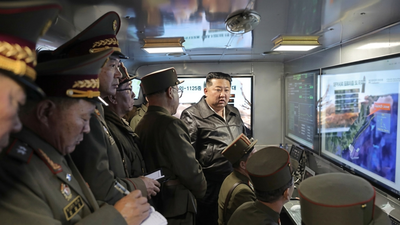
North Korea has test-fired upgraded tactical ballistic missiles equipped with cluster warheads to refine the striking power of its short-range arsenal, ANI reported, citing state-run Korean Central News Agency (KCNA).The launches, conducted on Sunday under Kim Jong Un’s supervision, come amid a series of recent weapons tests, including ballistic missiles, anti-ship cruise missiles, and cluster munitions, and reflect a long history of such test-firings in the region. Kim “expressed great satisfaction over the test results,” KCNA reported, adding that the development of diverse cluster bomb warheads could “boost high-density strike capability to neutralise specific target areas” while also improving precision.According to KCNA, five “Hwasongpho-11 Ra” surface-to-surface missiles were launched during the drills, striking a target about 136 km away, which is well within the reach of Seoul. The missiles struck an area of 12.5 to 13 hectares with “very high density, fully displaying their combat might.”While Pyongyang described the launches as land-based, authorities in Japan and South Korea said the projectiles were fired from the Sinpo region.
Seoul indicated the coastal location raises the possibility that the missiles were submarine-launched.“Our military detected several short-range ballistic missiles fired into the East Sea from the Sinpo area of North Korea at around 6:10 am (2110 GMT),” South Korea’s Joint Chiefs of Staff said, referring to waters also known as the Sea of Japan.The missiles travelled roughly 140 km, with South Korean and US intelligence agencies conducting further analysis of their specifications.
Seoul said it is maintaining a “firm combined defence posture” with the United States and warned it would “respond overwhelmingly to any provocation.” South Korea’s presidential office convened an emergency security meeting following the launches.The test aimed to verify the performance of cluster bomb and fragmentation mine warheads fitted on the missiles. It follows an earlier test this month of a Hwasongpho-11 Ka missile carrying a similar payload, underscoring North Korea’s ongoing efforts to refine short-range delivery systems using submunitions.
Analysts say the tests may also signal Pyongyang’s continued rejection of Seoul’s attempts to repair strained ties.
What is a cluster warhead?
A cluster warhead is a payload that opens mid-air, dispersing dozens of smaller submunitions, or “bomblets,” across a wide area. These are designed to target personnel, vehicles, or infrastructure, enhancing what KCNA described as “high-density strike capability.”According to KCNA, recent tests showed such systems could affect targets across an area of up to seven hectares.Cluster munitions can be delivered by aircraft or ground-based systems. However, a significant proportion of bomblets fail to detonate on impact, leaving behind unexploded ordnance that can remain dangerous long after a conflict ends. Failure rates are estimated to range from 2% to over 40%.Their use remains highly controversial. North Korea is not a signatory to the Convention on Cluster Munitions, which prohibits the use, production, and stockpiling of such weapons due to their humanitarian impact.
Why is North Korea testing them?
Once deployed, cluster warheads release multiple submunitions that are extremely difficult to intercept individually. Even if missile defence systems detect the main missile, the dispersed bomblets significantly complicate interception—raising the stakes by increasing the likelihood of widespread damage across a larger area.Separately, Reuters reported last week that North Korea tested electromagnetic weapons, carbon-fibre bombs, and a mobile short-range air defence system—highlighting efforts to modernise its arsenal and enhance capabilities for what it calls “modern warfare.”A KCNA report said the country also tested a mobile short-range anti-aircraft missile system and assessed the combat effectiveness of its tactical ballistic missile warheads. One such test showed that a Hwasongpho-11 Ka missile equipped with a cluster warhead could strike targets across a seven-hectare area.






 English (US) ·