

 1 hour ago
5
1 hour ago
5
ARTICLE AD BOX
Last Updated:July 13, 2026, 14:35 IST
Decades of bad blood, the Hand of God, and Beckham's red card: Argentina and England meet again in a historic World Cup semi-final. This storied rivalry awaits its new protagonist.


News18
Argentina and England meet again, this time in a World Cup semi-final, on Wednesday in Atlanta. While a FIFA World Cup knockout clash to send England to only their second final, or Argentina to a second-consecutive summit game, hardly requires any context, there’s a glut of it anyway.
The fixture carries six decades of history that few rivalries can match.
England lead the head-to-head three wins to one across five previous World Cup meetings, with a solitary draw at France 1998, which Argentina eventually won on penalties. The start, in 1962, was rather innocuous, with second-half goals from Bobby Charlton and Jimmy Greaves giving England a 3-1 win in the group stage.
The edge appeared four years later, when Geoff Hurst’s late goal settled a bad-tempered 1966 quarter-final that saw Argentina captain Antonio Rattin sent off for two offences in as many minutes — not before he threatened to punch the referee. Later, English manager Alf Ramsey branded the Argentine players ‘animals’, ordering his fullback George Cohen not to swap his shirt ‘with that animal.’
“Tackling is fine," Cohen said. “But it was some of the snidey things, the spitting and pulling the short hairs on your neck, pulling your ear. They were trying to intimidate us. The trouble was when they found out they weren’t going to get their way, they fell into some of the worst excesses I’ve ever seen. I just consider it the greatest shame that they didn’t play the game they were capable of. We might even have got beaten but they just should have got on and shown what they could do."
In another example of how times have changed, Argentinian players accused the referees of favoring England and even threw chairs at the opposite dressing room. One can suspect the entirely opposite of it will happen were Lionel Messi to get away with a foul this time.
Anyway, Argentina had their reply twenty years on, Diego Maradona scoring twice in a 2-1 win at Mexico 1986 that Gary Lineker’s late goal could not undo.
The two would meet again at France 1998, where a 2-2 draw in Saint-Etienne, shared between Gabriel Batistuta, Alan Shearer, Michael Owen, and Javier Zanetti, went to penalties that Argentina won 4-3, and then again in 2002, where a David Beckham penalty settled it 1-0 for England.
Bad blood
But what elevates this fixture beyond any scoreline is something close to what the India-Pakistan rivalry represents in cricket, a contest in which the result has often mattered less than the history and pride riding on it. Matches between the two are rare given the geography, yet each one carries weight disproportionate to its frequency, because football here has never been separate from politics.
English and Argentine referees are barred to this day from officiating each other’s matches, an unsaid rule that stems directly from the Falklands conflict, a British Overseas Territory that Argentina claims as the Islas Malvinas.
Tensions erupted into the 1982 Falklands War after Argentina invaded the islands on April 2. The 74-day conflict ended with Britain regaining control, but Argentina has continued to claim sovereignty ever since, leaving the issue a sensitive diplomatic flashpoint.
At the 2026 World Cup, this meant England’s Michael Oliver and Anthony Taylor, and Argentina’s Facundo Tello, could not be appointed to the other nation’s fixtures at any stage.
Hand of God
Nowhere is that residue more visible than in the 1986 quarter-final in Mexico City, played four years after the war and still the defining chapter of this rivalry. In the 51st minute, Maradona punched the ball past goalkeeper Peter Shilton, a goal Tunisian referee Ali Bin Nasser allowed to stand.
Maradona later described it, half in jest, as scored a little with the head of Maradona and a little with the hand of God, the remark that gave the goal its name. Four minutes on, he scored what was later voted the greatest goal in World Cup history, gliding past five England players before beating Shilton again.
Argentina won 2-1 and went on to lift the trophy. Back home, the victory was read as revenge, not only for 1966 but for the war itself, and Maradona would later say it felt like beating a country rather than a football team. Even though there’s now a video of Maradona being friendly with Harry Kane going viral, don’t be surprised if some of this bad blood spills over in the USA.
‘The’ red
The rivalry’s next flashpoint needed no war to explain it. In the 1998 last-16 tie, early in the second half at 2-2, David Beckham was fouled by now Atletico Madrid coach Diego Simeone, then kicked out at the Argentine as both lay on the ground. Referee Kim Milton Nielsen showed him a straight red card, and England, reduced to ten men, held out through extra time before losing the shootout.
Beckham was made a national scapegoat for months afterward, an ordeal he has since called one of the hardest periods of his career. He found redemption four years later, scoring the winning penalty against Argentina at the 2002 World Cup, and went on to captain England.
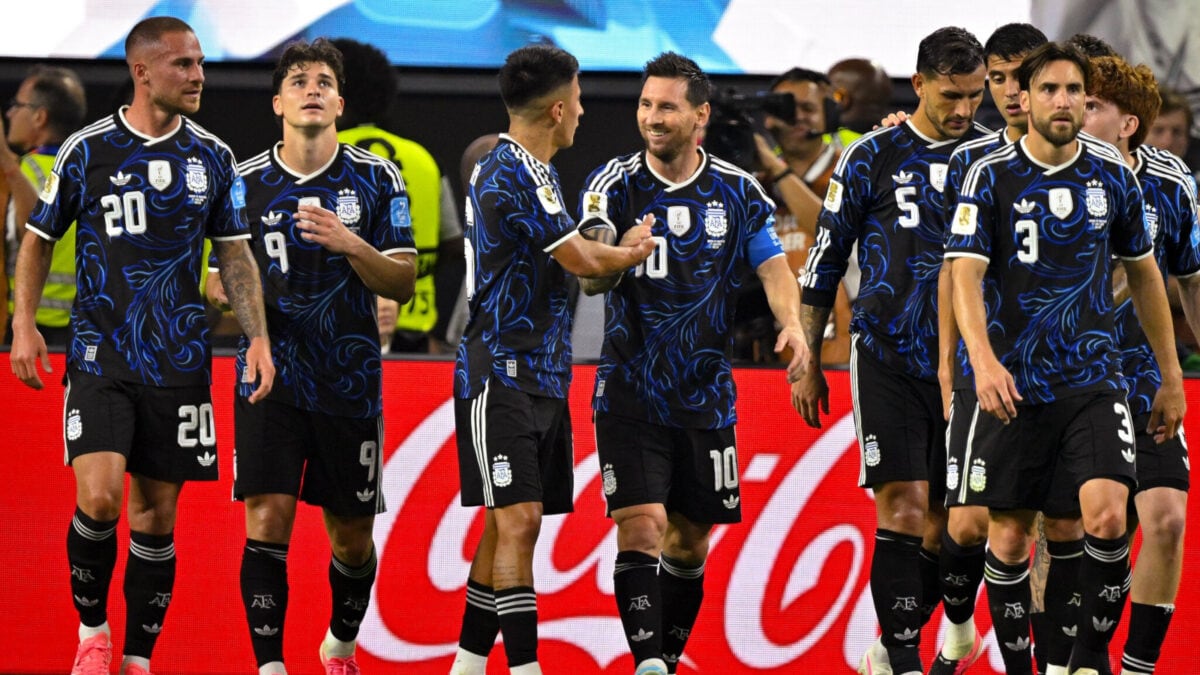
That brings the story back to Atlanta, where England will lead a similar hero-of-sorts to overcome Messi and his army of supporters. Wednesday’s semi-final is the first World Cup meeting between the two in 24 years, and the first time this fixture has gone to this stage.
The rivalry is ready for another chapter. All it needs is a protagonist.
Handpicked stories, in your inbox
A newsletter with the best of our journalism
News sports football Of Politics, Bad Blood And 'God': Argentina Vs England, A Rivalry Beyond Football
Disclaimer: Comments reflect users’ views, not News18’s. Please keep discussions respectful and constructive. Abusive, defamatory, or illegal comments will be removed. News18 may disable any comment at its discretion. By posting, you agree to our Terms of Use and Privacy Policy.
Read More



 English (US) ·