

 1 hour ago
5
1 hour ago
5
ARTICLE AD BOX
Arvind Kejriwal's built AAP on the promise of principles. But it now thrives on blind loyalty, and prodigals like Raghav Chadha drift away, exposing a party built on talent too ambitious to stay in one man's shadow forever.
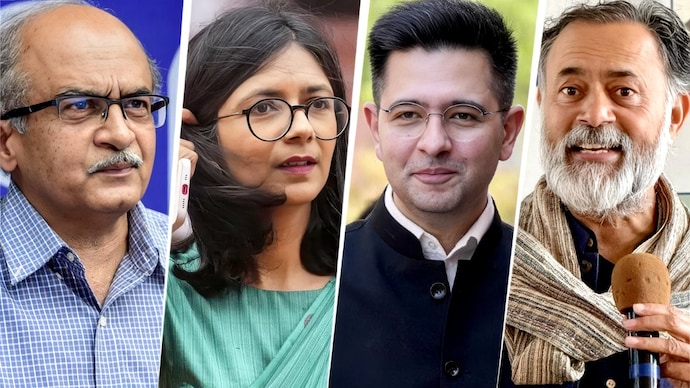
Former AAP leader Prashant Bhushan, AAP Rajya Sabha MP Swati Maliwal, AAP Rajya Sabha MP Raghav Chadha, former AAP leader Yogendra Yadav.
The political betrayals that sting the most are not the ones you see coming. When an ideological opponent turns hostile, or an ambitious rival makes their move, there is at least the cold comfort of precedent. You knew the terms, you understood the game.
But there is a particular, quieter kind of grief reserved for the loyalist who drifts. Not the one who stabs you in the back. The one who simply stops showing up. Who begins making different choices, almost imperceptibly, until one day you look up and realise that the person you trusted most, the one for whom you moved others aside, the one you toasted at his engagement, the one whose ascent felt like an extension of your own, is now on the other side.
That is the Raghav Chadha story. That is the Arvind Kejriwal story. That is the Yogendra Yadav, and the Prashant Bhushan story. That is the AAP story.
And it is, in many ways, the most human chapter in Arvind Kejriwal's long political autobiography.
THE PRODIGAL LOYALIST
Chadha's journey in AAP began almost at the party's inception. Encouraged by Arvind Kejriwal himself, he worked on drafting the Delhi Lokpal Bill in 2012. From there, his ascent was swift. He became the party's TV face, its youngest national spokesperson, its sharpest debater at a time when AAP needed credibility and visibility in equal measure. By 2015, after AAP's sweeping victory in Delhi, Chadha, just 26, was appointed national treasurer. It was a signal of trust from the leadership and cemented his place within the party's inner circle.
The depth of this relationship was visible to anyone paying attention. Chadha's engagement to actor Parineeti Chopra was held at Kapurthala House, the official Delhi residence of Punjab's Chief Minister, with Kejriwal himself raising the toast. The only other occasion that the home was opened for a private ceremony was Kejriwal's own daughter's wedding.
These are not the gestures of a party boss rewarding a useful functionary. This is a man telling the world: this person is mine. Which is precisely what makes what followed so striking.
THE SILENT BREAKUP
When Kejriwal was in jail, the party needed its sharpest voices. But Chadha distanced himself at that critical juncture. Citing an eye condition he travelled to London with Parineeti Chopra. Within the party, it quickly became a talking point. The optics were poor. It looked like when the moment mattered most Raghav Chadha chose himself.
The silences then multiplied. Even when Chadha returned, his alienation from AAP's agenda continued. He did not even make a statement welcoming a Delhi court discharging Kejriwal in the excise matter.
This was a signal. And both sides knew exactly what was being communicated.
Senior leader Saurabh Bharadwaj accused Chadha of “soft PR”: polished, viral, carefully curated interventions on low-risk issues.
Former CM Atishi put it more bluntly: "When Arvind Kejriwal was arrested, we were beaten and dragged on the streets. You may be scared of going to jail and hence escaped to London. But we are Kejriwal's soldiers and we will not cower down."
ALL THE KEJRIWAL MEN (AND WOMEN)
Soldiers. That word reveals the foundational demand of Kejriwal's politics. His politics demands a willingness to make his crisis your crisis. To make his enemies your enemies. To subordinate your individual political identity so completely to the leader's narrative that the question “what do you stand for?” has only one acceptable answer: him.
This is the real problem with Kejriwal, and, by extension, with AAP.
Kejriwal gave Chadha a platform, a career, a national profile, and a place at the table. Chadha used all of those things to become someone who no longer fits neatly under Kejriwal's umbrella. That is the bargain gone wrong. And it has happened, in identical slow motion, with everyone: Yogendra Yadav, Prashant Bhushan, Navjot Sidhu, Swati Maliwal – the list is long.
To be fair, it was never a one-sided story. Kejriwal did not simply destroy his people through paranoia and centralisation. His people also, at various moments, let him down through ego, through ambition, through a failure of nerve at precisely the wrong moment. The great tragedy of AAP is that it is a story full of complicated people who all wanted slightly different things, held together for a while by a shared purpose, and then broke apart.
To understand this, you have to go back to the bloodiest chapter. Not Chadha's quiet drift. The original sin.
FOUNDING FATHERS & MURDER OF DEMOCRACY
In March 2015, barely a month after AAP had won 67 of 70 seats in Delhi, the party held a national council meeting on its outskirts that descended into chaos. Yogendra Yadav and Prashant Bhushan were ousted from the party's national executive. Both Yadav and Bhushan called it the “murder of internal democracy” and alleged 'goondaism' was used to silence dissent.
Bhushan told reporters soon after the meeting: “All dreams of a movement have been shattered by a small coterie and a dictator.”
Yadav, one of the finest psephologists of his generation, asked reporters with visible anguish: “How would you feel if someone drags you and throws you out of your own house?”
Medha Patkar, the legendary activist who had lent the movement enormous moral credibility, resigned from AAP the same day. She said the party had reduced itself to a “tamasha” and that political principles were being trampled upon.
From the outside, this looked like Kejriwal devouring his own founders. And in one sense, it was exactly that. Striking first, Kejriwal had offered to step down as convener. The move was swiftly rejected by the room, effectively forcing the question: him or them.
The roots of the conflict lay partly in a power struggle between Manish Sisodia and Yadav over candidate selection in Delhi. These were not purely idealistic men defending abstract principles of internal democracy. Ideology and ego were, as they always are in these situations, thoroughly entangled.
Kejriwal, addressing the national council, said: "Saathiyon ne dhoka diya (our friends betrayed us)".
There, in one sentence, was the full Kejriwal playbook: any internal dissent is not legitimate criticism but enemy action. There is no loyal opposition inside AAP. There is only loyalty, or treason.
THE TOXIC PATTERN
If the Yadav-Bhushan episode was about ideology curdling into faction, the Kumar Vishwas story is about a man who never quite accepted that a movement he helped build was not going to reward him the way he believed he deserved.
Vishwas was the crowd-puller, the one who could fill the grounds with his Urdu verse, who made Anna Hazare's movement feel like a cultural event rather than a protest. He was AAP's most beloved entertainer and, for a while, one of its most prominent faces. He ran against Rahul Gandhi in Amethi in 2014, a quixotic gesture, but a nationally watched one.
When the Rajya Sabha seats came up, Kejriwal did not give him one.
This pattern is on autopilot in AAP. Ambition defied–resentment stoked–suspicion aroused–exit or irrelevance.
And this is what makes the AAP story so genuinely complex. Kejriwal is not simply a paranoid autocrat who destroyed loyal idealists. And his estranged allies are not simply brave truth-tellers silenced by a dictator. The reality is murkier, more human, and in some ways more damning on all sides.
Raghav Chadha is the latest chapter of this story. He will almost certainly not be the last. Because the structure has not changed. The demand for soldiers, not citizens, remains. And talented people, given enough time and enough distance from their original devotion, have a tendency to develop the one thing that cannot survive in AAP: ambition and impatience.
AAP's formula–talent summoned, loyalty demanded, ambition crushed-guarantees more battles, one after the other. Till the last man standing.
- Ends
Published By:
Sahil Sinha
Published On:
Apr 4, 2026 15:02 IST
Tune In







 English (US) ·