

 55 minutes ago
4
55 minutes ago
4
ARTICLE AD BOX
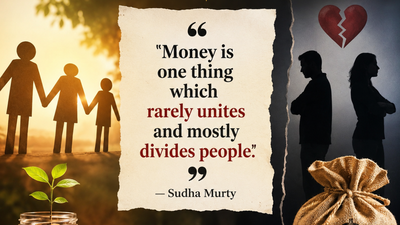
You've probably noticed this yourself without needing someone to spell it out. Money has this weird power to turn reasonable people into versions of themselves they don't recognize.
Families that seemed rock-solid suddenly fracture over an inheritance. Friendships that lasted decades disappear because someone owes someone else five thousand rupees. Couples who claimed they'd do anything for each other end up in brutal fights about whose paycheck is whose.Sudha Murty's observation cuts right to something we all know but don't always want to admit. Money doesn't bring people together the way we pretend it does.
If anything, it does the opposite.The strange part is that money itself isn't even real in any meaningful way. It's just a symbol we've all agreed means something. But because we've tied it so tightly to survival, dignity, and worth, it's become loaded with emotion in a way almost nothing else is. When someone asks about your salary, they're not really asking about numbers. They're asking about your value as a person, whether you're succeeding, whether you're deserving of respect.
No wonder it divides people.And it's not just about having or not having. It's about how people treat you when your financial status changes. When you're successful, people want to be your friend. They return your calls. They think your ideas are brilliant. But go through a rough patch, lose a business, get laid off—and suddenly those same people are mysteriously busy. Money is the invisible scoreboard everyone's using to figure out who matters.The really tragic part is that money could be a tool for connection. Imagine if we saw it that way. You help someone when they're in trouble, not because you're trying to prove anything, but because that's what people do for each other. You share what you have without keeping a mental tally. You celebrate someone's success without wondering if it threatens you. But that's not how it actually works for most of us.Instead, we're stuck in this constant comparison. Am I making enough? Is she making more? Can I afford what they have? Should I lend money to my brother-in-law? Every financial decision becomes tangled up with ego and fear and resentment. Money stops being about survival and becomes about status, and that's when it really starts destroying relationships.Murty's saying something uncomfortable but true: money doesn't unite us because it forces us to reveal what we actually value and who we actually are. And that's a lot scarier than just admitting we all want it.








 English (US) ·