

 5 days ago
14
5 days ago
14
ARTICLE AD BOX
At the practice nets flanking the Premadasa stadium square, something peculiar unfolded on Saturday afternoon. Suryakumar Yadav ran in to bowl, then stopped mid-stride—frozen for a heartbeat—before releasing the ball. Washington Sundar did the same.
Again and again, India’s batsmen faced this stuttering delivery, preparing their eyes for a challenge unlike any they’ve encountered: Usman Tariq’s unique pause-and-release action.
This is how you prepare for the unpredictable in an India-Pakistan world cup encounter. When Pakistan captain Salman Agha named Tariq as their trump card, India’s coaching staff didn’t just take note—they reconstructed the threat in their own nets.
“Sometimes there is a question in the exam that’s out of syllabus,” Suryakumar explained with characteristic calm. “We can’t leave that question unanswered. We have to try something, adopt our own way. Yes, he is a different character when he comes to bowl, but we cannot just surrender to him.”
The metaphor captures India’s approach perfectly. For 18 months, this batting lineup demolished opponents with ruthless efficiency. Now, on slow tracks at Premadasa, they’ve looked scratchy—human, even. The rhythm that once seemed automatic has required conscious effort to rediscover.
Premadasa doesn’t forgive. One boundary measures 84 yards, the other 74. The pitch is already worn, the same surface where Australia’s power-hitters stumbled chasing a modest 170 against Zimbabwe. Batsmen don’t waltz to centuries here; they grind, adapt, survive.
ALSO READ | Neutral Colombo ready for cricket, some rain, but clarity on handshakes awaited
Story continues below this ad
This creates fascinating tactical chess. Bat first and you must divine the par score—too aggressive on a slow pitch and you sink into quicksand, misjudging what’s achievable for what’s ideal. Chase and you face the opposite challenge: heavy lifting during the powerplay when the ball is new and field restrictions apply, potentially against Pakistan’s varied spin attack.
Spin dominates both teams’ thinking. As Ishan Kishan and Shivam Dube took guard in the practice nets, the challenge came immediately from Varun Chakaravarthy, Washington Sundar, Axar Patel, and Kuldeep Yadav—replicating the variety Pakistan possess. Like India’s X-factor bowling arsenal, Pakistan boast their own weapons of unpredictability.
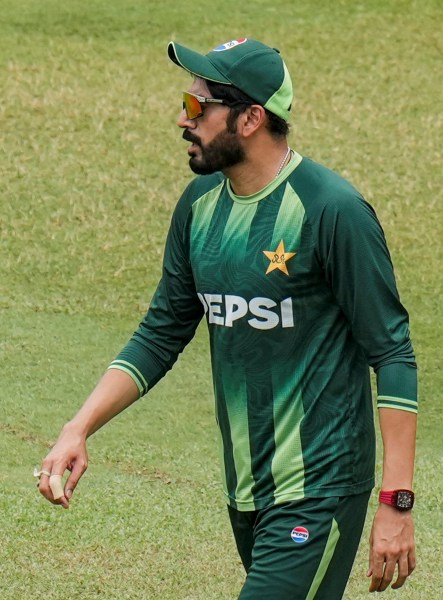 Pakistan’s Usman Tariq during a practice session on Saturday. (PTI Photo)
The team selection riddles compound the intrigue. Abhishek Sharma returns from illness to replace Sanju Samson at the top. But the bowling composition? That’s where head coach Gautam Gambhir faces genuine dilemmas. Playing both Kuldeep and Washington means dropping Rinku Singh. Choosing between Bumrah, Arshdeep, and Siraj—all quality options—becomes an exercise in sacrifice rather than preference.
“It’s very difficult to decide which fast bowlers to play, how many fast bowlers and spinners,” Suryakumar admitted. The honesty is refreshing. Even for a team with India’s depth, the conditions create no easy answers.
Story continues below this ad
The strategy crystallizes around one phase: the powerplay. India plan to attack with both bat and ball during those crucial opening overs. The openers have been instructed to trust their instincts, but with a critical caveat. Lose wickets in clusters—as they did at Wankhede and Kotla—and recovering momentum becomes nearly impossible on this surface.
For the bowlers, early success could effectively end the contest before it truly begins. Strike in the powerplay and Pakistan’s middle order must rebuild against spin on a pitch offering natural assistance. It’s a knockout punch India will hunt aggressively.
Yet unpredictability lurks everywhere. Match-ups dominate modern T20 preparation, but bowling changes could scramble the script. Rain threatens to alter conditions mid-contest. Pakistan’s spin options—including that distinctive pause-and-release—present variables that defy neat categorization.
Suryakumar referenced the Asia Cup, when similar conditions on a bigger ground demanded specific combinations. “This is also a bigger ground, but the wicket should be better,” he noted, suggesting India will deploy familiar tactics with slight adjustments.
Story continues below this ad
Context matters immensely here. India have dominated Pakistan in world cup encounters throughout history—only one Pakistani victory mars an otherwise overwhelming record. The weight of that history, combined with the stakes of knockout cricket, transforms tactical decisions into pressure-laden gambles.
When Abhishek Sharma walked to the nets Saturday, still recovering from his illness, he joined a battalion preparing for examination under the harshest spotlights. The questions won’t all be from the syllabus. Some will arrive with a pause mid-action, disrupting timing and testing preparation.
India’s response—meticulous, adaptive, yet confident—suggests they’ve studied for this exam thoroughly. Whether their answers prove correct, Premadasa will reveal on Sunday. In an India-Pakistan world cup match, nothing else ever could.







 English (US) ·