

 1 hour ago
6
1 hour ago
6
ARTICLE AD BOX
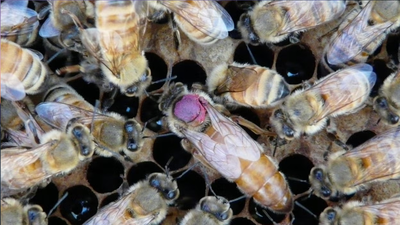
Image: https://www.ucdavis.edu/
Honeybee queens facing ongoing pesticide exposure quietly unload that contamination into the eggs they lay, according to a study published this week in the journal Current Biology, led by researchers at UC Davis using radioactive tracing to follow the chemicals at the atomic level.The behavior, which researchers are calling maternal offloading, had never been documented in honeybees before. Sascha Nicklisch, the study's senior author and an associate professor in UC Davis's Department of Environmental Toxicology, said that no one had shown this happening in bees until now.
The queen protects herself, and the eggs pay for it
Worker bees have long been assumed to shield the queen from contamination by filtering pesticides out of the food they bring her.
The new research shows that shields have limits. Early on, workers strip out about 95% of dietary pesticide through filtering and by depositing residue in the honeycomb itself. But that protection weakens over time, dropping to around 86% effectiveness by day ten of continuous exposure.Once that buffering starts breaking down, the queen's body takes on the leftover chemical burden. Her overall pesticide levels stay lower than a worker bee's, but the study found the contamination doesn't just sit in her tissue.
It builds up in her ovaries and gets packaged directly into the eggs as they develop, essentially routing the toxic load out of her body and into the next generation.Researchers also found a kind of dilution effect. Queens who laid more eggs spread their chemical burden across a bigger batch, which meant each individual egg carried less contamination. Queens laying fewer eggs concentrated more of the pesticide into each one.
Nicklisch pointed out that the queen is the only bee in the colony capable of producing the next generation of workers, which is exactly why her exposure levels, and what she passes down, matter so much for the hive's survival.
How scientists tracked pesticide down to the atom
The research pulled together expertise from the USDA, which brought decades of honeybee biology knowledge, and Lawrence Livermore National Laboratory, which supplied a technique called biological accelerator mass spectrometry, or BioAMS.
That method let the team trace radioactively tagged pesticide molecules at extremely low concentrations, low enough to reflect real-world exposure levels rather than a lab-only worst-case dose.
Bruce Buchholz, an LLNL scientist and co-author on the paper, noted that the doses used weren't lethal and were meant to mirror what bees actually encounter outside a lab.The study looked beyond the standard focus on individual worker bees and instead mapped where chemicals ended up across the whole colony, tracking the queen's body, her ovaries, developing eggs and even the wax.
Why a slow buildup could matter more than a single dose
Honeybee colonies pollinate roughly a third of the food crops grown worldwide, and a single queen can lay between 1,500 and 2,000 eggs a day to keep a hive running. Losing colonies has real consequences for food production, which is part of why researchers are paying closer attention to slow, chronic effects rather than just immediate die-offs.Nicklisch raised a concern about what happens if this offloading process keeps compounding. If pesticide keeps accumulating generation after generation, eggs could eventually carry a contamination load heavy enough to disrupt normal development, creating a gradual, easy-to-miss pressure that researchers think could contribute to colonies collapsing over time rather than all at once. How long this offloading continues, and whether it varies across different pesticides, is still an open question the team plans to study next.









 English (US) ·