

 1 hour ago
4
1 hour ago
4
ARTICLE AD BOX
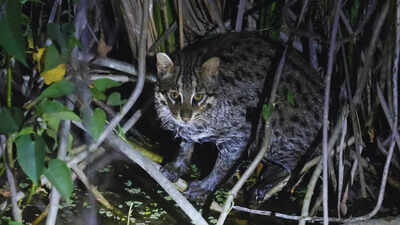
Fishing Cat spotted in Jhimil Jheel Conservation Reserve, a part of Rajaji National Park in Uttarakhand. Photo courtesy - Arun Kamath
An ordinary journey back following an evening safari has now gained much more importance, becoming one of the rarest records of wild animals which is bringing focus towards the wetlands of the Jhilmil Jheel Conservation Reserve that lies within Rajaji National Park.
Being a home to elephants, tigers, and swamp deer, a sighting of any other species has definitely grabbed the attention of wildlife lovers.According to Arun Kamath, a birder, he made a rare discovery of a predatory animal while accompanying his son Ashray in his visit to the national park. Speaking exclusively to Times Travel, Arun shared, “On the evening of April 3, 2026, around 7:45 to 8:00 PM, while returning from our safari to our place of stay, we were on a small road near our stay for the night.
On one side of that road, we could see a cat-like animal seated near the road and on the other side, there was a swamp area.”At first, nothing appeared strange about the creature. “We initially thought that it was a jungle cat, so we stopped and observed it,” he said. Mistaken identity is common under poor light conditions, particularly in areas where several small wild cats are found. But soon, something would make Kamath rethink the initial assessment.
“Suddenly, the cat jumped into the water, crossed a small channel, and swam to sit on a bed of reeds,” Kamath recounted. This was the first sign that something was amiss. Although jungle cats can come near water sources, they are not accustomed to boldly leaping into the water and crossing channels.
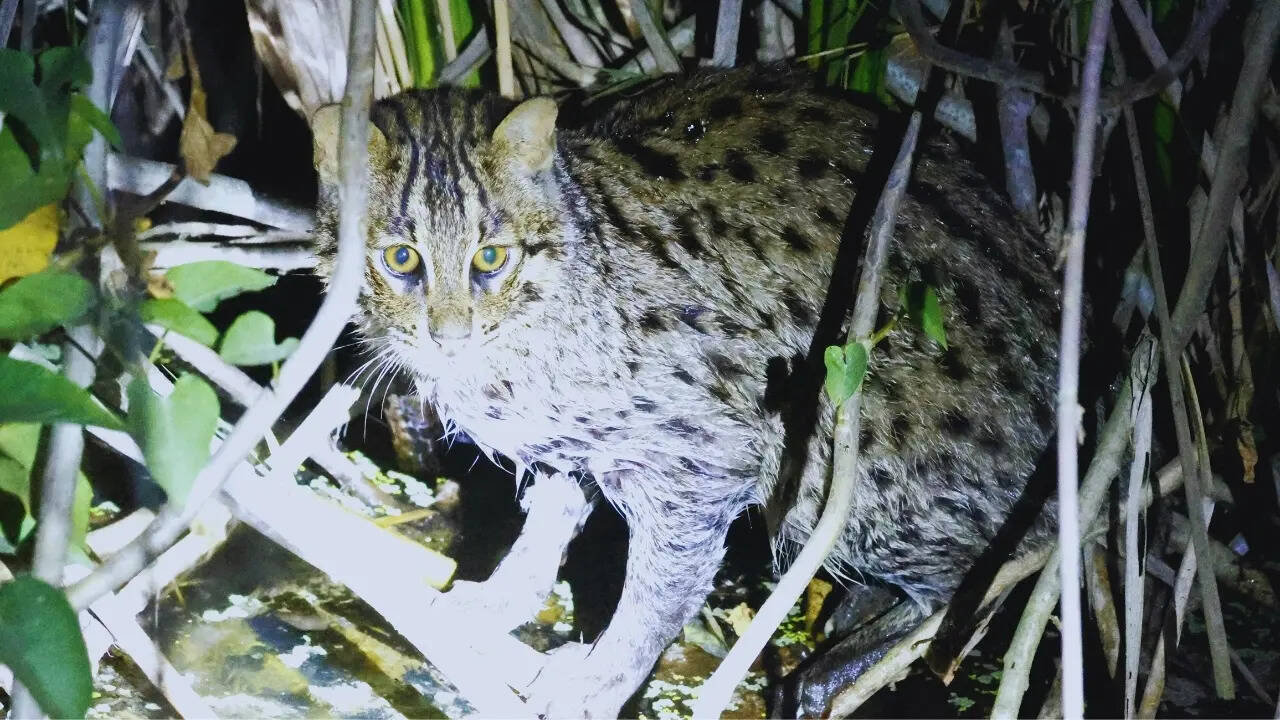
Fishing Cat spotted in Jhimil Jheel Conservation Reserve, a part of Rajaji National Park in Uttarakhand. Photo courtesy - Arun Kamath
Noticing the significance of the situation, Kamath and his son shone a torchlight on the animal. “This is when we saw the spots and stripes, something that's absent in the monochromatic coats of jungle cats," he added.These images were later shared with a wildlife expert for identification. The results only strengthened their suspicions; the cat was identified as a Fishing Cat, a rare and semi-aquatic species of wild cats, whose habitat includes wetlands and whose specialty is the skill to fish in water.Why is this sighting so important? Well, besides the fact that this cat is rare, one must take into account the location where it had been photographed.
In India, the fishing cat has been studied more extensively in its eastern habitat, where the species is more frequently found. These include the wetland areas of the West Bengal state, especially the Sundarbans area. There have also been occasional sightings in the southern state of Odisha and Andhra Pradesh and even rare reports in central India, including Ranthambore National Park.The Jhilmil reserve is not part of the range of this species according to any scientific study.
“There are no records of fishing cats from this region,” Kamath added.However, there have been a few hints about the presence of this species in the wider region. “There was a camera trap record from somewhere within Corbett in 2022–23, and one rescue record from Nainital,” he informed. Nonetheless, such evidence is limited and does not always point to an established population of the species. The distinctiveness of this particular sighting lies in the manner of spotting.
“But people actually seeing it and photographing it in the wild, this is probably the first time in this area,” he added.The Jhilmil Conservation Reserve itself presents a distinct ecosystem. With its swamps and grasslands, and a wetlands system, it creates a habitat environment that should be conducive for the existence of this species. The barasingha, or swamp deer, population in this Reserve, among others, suggests the existence of wetland-based wildlife in the area.
Nevertheless, despite all these favorable factors, this particular species had not been recorded in the Jhilmil Reserve before.The observation poses some interesting ecological inquiries. There is always a possibility that fishing cats may have inhabited the area all along, but they may not have been spotted due to their elusive and nocturnal behavior. This can also be a situation where range extension can be seen as a result of the changing ecology and the need to disperse into other areas.
This is a possibility that the observed animal was a transient looking for a new territory.Whichever way it might be, the importance of the situation is huge. At present, IUCN classifies fishing cats as Vulnerable, with high risk of extinction in the wild. The species faces threats from wetland degradation, habitat fragmentation, and increasing human-wildlife conflict. Wetlands across India are under pressure, making every new record of a wetland-dependent predator particularly important for conservation planning.








 English (US) ·