

 3 hours ago
3
3 hours ago
3
ARTICLE AD BOX
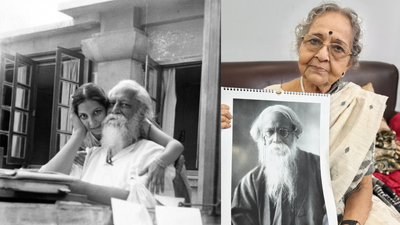
KOLKATA: As the world prepares to mark the 165th birth anniversary of Rabindranath Tagore in 2026, a meticulously curated collector’s calendar promises to offer Tagore admirers a rare visual and intellectual journey into the poet’s life and times.
Titled Rabindranath & His Contemporaries – Calendar 2026, the limited-edition wall calendar brings together some of the most elusive and lesser-seen photographs of the Nobel laureate, accompanied by rich historical trivia and anecdotes.Although Rabindranath Tagore was among the most photographed Indians of the late 19th and early 20th centuries, many iconic moments from his life have remained scattered across archives and largely inaccessible to scholars and enthusiasts.
Curated by collector and researcher Agniva Chakraborty, the calendar assembles a handpicked selection of rare images capturing Tagore in his many moods—philosopher, poet, educator and global cultural interlocutor.Tagore’s extraordinary international engagements form the backbone of the calendar. During his extensive travels, the poet interacted with several towering figures of his era—both Indian and international.
The calendar features rare photographs and narratives involving personalities such as George Bernard Shaw, Romain Rolland, C.F. Andrews, Sir William Rothenstein, Okakura Kakuzō, William Pearson, Lady Ranu Mukherjee, Maitreyi Devi, Maharaja Radhakishore Manikya and Dr Kalidas Nag, among others.One of the highlights is a seldom-seen photograph of Tagore with playwright George Bernard Shaw, taken during Tagore’s stay in London in early 1931.
Tagore had arrived in London on December 23, 1930, and met Shaw on January 8 while staying at the Hyde Park Hotel, where the two engaged in wide-ranging discussions on literature, society and humanism.Equally compelling are the anecdotes woven into each month. The calendar recounts how Japanese art and jujutsu were introduced at Visva-Bharati through Tagore’s association with Okakura Kakuzō—who, intriguingly, never visited Santiniketan despite coming to India in 1902.
It also revisits Tagore’s close bonds with figures like Victoria Ocampo, who gifted him an object he used until his final days, and Maitreyi Devi, whom Tagore affectionately renamed.
Another lesser-known detail reveals that Tagore conceived the theme of his celebrated play Malini during a stay at his friend Loken Palit’s residence.The textual material has been carefully compiled by Tagore scholars Dr Minakshi Sinha and Soumyabrata Dasgupta, lending academic depth to the visual archive.
Adding a contemporary digital layer, each page of the calendar features a QR code linking to a Rabindra Sangeet rendition by legends Suchitra Mitra or Debabrata Biswas.Each copy also comes with a complimentary poster featuring a rare photograph of Tagore descending the stairs of Udayana, Santiniketan, making the calendar both a scholarly keepsake and a collector’s item.With its blend of rare visuals, archival research and musical memory, Rabindranath & His Contemporaries – Calendar 2026 seeks to reintroduce Tagore not just as a literary icon, but as a global figure deeply embedded in the cultural currents of his time.









 English (US) ·