

 1 hour ago
6
1 hour ago
6
ARTICLE AD BOX
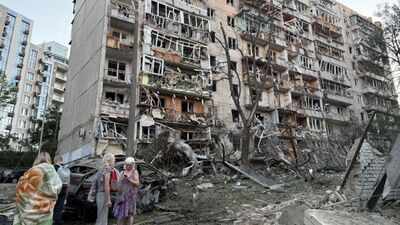
Russia launched one of its largest combined aerial assaults on Ukraine's capital Kyiv early Thursday, killing at least 10 people and injuring more than 50 after waves of drones and missiles struck residential neighbourhoods and key infrastructure across the city.The overnight barrage, which Ukrainian officials described as one of the heaviest attacks since mid-June, combined long-range cruise missiles, ballistic missiles and attack drones launched from multiple platforms. The strike damaged dozens of locations across Kyiv, partially collapsed a nine-storey residential building and forced thousands of residents into underground shelters as air raid sirens echoed across much of the country.The Russian Defence Ministry later confirmed it had carried out a "massive attack" using "long-range, high-precision air-, land-, sea-launched weapons and drones." Moscow said the strikes targeted Ukraine's military facilities, energy infrastructure and airports in retaliation for recent Ukrainian attacks on Russian civilian infrastructure.Ukraine, however, said residential neighbourhoods bore the brunt of the attack.
Kyiv Mayor Vitali Klitschko said at least 10 people were killed, while 56 others, including two children, were injured."The enemy has once again deliberately targeted residential neighbourhoods and killed civilians. We have sustained extensive damage and a significant number of casualties, including children," Tymur Tkachenko, head of Kyiv's military administration, wrote on Telegram.Reuters footage showed rescue workers searching through the rubble of a partially collapsed nine-storey apartment building as fires continued burning across parts of the capital.What weapons did Russia use?Although Moscow did not disclose the exact missile types used during the operation, the Russian Defence Ministry confirmed the attack combined weapons launched from the air, land and sea alongside large numbers of drones.The strike reflected Russia's increasingly common strategy of saturating Ukrainian air defences by launching multiple categories of weapons simultaneously.Air-launched missilesAir-launched missiles are typically fired by Russia's strategic bombers, including the Tu-95MS Bear and Tu-160 Blackjack, as well as tactical aircraft such as the Su-34.These aircraft generally carry long-range cruise missiles capable of flying hundreds or even thousands of kilometres before striking their targets. Flying at relatively low altitudes, cruise missiles are designed to evade radar and force air defence systems to track multiple incoming threats simultaneously.Launching missiles from aircraft also allows Russia to attack targets deep inside Ukraine while keeping its bombers well away from frontline air defence systems.Land-launched missilesRussia also employs ground-based missile systems capable of firing both ballistic and cruise missiles.Unlike cruise missiles, ballistic missiles travel at extremely high speeds along steep trajectories, making them significantly harder to intercept. Their short flight times leave defending forces with only a limited window to detect, track and engage them.During Thursday's attack, Kyiv authorities confirmed that ballistic missiles were among the weapons launched toward the capital.The combination of ballistic and cruise missiles forces Ukrainian air defence operators to deal with threats arriving at different speeds, altitudes and directions at the same time.Sea-launched missilesSea-launched cruise missiles provide Russia with another layer of flexibility.These weapons are generally fired from warships and submarines operating in the Black Sea. Because they approach from different directions than land-based missiles, they complicate Ukrainian air defence planning and increase the number of potential attack routes.Sea-based launches also allow Russia to maintain long-range strike capability even when aircraft or ground launchers are operating elsewhere.Attack dronesAlongside missiles, Russia deployed large numbers of attack drones, which have become a central element of its long-range strike campaign.Drones are frequently used to overwhelm air defence systems before missiles arrive. Their relatively low cost allows Russia to launch them in large numbers, forcing Ukraine to expend expensive interceptor missiles.Even when intercepted, drones compel Ukrainian radar operators and air defence units to remain engaged for extended periods, reducing their ability to focus exclusively on incoming missiles.Air raid alerts remained in effect across much of Ukraine overnight as successive waves of drones and missiles approached Kyiv.Residents crowded into underground metro stations carrying children, pets, sleeping bags and emergency supplies after authorities warned that a large-scale attack was imminent.Hours before the assault, Ukrainian President Volodymyr Zelenskyy had warned that intelligence indicated Russia was preparing another major strike on the capital.Speaking in Ireland before cutting short his visit, Zelenskyy said, "Putin wants to keep fighting. That is why he must face conditions that make it impossible for him to keep this war going."Kyiv Mayor Vitali Klitschko urged residents to remain in shelters as ballistic missiles entered Ukrainian airspace.
Fires broke out across multiple districts, including on the roof of a hotel, while emergency crews continued searching for people trapped beneath collapsed buildings.The latest assault came amid an escalating exchange of long-range attacks between the two sides. In recent weeks, Ukraine has expanded drone strikes deep inside Russian territory, targeting oil refineries, military facilities and logistics infrastructure, contributing to fuel shortages in several Russian regions.Russia said Thursday's barrage was carried out in response to those attacks, describing it as retaliation for strikes on Russian civilian infrastructure.The intensifying cycle of long-range missile and drone attacks highlights how both countries are increasingly relying on precision weapons capable of striking hundreds of kilometres behind the front lines, making cities, military facilities and critical infrastructure central targets in the fourth year of the war.









 English (US) ·