

 1 hour ago
6
1 hour ago
6
ARTICLE AD BOX
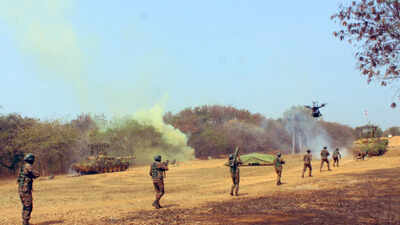
Indian army soldiers train alongside drones. (Image credit: Indian army)
Modern militaries are investing in both drone and counter-drone technologies to stay relevant on the modern battlefield. The conflict in Ukraine has demonstrated that, in the era of cheap drones deployed extensively, it is those at the frontline who face the greatest threat from these unmanned systems.
Footage from First Person View (FPV) drones uploaded by both the Russian and Ukrainian militaries shows the ruthless efficiency with which these drones hit their targets, many times resulting in a solitary soldier meeting his end at the hands of an operator sitting on a cushy chair kilometres behind the frontline.Specialised anti-drone bullets are emerging as the last line of defence for frontline troops facing the growing threat of hostile unmanned aerial systems.
While electronic jammers, directed-energy weapons and missile interceptors form the layered counter-drone architecture, there remains a critical need for close-range solutions when drones slip through these defences.These bullets are engineered with unique designs to maximise their effectiveness against small, fast-moving aerial targets. Unlike conventional rounds, they often feature enhanced fragmentation or specialised payloads that increase the probability of damaging a drone's rotors, sensors or onboard electronics.
Fired from standard infantry rifles or machine guns, they provide soldiers with a practical tool to engage drones at short distances without relying on complex systems.Many of these bullets fragment soon after leaving the barrel of the rifle, thereby increasing the spread of the shot. A small bullet less than 6 mm across can transform into smaller pieces, thereby increasing the chances of hitting the drone. Other options in the market operate on the same principle but have the fragments attached by a metallic cord that further reduces the gap between the fragments and also ensures that the spread of the shot is controlled.
Such bullets also provide an advantage to soldiers, in the sense that they do not have to carry an additional weapon to counter the scourge of drones.For troops, such ammunition offers a vital safeguard. Drones used for reconnaissance, targeting or even kamikaze strikes can appear suddenly and at low altitude, leaving little time for larger air defence systems to react. In such scenarios, anti-drone bullets act as the final protective measure, empowering soldiers to defend themselves and their positions directly.India's Armament Research and Development Establishment (ARDE), a part of the Defence Research and Development Organisation (DRDO), is reported to be creating a 7.62 mm anti-drone bullet that will both fragment and have an explosive filler. Private firm SSS Defence has also produced an anti-drone shotgun.The development of these rounds reflects the broader shift in modern warfare, where drones have become ubiquitous on the battlefield. Nations are investing in multi-layered counter-drone strategies, but the frontline soldier remains the ultimate custodian of security. By equipping them with specialised ammunition, militaries ensure that even the smallest unit has a fighting chance against aerial threats.








 English (US) ·