

 1 hour ago
3
1 hour ago
3
ARTICLE AD BOX
The Madhya Pradesh High Court ruled that the disputed Bhojshala Complex originally functioned as a Saraswati temple established during the reign of Raja Bhoja. Here's are the literary and archaeological evidence that the court relied on to give its landmark verdict.
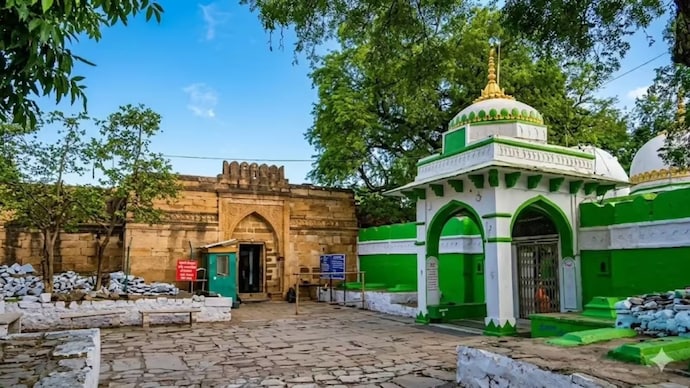
For decades, the site in MP's Dhar was listed in the ASI's records as Bhojshala and Kamal Maula's mosque. (Image: X)
The Madhya Pradesh High Court on Friday ruled that the long-disputed site of Bhojshala complex and Kamal Maula Mosque in Dhar was originally a temple dedicated to Goddess Vagdevi (Saraswati). The court said the site was established as a centre of Sanskrit learning during the reign of Raja Bhoj of the Parmara dynasty (around 1010 CE to 1055 CE).
For decades, the site was officially listed in the ASI's records as "Bhojshala and Kamal Maula's mosque". After Independence, the site became a matter of contention among the local Hindu and Muslim communities in Dhar. Now that the court has ruled it to be a temple, let's have a look at the evidence that led it to conclude the complex was originally a place of worship for the Hindus.
The dispute revolved around the site's origins, use, and identity, which has a deeply layered history. As per ASI listings, the structure is a hypostyle hall with pillars and architectural features that have drawn scholarly attention for its composite character.
Artefacts recovered by the ASI from the complex include sculptures and iconography linked to Hinduism. The survey and excavation at the complex revealed a layered history. Unearthed artefacts included idols of Hindu deities like Ganesha, Brahma, Narasimha, Hanuman, Saraswati and Krishna, Jain Tirthankara-linked iconography. Islamic-era Arabic and Persian inscriptions, which included Quranic verses carved on reused stones, have also been recovered.
The ASI has protected the complex since the early 20th century. It was notified as a "Monument of National Importance" in 1951, following earlier recognition around 1904-1909.
THE 2024 SCIENTIFIC SURVEY OF BHOJSHALA COMPLEX
In its 2024 scientific survey, conducted over 98 days under the direction of the Madhya Pradesh High Court, the ASI documented extensive evidence through excavation, architectural analysis, inscriptions, art, and sculptural studies.
The more than 2,000-page report, submitted in July 2024 in multiple volumes, concluded that the existing structure incorporates parts of an earlier monumental complex from the Paramara dynasty era, which is roughly from the 11th century.
Scientific investigations revealed that the current building (referring to the Kamal Maula Mosque) was constructed "centuries later" using dismantled remains of earlier structures, with limited attention to symmetry, design uniformity, or original alignment. This is an example of rubble masonry, a feature seen in several monuments from the early period of Islamic rule in northern India, including structures within the Qutb Minar Complex in New Delhi.
Similar patterns and reused stones have also been reported at Varanasi's Gyanvapi Mosque and the Ram Janmabhoomi site in Ayodhya.
The survey recovered over 1,700 relics, including sculptural fragments, pillars, pilasters, and elements suggestive of pre-existing temple architecture, some bearing motifs or forms associated with Hindu iconography. Defaced figures of Hindu deities have also been found at the site in Dhar. Inscriptions and architectural fragments were analysed to support the presence of an earlier Paramara-period structure at the site, which predates the later structure of a mosque.
The ASI's findings were based on empirical methods, such as ground-penetrating surveys, documentation of reused materials, and study of retrieved artefacts. The report noted that the standing edifice appears to post-date the Paramara phase, built from recycled basalt and other elements.
These observations formed the core of the official archaeological record presented to the High Court.
LITERARY EVIDENCE REFERRED TO BY HIGH COURT
The Madhya Pradesh High Court extensively referred to historical literature while declaring Bhojshala a temple.
The 14th-century Jain scripture, Prabandha Chintamani, records that Raja Bhoj of the Parmara dynasty built the Bhojshala temple in 1034 AD for the worship of Goddess Saraswati. It served as a renowned centre of Sanskrit learning and Hindu philosophy, patronising over 1,400 scholars including Kalidas, Bhavabhuti, and Maagh.
In 1903, KK Lele, who was then the Superintendent of State Education and head of the archaeology department in Dhar State, discovered important Sanskrit and Prakrit inscriptions within the structure, including grammatical texts and portions of a drama praising Saraswati. These findings led him to name the building "Bhojshala". The Imperial Gazetteer of India (1908) noted that the existing mosque was constructed from the remains of an older Hindu temple, most likely dedicated to Saraswati, with its carved slabs reused in the floor and mihrab.
Similar observations were made in the Royal Asiatic Society's 1904 journal and G Yazdani's 1929 book Mandu, which described the building as a mosque built by Muslim rulers using materials from an 11th-12th century Hindu temple dedicated to Saraswati.
CLAIMS BY THE KAMAL MAULA MOSQUE SIDE
Parallel to the ASI's documentation ran the historical claim maintained by the Muslim side associated with the Kamal Maula mosque.
Petitioners representing the mosque side, including descendants of Maulana Kamaluddin Chishti (Kamal Maula), have consistently asserted before the courts that the complex has functioned as a mosque for centuries.
They pointed to revenue records that historically register the site as a mosque. In arguments before the Madhya Pradesh High Court, counsel for the Muslim side, including references to family titles held by ancestors linked to the Sufi saint, emphasised continuous custodial and devotional use.
A key document in these claims is an "Ailaan" [official notification] issued by the Dhar State court (Darbar) on August 24, 1935. According to submissions in the High Court, the order explicitly declared the complex a mosque and directed that namaz continue to be offered there.
The 1935 declaration, presented as a legal gazette-like notification from the princely state era, was cited to underscore administrative recognition of the site's mosque status prior to independence.
The mosque's association with Sufi saint Kamal Maula forms a key part of its Islamic history. Historical records from the British era and earlier princely administrations largely treated the site as a mosque, where local Muslim communities regularly offered prayers.
The Kamal Maula side maintained that available historical sources do not explicitly corroborate the establishment of a Saraswati temple by Raja Bhoja in a manner that overrides the mosque's documented use.
THE DISPUTE GAINED MOMENTUM POST-INDEPENDENCE
The modern dispute gained legal momentum in the post-independence era.
In 2003, the ASI issued an administrative order to manage access amid rising tensions. It permitted Hindu devotees to perform puja every Tuesday from sunrise to sunset and allowed Muslim worshippers to offer namaz every Friday between 1 pm and 3 pm.
This arrangement, intended as an interim measure for a protected monument, was the operational framework for two decades, though challenged periodically in various courts.
Tensions escalated over the years, particularly when festivals like Basant Panchami coincided with Fridays, leading to administrative restrictions and occasional curfews. Petitions in the Madhya Pradesh High Court and the Supreme Court repeatedly referenced both the ASI's protective mandate and the competing claims.
The 2024 report, which was filed in a sealed cover and later opened for parties, became central to arguments.
The mosque side critiqued aspects of the ASI survey in court, questioning the interpretation of certain findings and arguing that the report does not definitively establish a pre-existing temple in the exact location or form claimed. They reiterated reliance on revenue records and the 1935 Dhar State order as evidence of the site's established mosque character.
However, the High Court, based on the ASI findings and literary evidence, has now ruled that the long-disputed site of Bhojshala complex and Kamal Maula Mosque in Dhar is a temple of goddess Vagdevi. It said, therefore, the Hindu community was allowed to worship at the site. It dismissed the Muslim community’s claim on the site and legally recognised the Bhojshala complex's original character as a temple.
- Ends
(With inputs from Bishwajeet)
Published By:
Anand Singh
Published On:
May 15, 2026 19:58 IST




 English (US) ·