

 1 hour ago
4
1 hour ago
4
ARTICLE AD BOX

Rekonstruktion Carcharocles megalodon W. Kraus. Image Credit: Wikimedia Commons
For years, one of the most significant fossil findings associated with the prehistoric mega-shark Otodus megalodon was thought to have disappeared. In an exciting development, fossils that were long missing have been found in Denmark, providing crucial information about the gigantic size of the shark, but also allowing scientists to estimate the age of the fish and even its diet.According to a new study published in Palaeontologia Electronica, scientists reviewed the discovery of previously lost fossils of megalodon vertebrae that were described in the early 1980s. Using these fossils, scientists supported earlier studies suggesting that megalodon could reach up to 24.3 meters, or about 80 feet.Fossils that went missing for decadesThe comma placement makes the location read awkwardly. They are about 10.8 million years old and belong to the species Otodus megalodon, which existed on Earth around 15 to 3.6 million years ago.
After the museum collection was relocated, the fossils were misplaced. Until recently, the fossils could be studied only based on pictures and measurement data.The fossils resurfaced when curators at Museum Sønderjylland found old boxes while reviewing archived collections. It appeared that those boxes contained long-lost vertebrae fossils.As stated in the research, the new discovery brings back one of the largest pieces of evidence for estimating the maximum size of megalodon.
Giant vertebrae of the largest sharks everAccording to the study conducted by researchers, the biggest vertebra had an approximate diameter of 23 centimeters. The size found corresponds with sizes described several decades ago and confirms previous estimates about the immense body size of the shark. Lead author Prof. Kenshu Shimada of DePaul University explained that the fossils are not only the biggest shark vertebrae ever found but also the biggest fish vertebrae ever discovered.Like most extinct animals, megalodon is known only from incomplete remains because sharks have cartilaginous bodies rather than bony skeletons, which makes them less likely to fossilize. Therefore, the estimates of their body sizes are obtained from teeth and vertebrae fossils.The most recent estimate of the megalodon's body size was made after comparing the Danish fossils to another vertebral column discovered in Belgium belonging to an estimated 16.4 metre-long specimen.
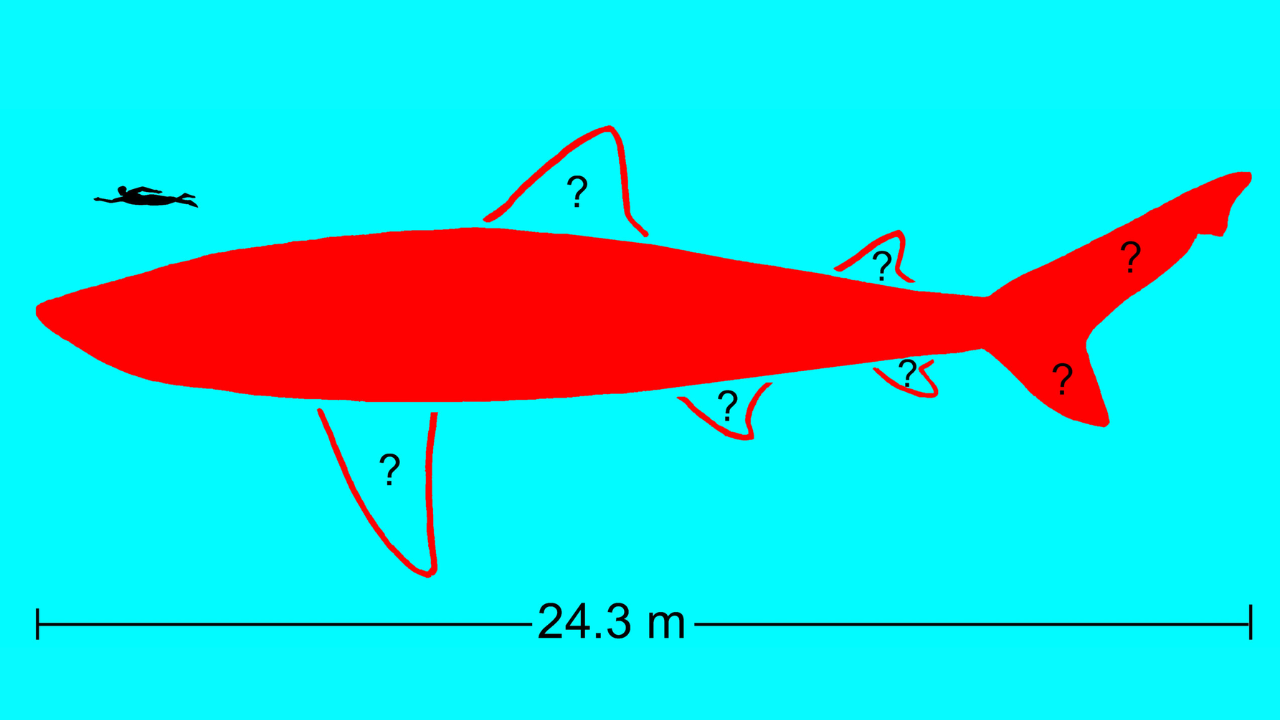
Tentative body outline of 24.3-meter-long (80-foot-long) extinct megatooth shark, Otodus megalodon. Image Credit: Phys.org
Growth bands from antiquity reveal an unexpectedly long life spanMicro-CT scanning with high resolution was also employed by the team to analyse growth bands contained in the vertebral column of the fossil remains. As the rings present in trees, such bands are supposed to be annual growths in sharks. According to the scans, the individual was at least 64 years old when they died. Based on growth models, the scientists suggested that megalodon could have lived up to 96 years under perfect circumstances.The scanning procedure was highly complicated due to the fact that the fossils were encased in thick clay. The scientists gathered more than 100 gigabytes of scans in order to see the inner structure of the fossils without causing any damage.Although the age estimate remains tentative, it offers one of the clearest insights yet into the predator's possible lifespan.A possible peek into the megalodon’s stomachThe most surprising conclusion drawn by the study is the one related to the sediments surrounding the vertebrae.It was found that there were very small scales and fragments of the gill structure of the basking shark present in the sediments. Comparing the fossils to the anatomy of the basking shark, scientists concluded that the vertebrae themselves cannot belong to this species. Instead, they believe the material came from the megalodon's stomach at the time of death. This will be the first example of fossil evidence that will show us the last meal of the megalodon.While modern basking sharks are filter feeders, their ancestors must have been quite a prey for such a huge predator.Significance of the findUnlike any other information about megalodon, the recovered fossils represent much more than just another estimate of the giant fish’s size. Scientists argue that knowing the size, growth rates and predatory habits of ancient species helps explain their ecosystems and the influence of top predators on them.The significance of the Danish location from which the fossils were retrieved does not end here, as this place can be considered the most northern megalodon habitat ever discovered. The results of some previous studies have demonstrated that the exceptionally big species of megalodons inhabited colder regions rather than warmer waters.It can be argued that future findings may help adjust the estimates provided by the research team. However, the conclusions made by the researchers state that the largest scientifically verified size of O. megalodon equals 24.3 metres long.This example shows that important discoveries can come from museum collections as well as field excavations.









 English (US) ·